Working definition
The silk-fiber glass ceiling is the barrier woven from micro-frictions — each fiber feels fragile alone; together they hold like silk until you name them and cut them one by one.
How it works
You often experience “the glass ceiling” as one opaque plate: I can’t go further. In the room, the install is sharper. Science uses spider silk as a metaphor for strength from thin strands — a single fiber looks easy to break; the weave does not. Your ceiling works the same way: fear of the closer’s margin, fear of post-sale obligation, polishing the offer again, “I think” instead of evidence — each is a fiber. Alone, any one looks manageable. Together they keep you under the plate.
The move is not to smash the whole ceiling in one heroic week. List the fibers in factual language (Evidence as fuel), then deconstruct them one by one. Pair with Master of Opposites: the fiber you flee often hides a trait you condemn (obligation, delivery, not being “enough”). Until you can inhabit the opposite without organising life around it, you keep feeding saboteur loops and flight dressed as preparation (All Success Lies in Its Preparation).
Wire the cut to a daily lever: once fibers are named, protect the 1% that actually moves the climb (Pareto principle).
Signature
The image is spider silk under a glass plate: one strand you can snap with a finger; the web that still stops you. Name the fiber. Cut one. Then the next.
Room: 2026-08-03.
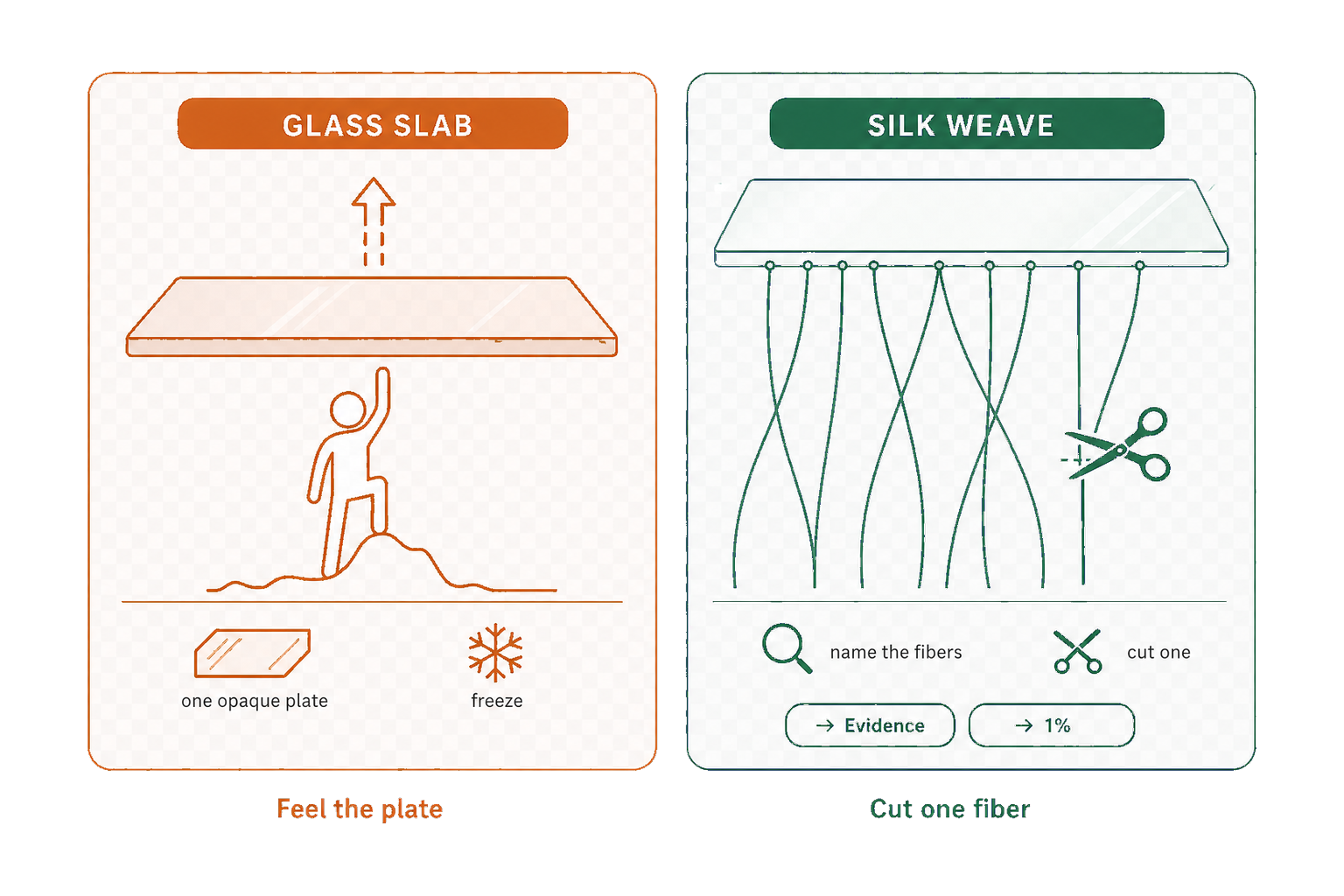
Spatial split — glass slab (one opaque plate · freeze) versus silk weave (name the fibers · cut one). Your move: Your move this week.
Your move this week
- List ≥5 micro-frictions blocking your weekly 1% — one factual line each (no “I think”).
- Circle one fiber you will cut in 24–72h (one observable behaviour change).
- Optional: write the opposite trait that fiber protects (Master of Opposites).
Scientific grounding
Cite
- Ko, F. K., & Jovicic, J. (2004). Modeling of mechanical properties and structural design of spider web. Biomacromolecules, 5(3), 780–785.
- Cacciotti, G., Hayton, J. C., & Mitchell, J. R. (2016). A reconceptualization of fear of failure in entrepreneurship. Journal of Business Venturing, 31(3), 302–325.
- Kool, W., McGuire, J. T., Rosen, Z. B., & Botvinick, M. M. (2010). Decision making and the avoidance of cognitive demand. Journal of Experimental Psychology: General, 139(4), 665–682.
Spider silk is a strength–toughness system (fiber + weave architecture); entrepreneurship fear of failure is a situated, multi-stage cue set, not one glass plate. Preferring polish over contact tracks cognitive-demand avoidance — fibers feel like comfort work.