Working definition
Perceived limit is the ceiling you feel as “max” — often only a fraction of capacity — so stretching past the first stop trains congruence and lowers fear of the next hard moment.
How it works
Under friction you negotiate: stop, walk, go home (Micro-negotiations). The story says this is my max. Training says: the first stop is regularly ~40% of what the system can still give — not a moral judgment, a stretch map. Arm-to-wall demo: mark “max,” release, then go further with intention — body centimetres become wall metres. Same circuit on the treadmill I’m done button and on the 5 km that must finish even if the clock overruns.
Stretching past perceived limit is how you learn you can count on yourself in hard moments — then hard moments scare you less (congruence · Choosing the right discomfort · Transfer of Certainty). It is not daily six-hour martyrdom; it is deliberate reps so two hours of deep work feel easy because you trained six once.
Distinction from Choosing the right discomfort: right discomfort picks which hard; perceived limit names the false ceiling inside that hard. Distinction from Micro-negotiations: micro-negotiations are the yes/no tax; perceived limit is the map that says the first no is early.
Signature
The image is the first chalk mark versus the second — same arm, further wall. Room: 2026-08-17 — the limit you felt was not the wall.
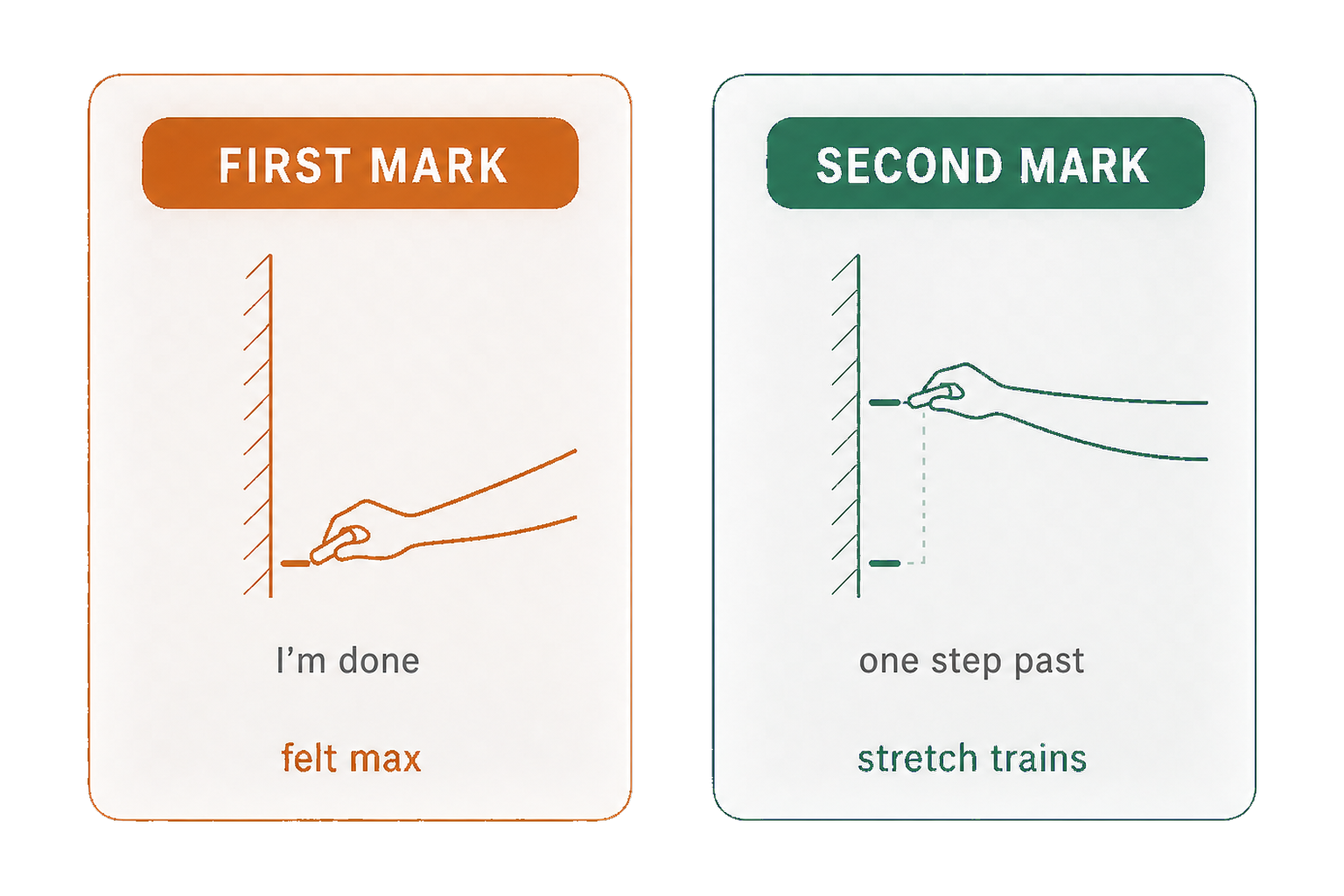
Spatial split — First mark (I’m done · felt max) versus Second mark (one step past · stretch trains). Your move: Your move this week.
The WOW: Past the first stop — then see who you become.
Your move this week
- Catch one I’m done impulse in training or deep work.
- Take one deliberate step past it (not a hero day — one step).
- Log: which identity did that yes feed?
Playcard — run it: My Limits
Scientific grounding
Cite
- Blanchfield, A., Hardy, J., & Marcora, S. (2014). Non-conscious visual cues related to affect and action alter perception of effort and endurance performance. Frontiers in Human Neuroscience, 8.
- McCormick, A., Meijen, C., & Marcora, S. (2015). Psychological determinants of whole-body endurance performance. Sports Medicine, 45(7), 997–1015.
Psychobiological stop rule — exhaustion arrives when perceived effort exceeds potential motivation, and cues can shift RPE (Blanchfield et al.). Effort as mediator — interventions that change perception of effort move endurance outcomes (McCormick et al.). Club ~40% framing is a stretch heuristic from the room, not a measured constant in these papers — use the science for first stop ≠ wall, not the percentage.