Definition
A peak state is a rich, usable configuration of body and attention — breath, posture, focus, voice — that you can enter on purpose, so the next act is not decided by the depleted state that triggered it.
Origin
Anthony Robbins put the phrase into popular coaching: change physiology first, and the story you are able to tell yourself changes with it (Awaken the Giant Within, 1991). The operational claim is that state is not only a report of circumstances. It is an input. Sport and stage traditions had already trained entrance rituals for the same reason. The academic neighbourhood is state-dependent cognition and the inverted-U of arousal, not a single lab construct called “peak state.”
Mechanism
A poor minute produces a poor chemistry. Decisions taken inside that chemistry tend to repeat it: quit, scroll, borrow a speech, wait to feel ready. Two upgrades get confused.
- Borrowed heat. A clip, a track, another person’s certainty. Extrinsic. It can lift you. It can also become the only way you lift, which is a dependency with a motivational costume.
- A prepared state. Breath, posture, a sentence you recorded while well, a sequence that does not ask the depleted minute to invent a reason. The decision was made before the drop.
You do not solve the drop by thinking harder inside the drop. You change the energy you are willing to bring to it, ideally with a system that does not require a fresh act of will each time.
Epistemic boundary. “Peak state” is a coaching handle, not a biomarker. It is not the Yerkes–Dodson law, which describes an inverted-U between arousal and performance on a class of tasks and does not tell you to live at maximum intensity. High arousal helps some acts and degrades others. A prepared state can be quiet. The claim here is only that the state in which you meet a problem is part of the intervention, and that borrowing heat and installing a sequence are different interventions.
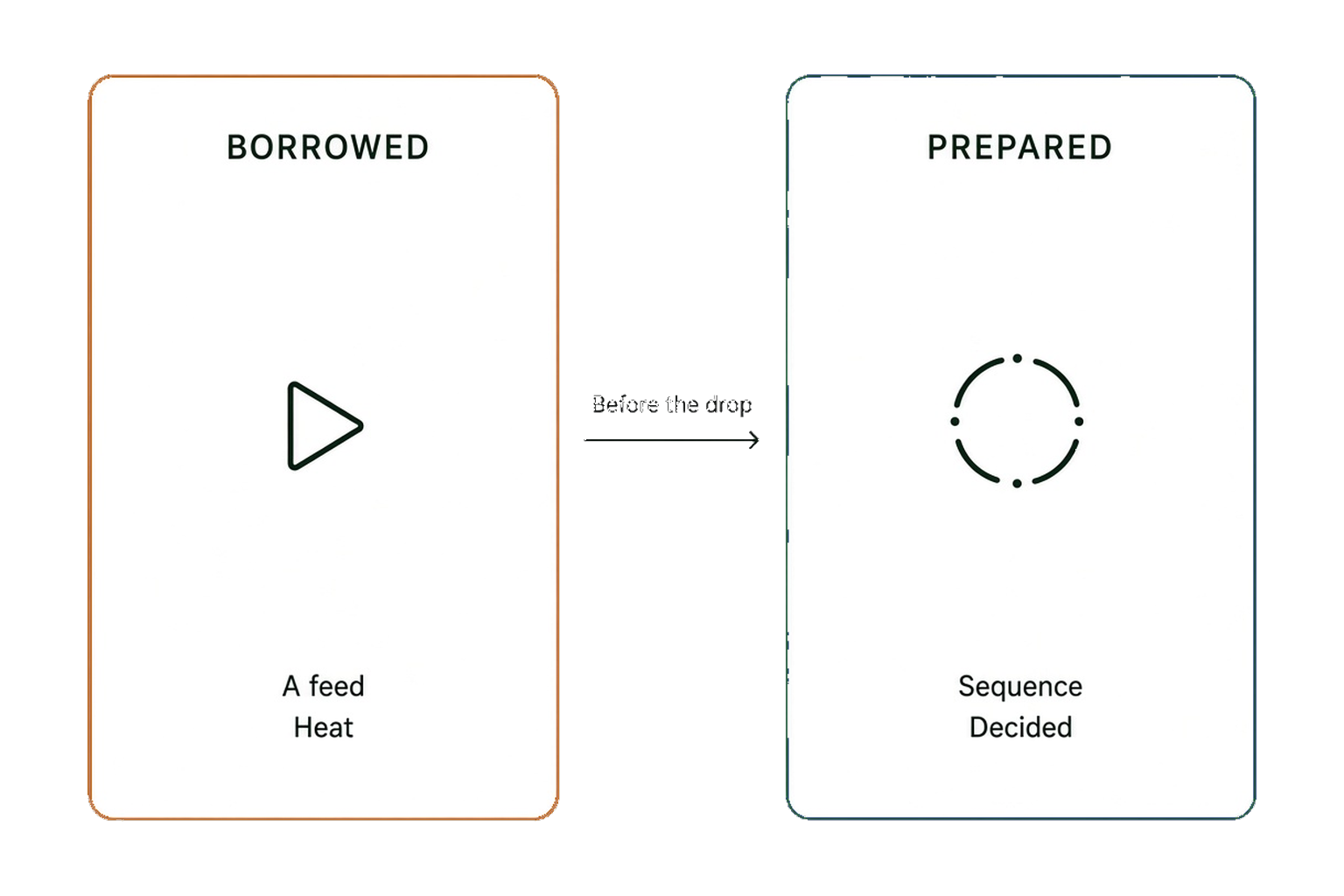
Borrowed heat needs the clip. A prepared sequence is already decided.
Applications
- When the first move after a setback is a feed, label it borrowed heat. Ask what sequence could already be running.
- Use a short physiology change (breath, stand, voice) before strategy, not after the strategy has failed inside the slump.
- Pair with an energy switch when the need is to leave one mode, and with a system when the need is to stop renegotiating the entrance.
Failure modes
- Collector trap: more motivational inputs, no sequence that runs without them.
- Overclaim trap: treating maximum intensity as the only competent state.
- Test today: in one poor minute, change breath and posture before you open a feed or make a quitting decision. Write which one you did.
Sources
Cite
- Robbins, A. (1991). Awaken the Giant Within. Free Press.
- Neiss, R. (1988). Reconceptualizing arousal: Psychobiological states in motor performance. Psychological Bulletin, 103(3), 345–366.