Definition
Lead measure focus is the discipline of acting on the high-leverage, controllable behaviours that predict a goal, rather than fixating on the lagging outcome that only reports the result after the fact.
Origin
Discipline 2 of The 4 Disciplines of Execution — “act on the lead measures.” It rests on the distinction between lag measures (the outcome: revenue, weight, podcasts published) and lead measures (the predictive, influenceable actions that drive them).
Mechanism
A lag measure cannot be moved directly — by the time you read it, the result is already produced.
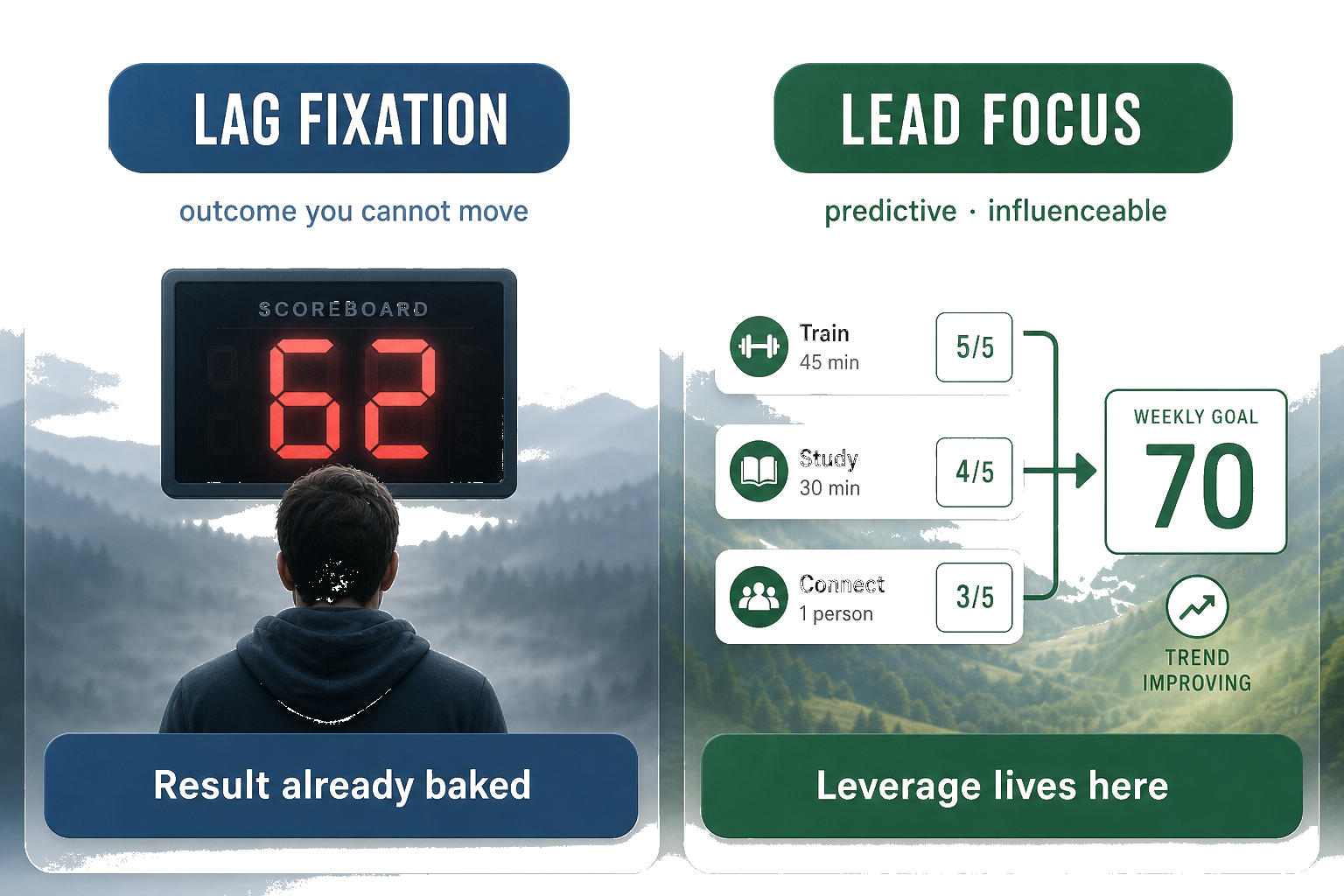
Lag fixation versus controllable lead actions. Pair Lag vs Lead Measure · Compelling scoreboard.
A lead measure has two properties: it is predictive of the goal and influenceable by you. Focusing effort on a small number of lead measures is therefore the only place leverage actually exists. The discipline is one of attention: resisting the gravitational pull of the scoreboard outcome and instead protecting and tracking the daily actions that quietly determine it.
Applications
- Choosing the two or three actions that predict a goal and measuring those, not the outcome.
- Shifting weekly review from “did the result move?” to “did I do the predictive actions?”
- Removing anxiety about a lag you cannot directly control by acting on the leads you can.
Sources
Cite
- McChesney, C., Covey, S., & Huling, J. (2012). The 4 disciplines of execution. Free Press.
- Locke, E. A., & Latham, G. P. (2002). Building a practically useful theory of goal setting and task motivation. American Psychologist, 57(9), 705–717.