Definition
A compelling scoreboard is a simple, highly visible display of the few measures that decide a goal, designed so anyone can tell in seconds whether they are winning or losing.
Origin
Discipline 3 of The 4 Disciplines of Execution — “keep a compelling scoreboard.” It operationalises a long-standing principle from feedback and goal-setting research: people regulate effort far better when they receive clear, frequent feedback on progress toward a specific target, because the gap between current and desired state is what mobilises action.
Mechanism
A scoreboard works when it is players’ (not coaches’) — simple, visible, and showing both lead and lag measures so the team can see whether the actions they control are moving the outcome.
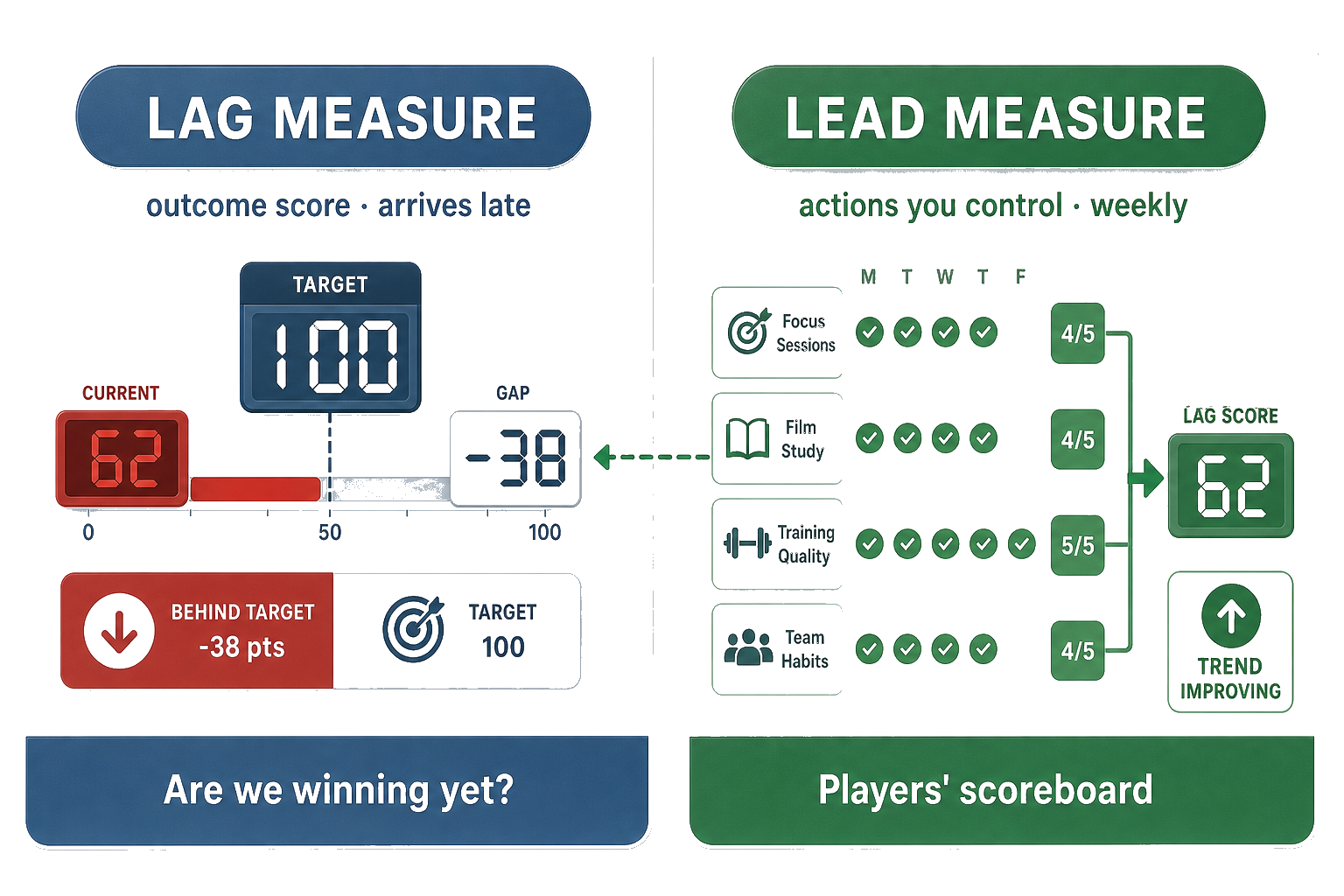
Lag outcome versus lead actions you control — visible score recruits correction. Pair Lag vs Lead Measure. The act of keeping score changes behaviour: a visible number recruits attention, makes drift obvious early, and converts a distant goal into an immediate, motivating “are we winning right now?” The emotional pull of seeing the score is what sustains the discipline.
Applications
- Reducing a goal to the two or three numbers that actually predict it, displayed where you see them daily.
- Catching slippage early instead of at the deadline.
- Sustaining motivation on long efforts by making progress visible.
Sources
Cite
- McChesney, C., Covey, S., & Huling, J. (2012). The 4 disciplines of execution. Free Press.
- Locke, E. A., & Latham, G. P. (2002). Building a practically useful theory of goal setting and task motivation. American Psychologist, 57(9), 705–717.