Definition
A control wall is the felt stop when extending a vision beyond a comfortable horizon — the tension between dream (open future) and control (only what can be managed).
Origin
Related to locus of control and goal hierarchies: some operators hold a clear twelve-month picture but resist four-to-five-year vivid stretch because uncontrollable variables activate a controller identity that equates uncertainty with failure.
Mechanism
The wall is often identity-grade, not information-grade — enough counter-examples may already exist, but the control self has not been given a question it can answer (how do I control the uncontrollable? from inside the control frame vs where did I release control this week?). Rotter’s internal–external control distinction is foundational but later work treats locus as multidimensional and culturally situated — avoid treating “internal control” as always adaptive or “external” as always defeat.
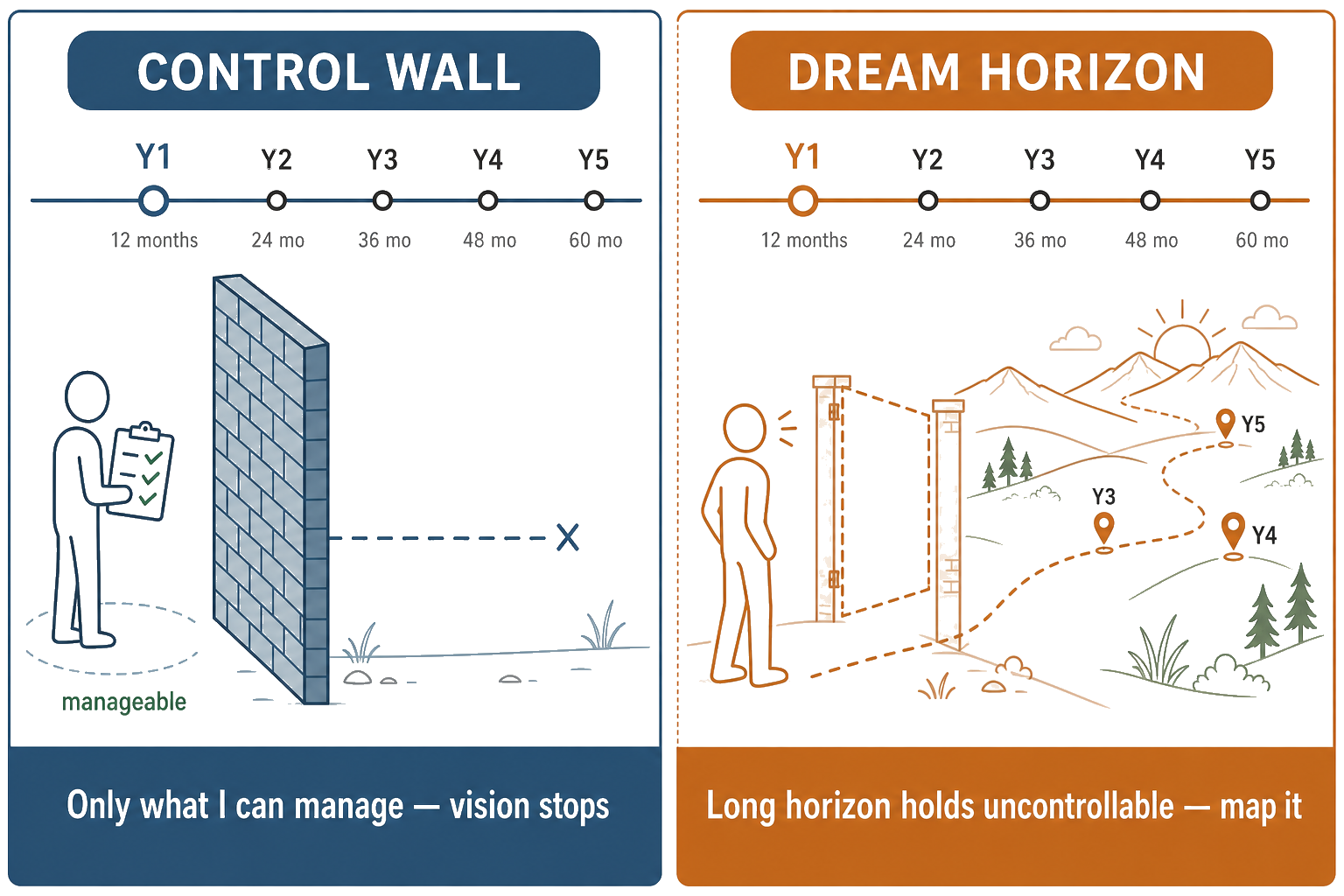
Twelve-month clarity with a wall at year two is identity-grade — map counter-examples and one weekly release log. Pair with Vivid Vision revision cadence.
Applications
Map the wall without moralising. Hunt counter-examples of horizons already held. Weekly release log — one line where control softened — pairs with vivid-vision revision cadence.
Sources
Cite
- Rotter, J. B. (1966). Generalized expectancies for internal versus…. Psychological Monographs, 80(1), 1–28
Related doctrine
Vivid Vision · Identity Gap · Be Your Real Boss