Definition
Cybernetic control theory describes goal-directed systems as feedback loops: a reference value (standard), ongoing input (behaviour or state), and correction until discrepancy shrinks.
Origin
Miller, Galanter, and Pribram’s TOTE units; Carver and Scheier applied the frame to human self-regulation; Bateson extended cybernetic epistemology to nested systems (Steps to an Ecology of Mind).
Mechanism
Negative feedback is not pessimism — it is thermostat logic: compare, act, re-compare. Hierarchies link abstract goals to concrete moves; affect often tracks velocity toward the standard (Carver & Scheier). Self-awareness and Self-monitoring function as loop monitors reading discrepancy signals — useful when standards are task-clear, costly when they are audience-based.
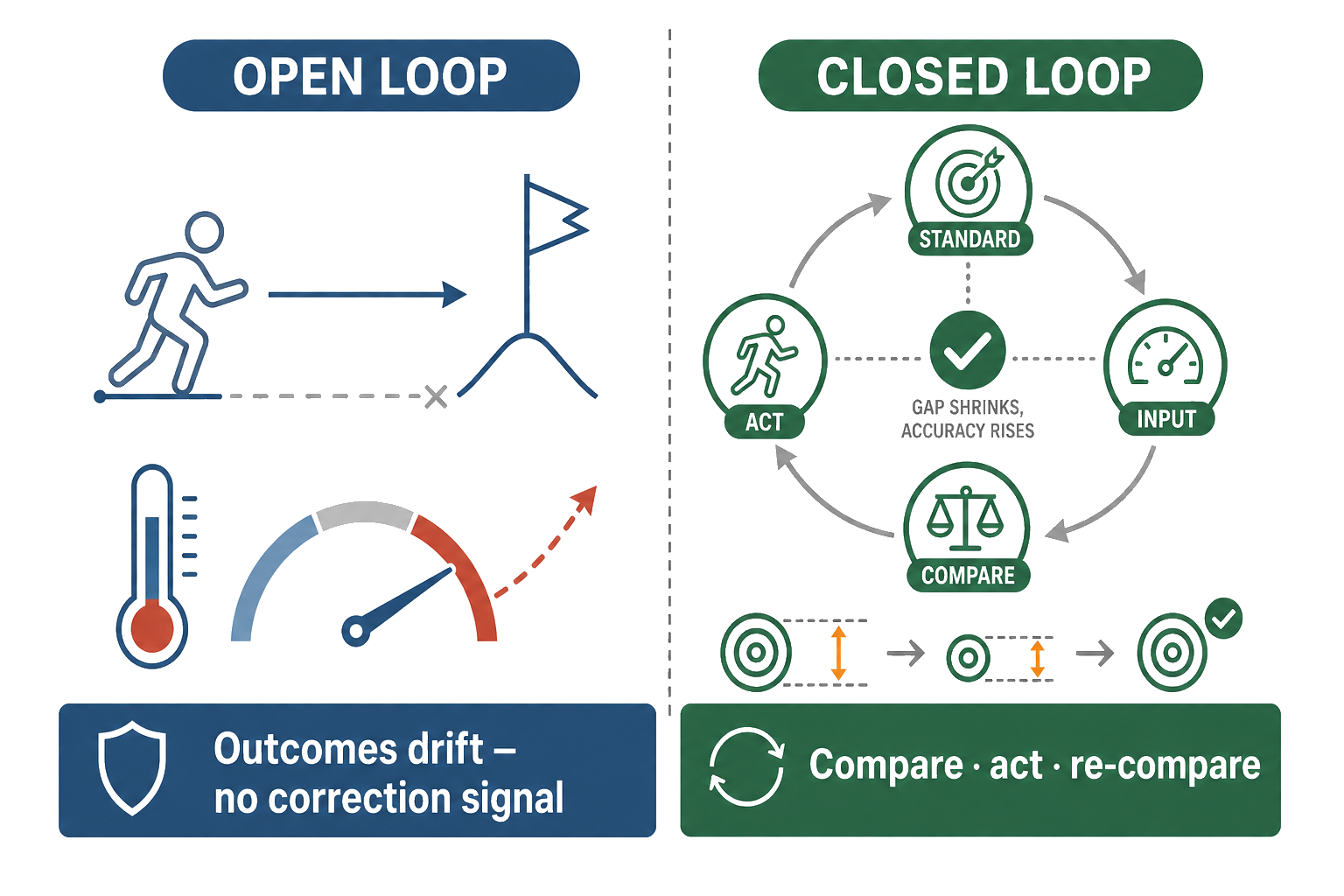
Open loops drift from the standard — closed loops compare, act, and re-compare. Pair with Lag vs Lead Measure for what you can still steer this week.
Applications
Explains why measuring only outcomes (lag) fails when the loop you can still steer is daily behaviour (lead). Pair with measurable standards and lead behaviours you control this week.
Sources
Cite
- Carver, C. S., & Scheier, M. F. (1981). Attention and self-regulation: A control-theory approach to human behavior. Springer
Related doctrine
Lag vs Lead Measure · Personal Standards