Definition
A cadence of accountability is a regular, short, recurring session in which each person reports on the commitments they made last time and commits to the next concrete actions — a rhythm, not a one-off.
Origin
Discipline 4 of The 4 Disciplines of Execution — “create a cadence of accountability.” It draws on two well-supported behavioural levers: the power of specific implementation intentions (deciding in advance when, where, how you will act) and the motivating effect of commitment made visible to others, both of which raise follow-through above private resolve.
Mechanism
The cadence works through frequency and ownership.
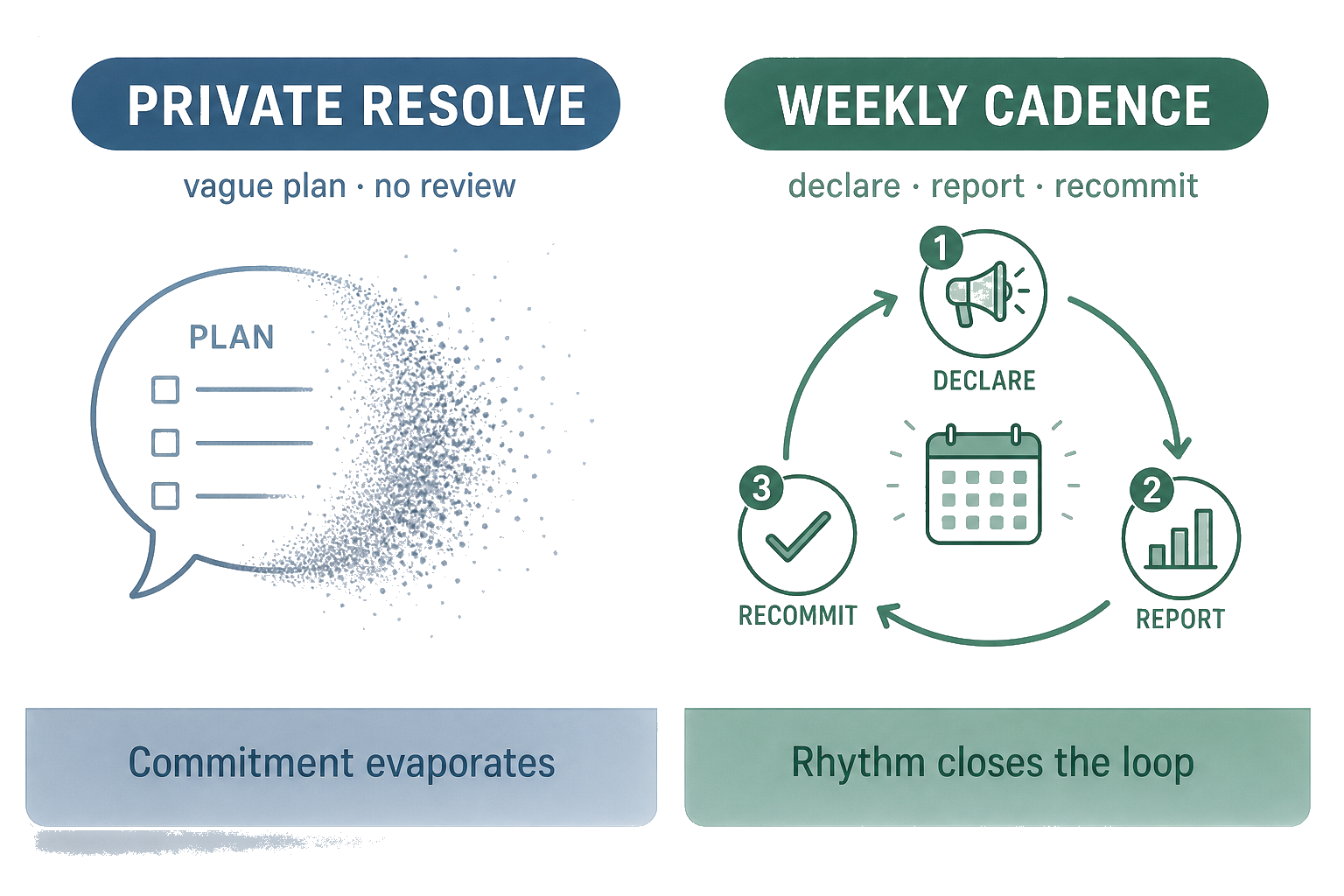
Private resolve versus weekly declare-report-recommit loop. Pair Commitment accounting · 4DX.
A fixed, recurring beat (typically weekly) creates a short horizon: you only have to keep a commitment until the next meeting, which is psychologically manageable. Reporting on the previous commitment closes the loop — what you measure and must account for, you tend to protect — and the act of naming the next commitment out loud, to be reviewed, converts a vague plan into a binding implementation intention. “Commitment accounting” is the ledger side of this: each commitment is tracked from declaration to outcome.
Applications
- A weekly self-review or team huddle that asks only two questions: did I do what I committed to, and what do I commit to next?
- Keeping a long effort alive by shrinking the accountability horizon to one week.
- Pairing the cadence with a scoreboard so commitments are anchored to the numbers that matter.
Sources
Cite
- McChesney, C., Covey, S., & Huling, J. (2012). The 4 disciplines of execution. Free Press.
- Gollwitzer, P. M. (1999). Implementation intentions: Strong effects of simple plans. American Psychologist, 54(7), 493–503.
Related doctrine
Deliberate Practice
Continuity SLA