Working definition
Snapback Effect — Stretch into a new identity, then snap back to the familiar self when fatigue, doubt, or unread body signal releases the elastic before the new pattern holds.
How it works
You pull the elastic: effort, constraint, a Battle that asks a newer self. Then something releases — fatigue, body alarm, doubt that it will work — and you snap back to the known identity because old certainty feels safer than the Identity Gap.
Snapback is not only weak will. Persistence toward a costume can still snap. The counter-moves are:
- Stay longer in the right discomfort — Choosing the right discomfort · pleasure inside the stretch so the brain does not order exit.
- Raise évidence — it is obvious I want this — Evidence as fuel · Transfer of Certainty so adversity is chosen, not negotiated.
- Raise observability — distinguish body signal from the story about the signal — Interoception — so you do not mistake training discomfort for a veto (or the reverse).
Crossing the gap requires letting parts die so others can be born. Snapback is the elastic refusing that death.
Signature
Stretch the elastic. Release. Snap back to the known self — until you stay long enough that the new pattern holds.
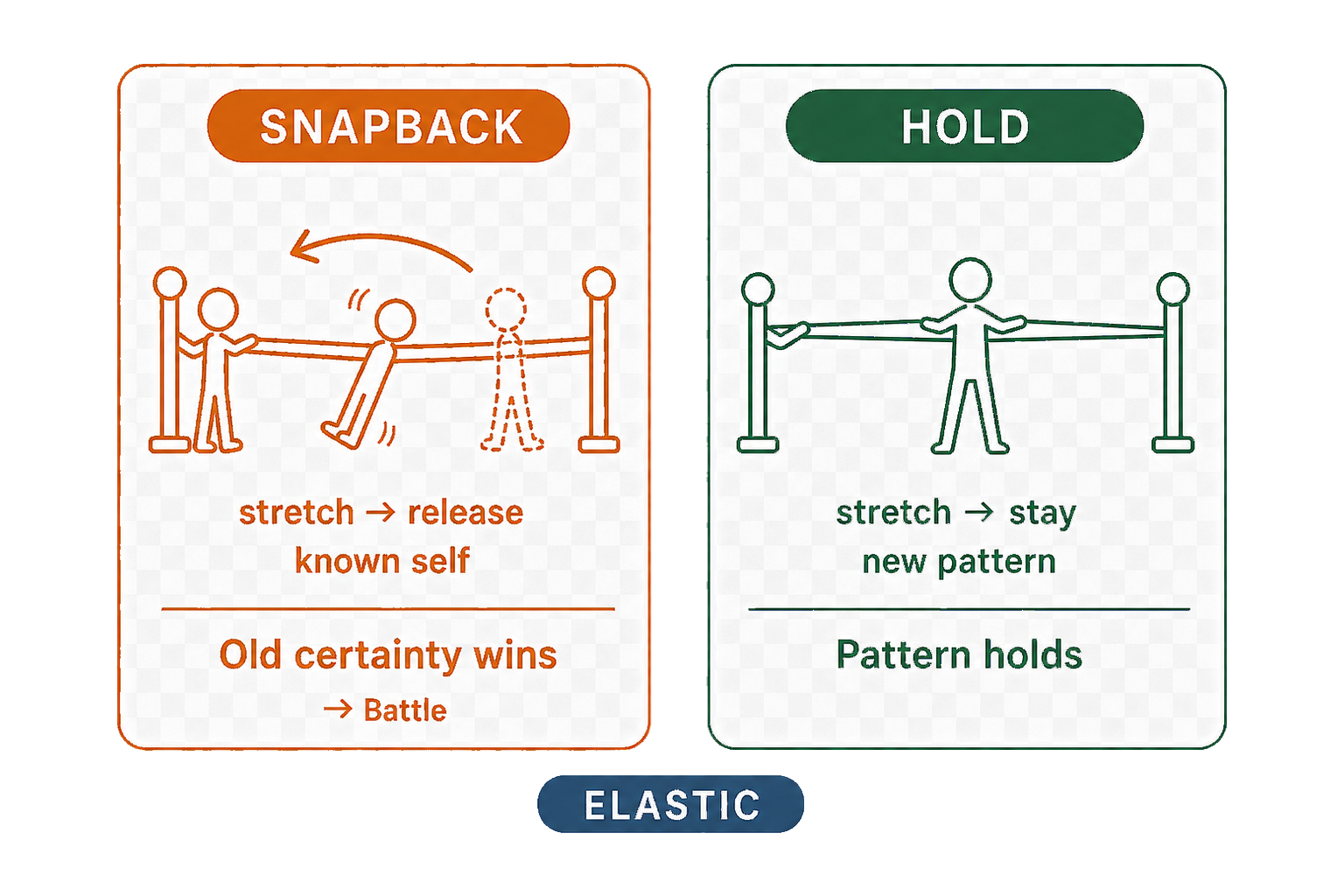
Snap returns you to the known self — hold keeps the stretch until the new pattern sticks.
Room: 2026-07-22.
Your move: Your move this week.
Your move this week
- Name one past stretch that snapped — the sensation and the story that pulled the elastic.
- For your current Battle, write one line that keeps you in the stretch 24–72h longer than last time (évidence, observability, or pleasure in the discomfort).
Scientific grounding
Cite
- Wood, W., & Neal, D. T. (2007). A new look at habits and the habit-goal interface. Psychological Review, 114(4), 843–863.
- Ouellette, J. A., & Wood, W. (1998). Habit and intention in everyday life: The multiple processes by which past behavior predicts future behavior. Psychological Bulletin, 124(1), 54–74.
Snapback maps to context-cued habit winning when goal-directed stretch is still fragile: familiar identity scripts fire without a mediating why, so fatigue or unread body signal releases you into the old response. Persistence alone does not rewire the cue–response link — repetition in the stretch context does.
Adjacent
Master of Opposites
Battle Of the Week
Problems at the Height of Ambitions
Astronaut syndrome