Working definition
Professionalise deliberate recovery — engineer restoration with the same seriousness you bring to the Battle.
How it works
Deliberate recovery is not passive rest. It is a trained stack: movement without time optimisation, psychological detachment, down-regulation rituals, anchor switches, nutrition experiments with guardrails.
Marie-Aude’s nuance belongs here: when does forcing progress me versus exhaust me? Tag the rep — progress or debt — before you moralise fatigue. Branka’s attention governance rule applies when tired: I cannot trust the thought running right now — change body or environment before you negotiate with garbage cognition.
Example
After back-to-back calls you skip detachment because one thread feels urgent — by evening you snap at someone unrelated. That is B3 miss — crash picked your stack because you never ran the craft move on purpose.
Signature
Know your stack before crash sends everything to hell.
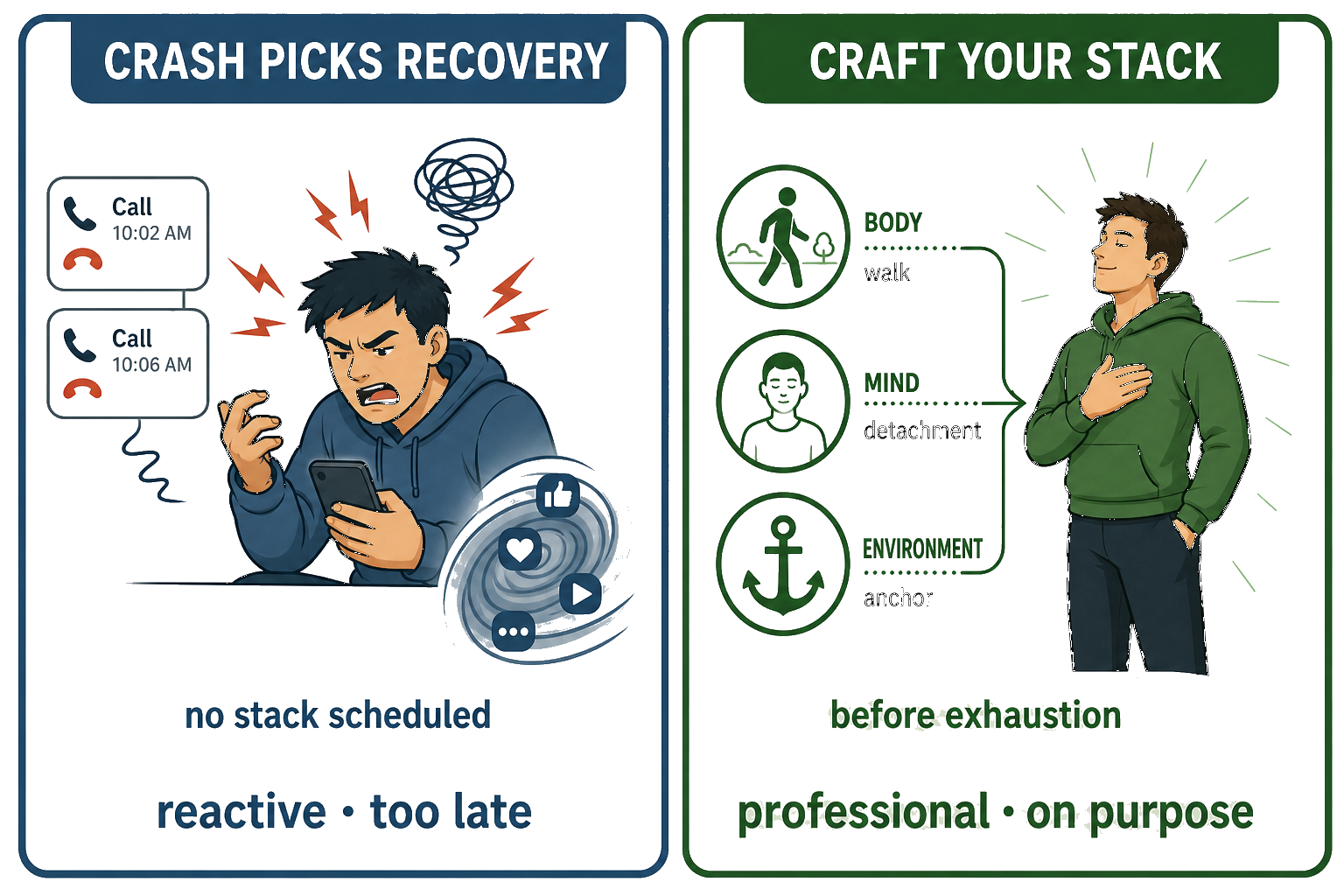
Crash-picked recovery versus a trained body · mind · environment stack. Your move: Your move this week.
Your move this week
One line in The Victory Journal: which recovery move you used before crash — and whether it restored workable attention or only masked depletion.
Scientific grounding
Cite
- Sonnentag, S. (2011). Recovery from fatigue: The role of psychological detachment. In P. L. Ackerman (Ed.), Cognitive fatigue (pp. 253–272). American Psychological Association.
- Sonnentag, S., & Fritz, C. (2015). Recovery from job stress: The stressor-detachment model. Journal of Organizational Behavior, 36(S1), S72–S103.
Mechanism detail: detachment mediates how stressors become exhaustion — professional recovery means designing off-hours experiences, not hoping leave alone clears load.
Adjacent
Mastering personal growth requires mastering recovery
Psychological Detachment
Cognitive Decompression
Non-Sleep Deep Rest (NSDR)