Working definition
Mastering personal growth requires mastering recovery — deliberate restoration as serious as deliberate adversity.
How it works
You can sprint on force for a season. You cannot outrun a missing recovery system — eventually you cancel the weekend, tell everyone off, or quit the Player to silence the noise.
The Club frame treats recovery as professional, not indulgent: know your stack (sleep, movement, detachment, anchors, nutrition experiments) before crash chooses for you. Fatigue opens the door to Saboteur mechanics — that is training data when you catch the loop early, not a verdict on your character.
Pair with Psychological Detachment and Allostatic Reset when you need the science spine; pair with Anchoring when you need a callable switch before mental negotiation.
Example
You planned a quiet Sunday reset; by ten AM three crises ate the block and you “make it up later” with doom-scroll until midnight. That is B3 miss — recovery stayed negotiable until crash owned the weekend.
Signature
When you want to tell everyone off, something inside says this rhythm does not fit — treat the fed-up moment as charnière data, not shame.
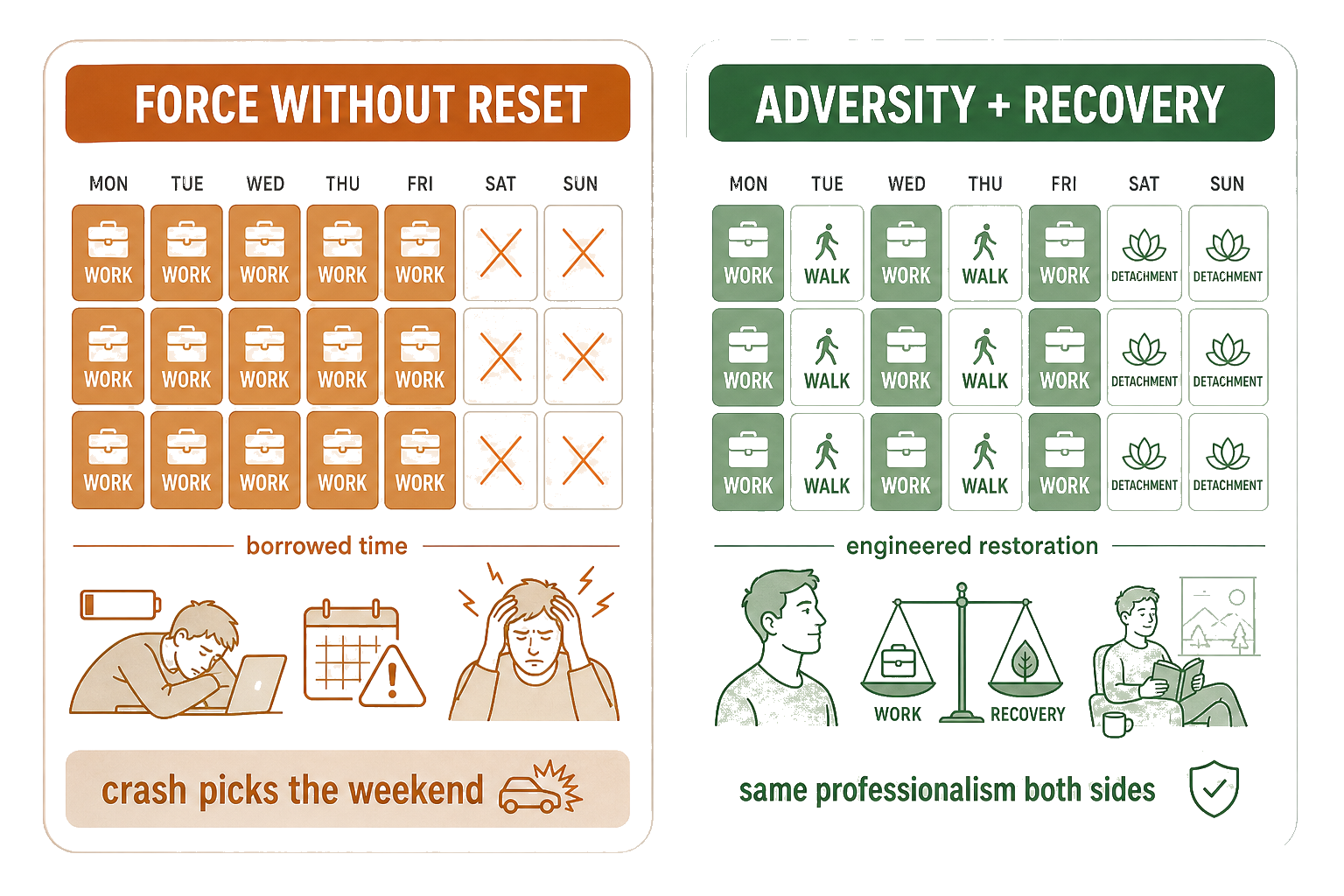
Force without reset versus adversity paired with recovery on the calendar. Your move: Your move this week.
Your move this week
Before your next push block, schedule one recovery rep on the calendar with the same weight as the work block — walk without optimising, detachment ritual, or anchor stack when mood drops.
Scientific grounding
Cite
- McEwen, B. S., & Stellar, E. (1993). Stress and the individual. Archives of Internal Medicine, 153(18), 2093–2101.
- McEwen, B. S. (1998). Stress, adaptation, and disease: Allostasis and allostatic load. Annals of the New York Academy of Sciences, 840, 33–44.
Mechanism detail: cumulative allostatic load turns skipped recovery into strain — restoration is regulatory work, not leftover time.
Adjacent
Professionalise Deliberate Recovery
Energy switch
Battle Of the Week