Working definition
Attention governance is the rule that you do not let fatigue-authored thoughts drive behaviour without a body or environment switch first.
How it works
Fatigue opens toxic loops — Saboteur mechanics amplified, not revealed truth. Attention governance is the operational counter: catch the sentence, refuse to negotiate from empty reserves, activate Anchoring or Energy switch before strategy.
The metacognition layer — the meta seat — lets you observe the scene instead of drowning. Governance is not suppression; it is sequencing: observe → switch physiology → then decide.
Example
Alone after a draining day, you rehearse tomorrow’s fight in bed for forty minutes — every line feels true because fatigue wrote it. You stand, run one anchor, and only then open notes. That is B3 miss — you almost let the wild horse negotiate strategy from empty reserves.
Signature
I cannot trust the thought running right now.
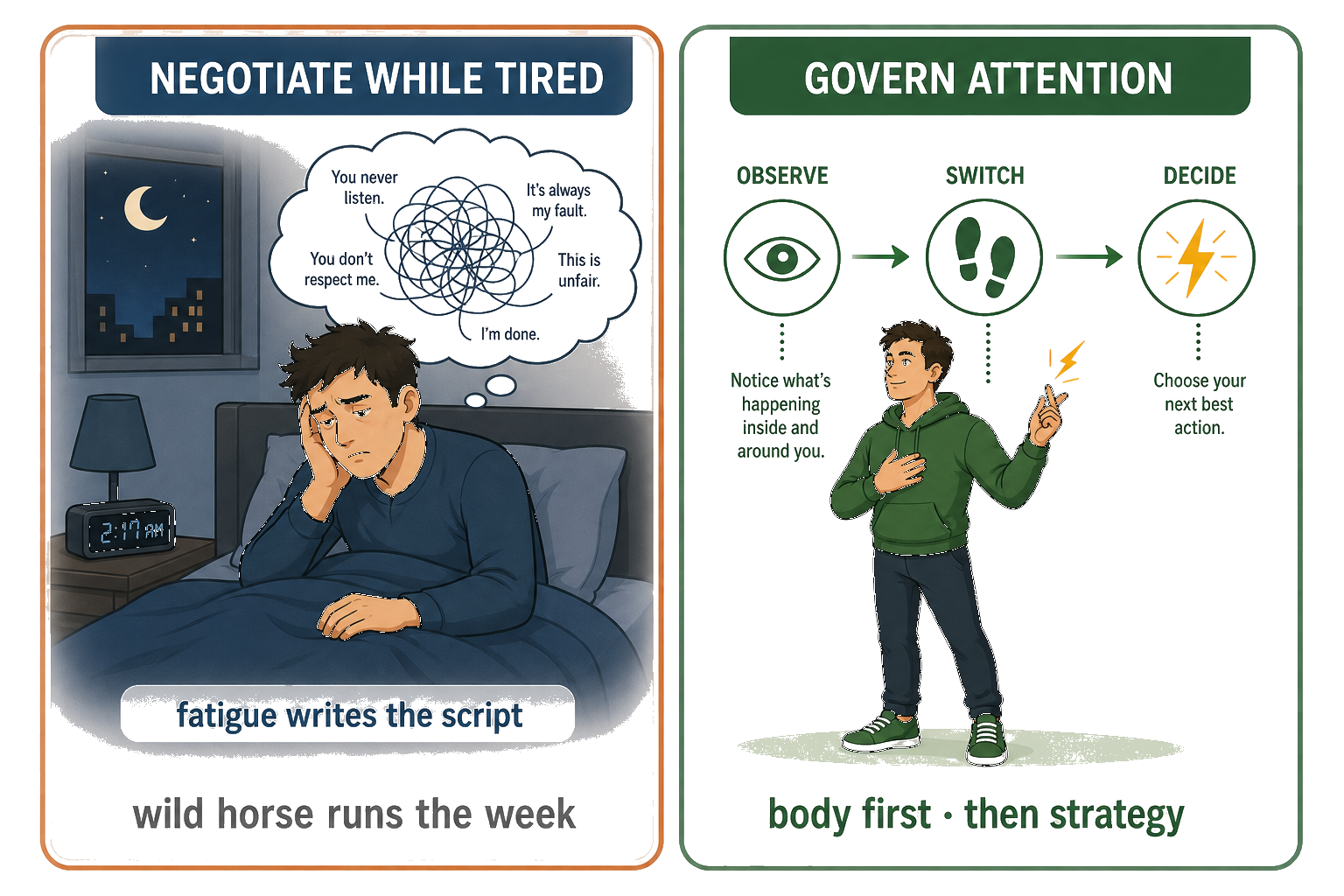
Wild horse versus governed sequence — body or environment before strategy. Your move: Your move this week.
Your move this week
When mood is wrong, stop negotiating — log one toxic-thought rep (body switch or walk-away) before you answer the loudest inner voice.
Scientific grounding
Cite
- Flavell, J. H. (1979). Metacognition and cognitive monitoring: A new area of cognitive–developmental inquiry. American Psychologist, 34(10), 906–911.
- Koriat, A., Ackerman, R., & Adiv, S. (2014). Metacognitive monitoring during learning: Goal-driven and data-driven regulation. Journal of Experimental Psychology: General, 143(1), 386–403.
Mechanism detail: monitoring your own cognition lets you treat low-energy sentences as data, not verdicts — governance is sequencing before strategy.
Adjacent
metacognition
Professionalise Deliberate Recovery
Quality of Questions