Working definition
You need both a certainty anchor and variety — put determinism where the result must be guaranteed, and variety where the path stays alive; never invert them.
How it works
A finished destination gives energy. So does the next unknown. When you treat those as enemies, you either freeze in planning (certainty without motion) or chase novelty mid-chain (variety where the result must land).
The install:
- Name the need at the exit — when you leave a determined stretch, ask which need spoke: certainty missing, or variety starved.
- Assign poles to links — result-chain (publish, ship, close) gets determinism; craft and discovery get probabilism / variety.
- Balance inside the week — Ideal day and ideal week holds both poles so you do not smuggle surprise into the SPOF link (Single point of failure).
Distinction from Master of Opposites: Master of Opposites is choose the pole on purpose; this doctrine names which need is driving the flip and where each belongs in the system.
Signature
Certainty on the result. Variety on the path — never the reverse.
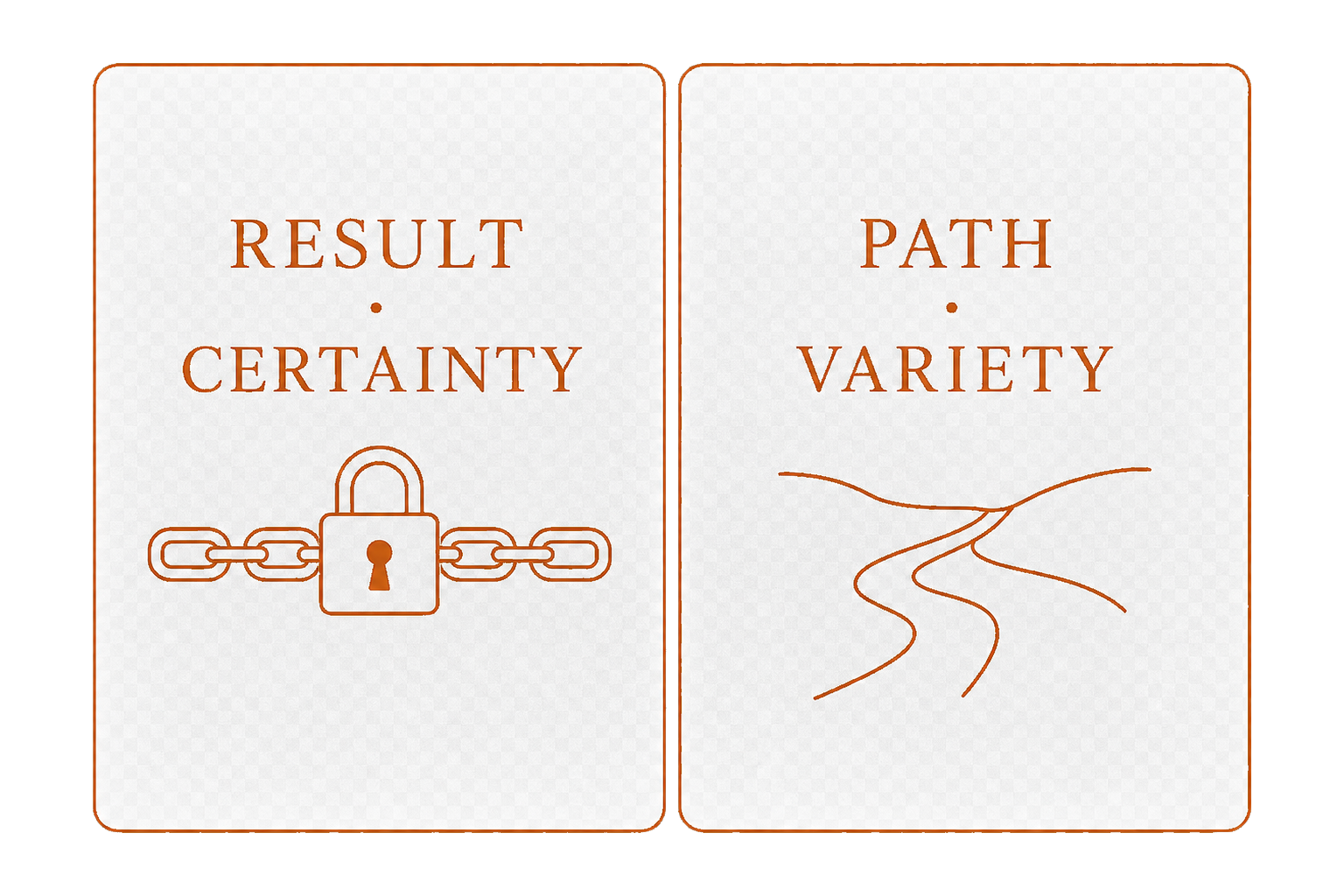
Left = result-link certainty · Right = path variety — assign poles; do not invert. Your move: Your move this week.
Room: 2026-07-24.
Your move: Your move this week.
Your move this week
- Draw five links of one chain you care about.
- Mark each link certainty or variety.
- Move any variety off the result-critical link before Friday.
Scientific grounding
Cite
- Ericsson, K. A., Krampe, R. T., & Tesch-Römer, C. (1993). The role of deliberate practice in the acquisition of expert performance. Psychological Review, 100(3), 363–406.
- Kruglanski, A. W., Shah, J. Y., Fishbach, A., Friedman, R., Chun, W. Y., & Sleeth-Keppler, D. (2002). A theory of goal systems. In Advances in Experimental Social Psychology, 34, 331–378.
Closure pressure and goal-system maps explain why a foggy destination scatters effort: without a clear means–goal map, variety-seeking hijacks the chain that needed a guaranteed recipe.