Definition
Yin and yang name two complementary, interdependent poles whose movement creates the whole: yang is active, outward, assertive; yin is receptive, inward, yielding. Neither is good nor bad — each contains the seed of the other.
Origin
A foundation of Chinese cosmology, articulated in the I Ching and in Taoist thought (Laozi, Tao Te Ching). The two are not warring forces but a single dynamic: light and shadow on one hillside, inhaling and exhaling of one breath. The classic symbol shows each pole carrying a point of its opposite — there is no pure yang without yin inside it.
Mechanism
Polarity is dynamic, not static.
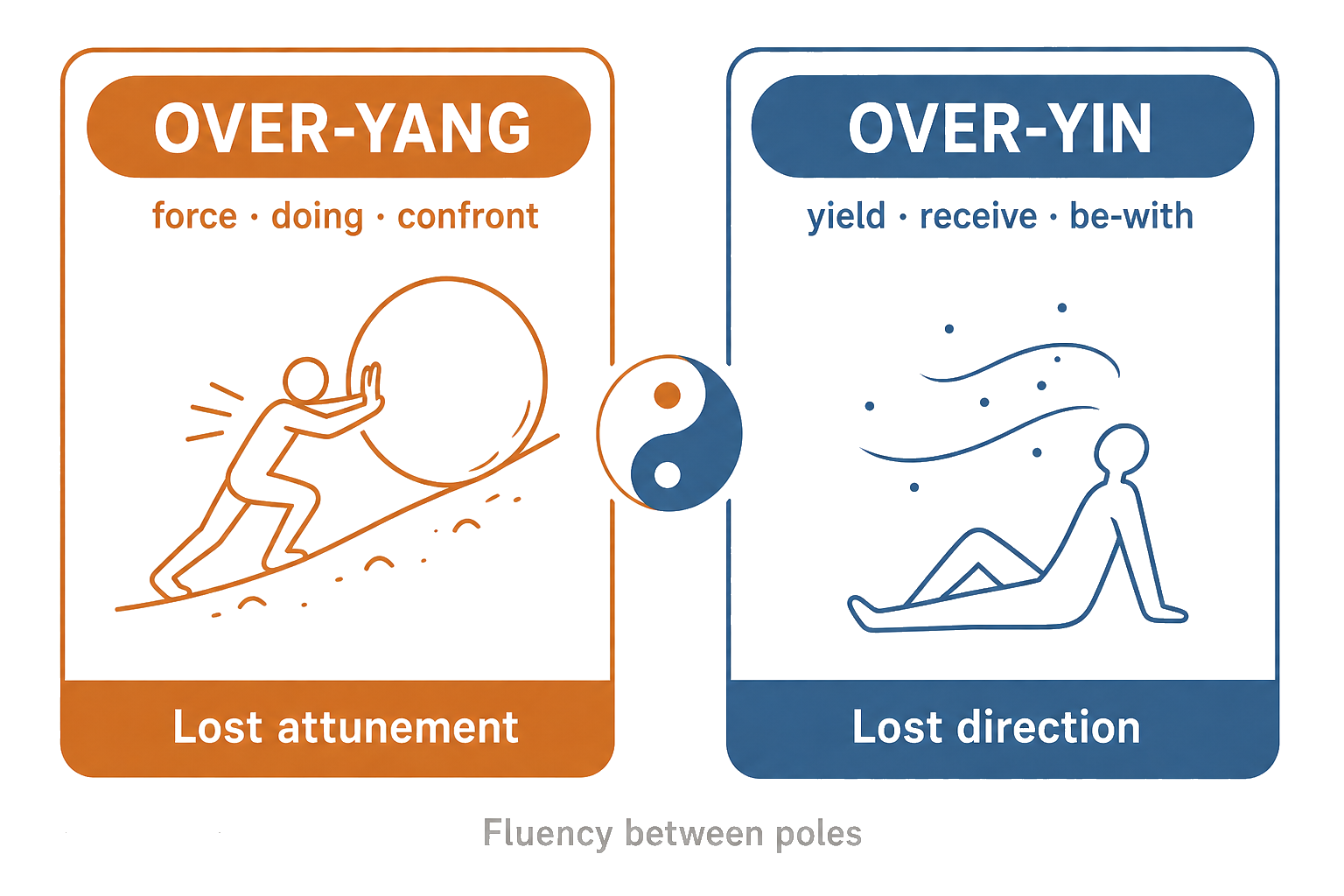
Over-yang versus over-yin — fluency between poles, not fixing one. Pair Master of Opposites · Being vs doing.
Health and competence lie in fluency between the poles, not in fixing one. Overcommit to yang (force, confrontation, doing) and you lose attunement; overcommit to yin (yielding, being-with, receiving) and you lose direction. The skilled move is to read what the moment requires and shift — to confront and to be present, to act and to receive.
Applications
Balancing outward confrontation with inward presence; leadership that can both drive and hold; pairing a deliberately provoked discomfort with the receptive work of staying with what rises. The frame is a practical antidote to one-sided self-development: train the pole you neglect.
Sources
Cite
- Laozi. (1989). Tao te ching (D. C. Lau, Trans.). Penguin Classics. (Original work ca. 4th century BCE)
- Wilhelm, R. (Trans.). (1967). The I Ching or book of changes (3rd ed.). Princeton University Press.