Definition
Self-assertiveness is the willingness to stand up for oneself — to honour one’s wants, needs, and values and seek their appropriate expression in reality — rather than betraying them to avoid disapproval.
Origin
The fourth of Branden’s six pillars of self-esteem, and the core construct of the assertiveness-training tradition (Alberti & Emmons). It is defined by contrast with its two failure modes: passivity (suppressing the self to keep the peace) and aggression (imposing the self at others’ expense).
Mechanism
Assertiveness is congruence between inner experience and outer expression.
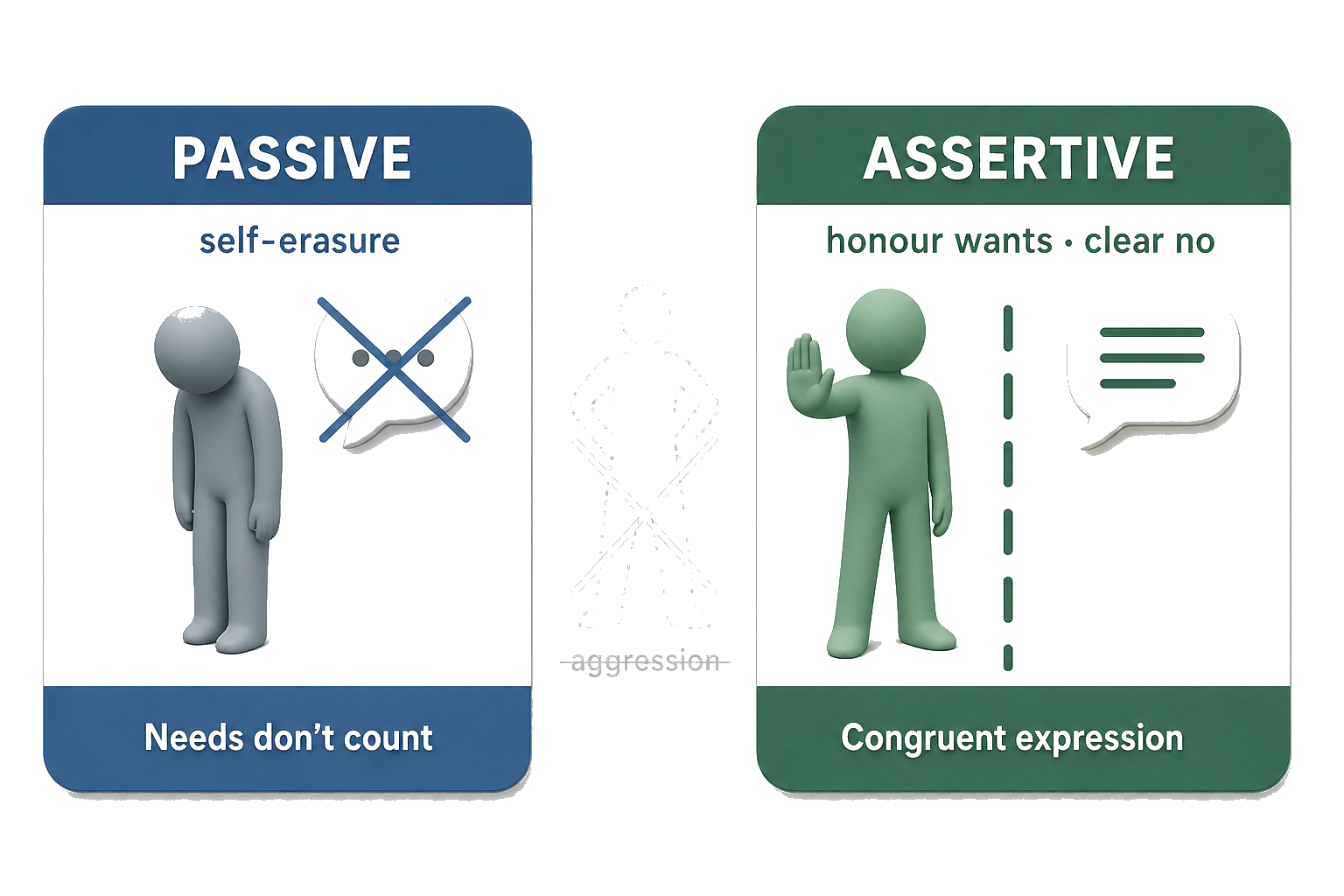
Passive erasure versus congruent expression — honour wants without aggression. Pair Personal integrity · Quality of Questions.
Suppressing what you genuinely value — chronic self-silencing — corrodes self-respect, because each act of self-betrayal teaches you that your needs do not count. Branden frames it as the courage to be authentic: to live and act from your convictions in the world, not only in private. The skill sits between two distortions and requires accurately naming the need before voicing it.
Applications
- Saying a clear no without aggression or guilt.
- Voicing a need or boundary instead of absorbing resentment.
- Letting your visible behaviour match your private values.
Sources
Cite
- Branden, N. (1994). The six pillars of self-esteem. Bantam.
- Speed, B. C., Goldstein, B. L., & Goldfried, M. R. (2018). Assertiveness training: A forgotten evidence-based treatment. Clinical Psychology: Science and Practice, 25(1), e12216.