Definition
Personal integrity is the integration of ideals, convictions, standards, and behaviour — the congruence between what you profess and what you do.
Origin
The sixth and culminating pillar of Branden’s six pillars of self-esteem. Its mechanism is illuminated by cognitive-dissonance research (Leon Festinger): a gap between belief and action creates internal tension, and how we resolve that tension shapes self-regard.
Mechanism
Integrity means integration — values and behaviour pulling in the same direction.
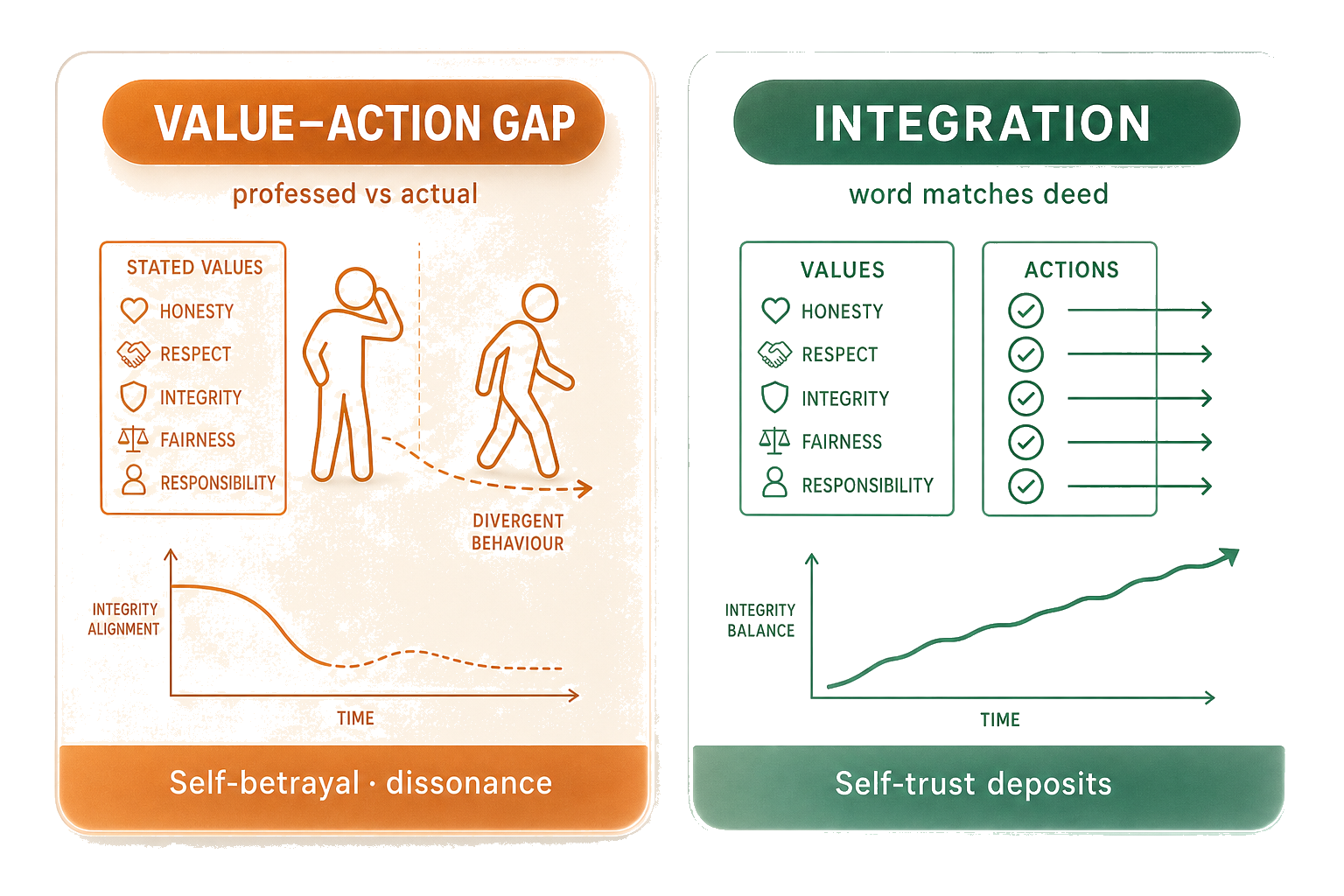
Value–action gap versus integration — self-trust from congruence. Pair Self-esteem · Six Pillars.
When they diverge (you act against what you claim to value), the result is self-betrayal, which quietly lowers self-esteem because you become someone you cannot fully trust. Each kept word, by contrast, deposits self-trust. Branden’s point is reflexive: integrity is not primarily about reputation with others but about the relationship you build with yourself through congruent action.
Applications
- Keeping a promise to yourself as seriously as one made to others.
- Closing the gap between stated values and daily behaviour.
- Reading a loss of self-respect as a signal of accumulated self-betrayal.
Sources
Cite
- Branden, N. (1994). The six pillars of self-esteem. Bantam.
- Festinger, L. (1957). A theory of cognitive dissonance. Stanford University Press.