Definition
Inside Feedback is the information arriving from inside the body and mind — sensation, urge, inner protest, self-talk — before you respond to outer tasks or ambient noise.
Origin
Interoception research (Craig, Barrett) treats ongoing inner signal as part of perception, not background noise. Coaching practice separates capturing that layer from obeying it — the name marks a deliberate pause between felt friction and the next move.
Mechanism
Inner friction often announces stop before the body has reached a real limit. Pair with Interoception (read the chain) and Exteroception (what competes for attention outside). Signal vs Noise asks which inner ping is data worth working versus noise to switch away from.
Interoceptive experience is partly predictive — limbic forecasts constrained by ascending visceral signal — so inner friction is data to interpret, not a command to obey.
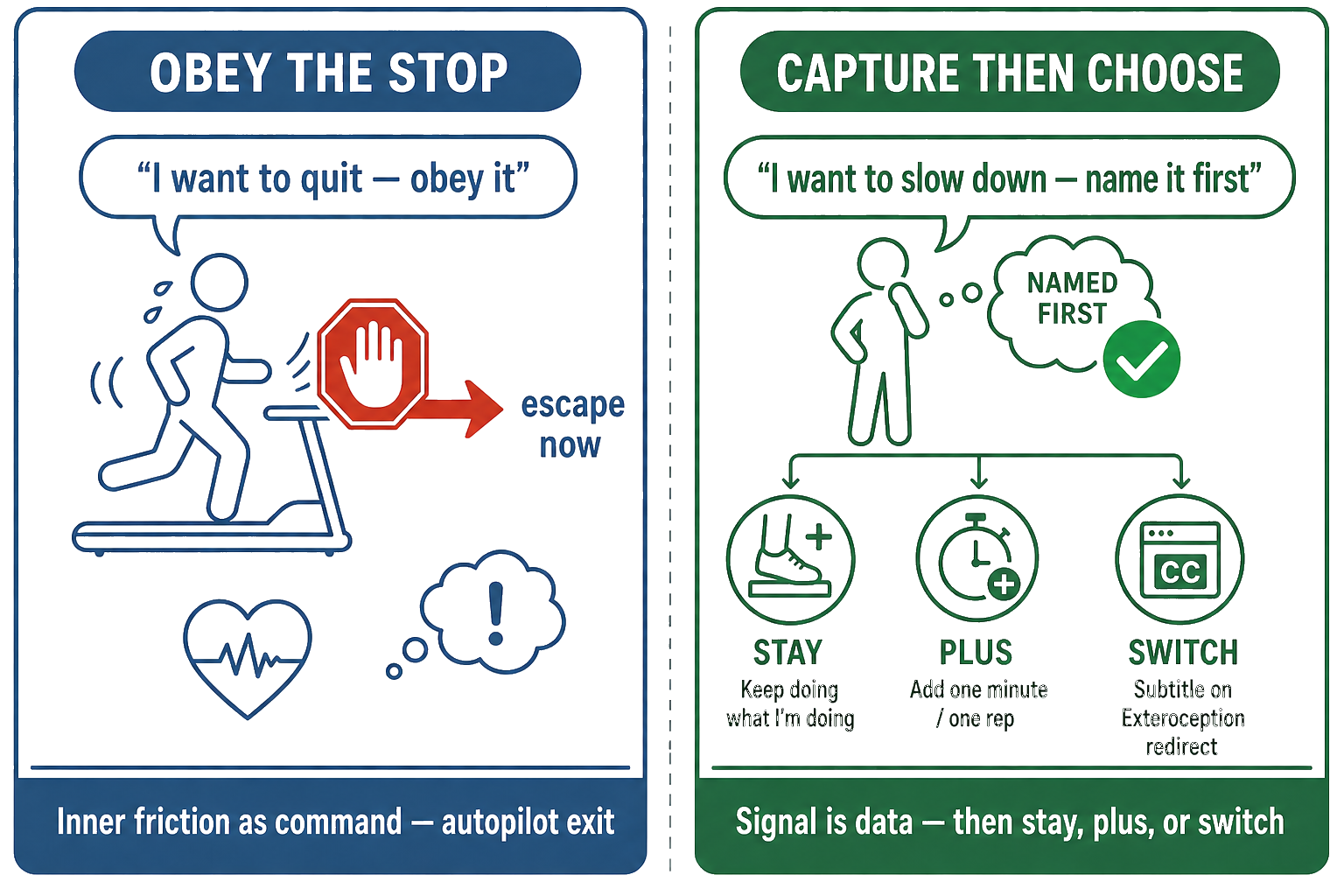
Obey the stop versus capture then choose — name inside feedback, then stay, plus, or switch attention. Doctrine: Interoception · outer channel: Exteroception.
Applications
On treadmill, cold shower, or relational hold: name the inside feedback first (I want to slow down), then choose — plus, stay, or switch attention (subtitles, count bias, five more minutes). Log in Manual Of Me as a personalised friction recipe.
Sources
Cite
- Strigo, I. A., & Craig, A. D. (2016). Interoception, homeostatic emotions and…. Philosophical Transactions of the Royal Society B, 371(1708), 20160010
- Barrett, L. F., & Simmons, W. K. (2015). Interoceptive predictions in the brain. Nature Reviews Neuroscience, 16(7), 419–429.