Definition
Inner fire is a mobilizing approach-drive — appetite, anger-as-fuel, the wish to move toward a stake — that has been muted over time by a practice of rebalancing, until action continues and the drive no longer organizes it.
Origin
The phrase is a performance metaphor, not a diagnostic category. The mechanism it points at is older. Approach and avoidance are separate motivational systems. Anger, in particular, is an approach-related affect: it narrows attention toward a goal and readies movement, and it is not identical with aggression or with harm (Carver and Harmon-Jones, 2009). Traditions that treat every strong affect as noise to be downregulated will also downregulate the approach that affect was carrying.
Mechanism
Three steps get collapsed into “I am calmer now.”
- The drive organized action. A stake, a fight, a build, a room full of people. Physiology and attention pointed toward contact.
- Balance became the goal. Understanding the pattern, refusing the destructive face, recentering. Each correction is locally sane.
- The correction generalizes. The person gets faster at not entering the state. The motor is not deleted. It is anesthetized. Output can remain high. The organizing heat is gone. Other people often name the flatness before the person does.
Reinstalling is not a speech about passion. It is a small dose of the approach that was muted, with a check, so the destructive face is not smuggled back in under the name of authenticity.
Epistemic boundary. This note does not claim that calm is a pathology, that anger should be cultivated as a lifestyle, or that every loss of intensity is repressed approach. Depression, illness, grief, and a real change of values also flatten a person. The claim is narrower: chronic downregulation of approach-affect can be mistaken for maturity, and the mistake is testable. If a precise, bounded return of the old heat changes contact, energy, and other people’s report, the anesthesia hypothesis earns another look. If nothing moves, look elsewhere.
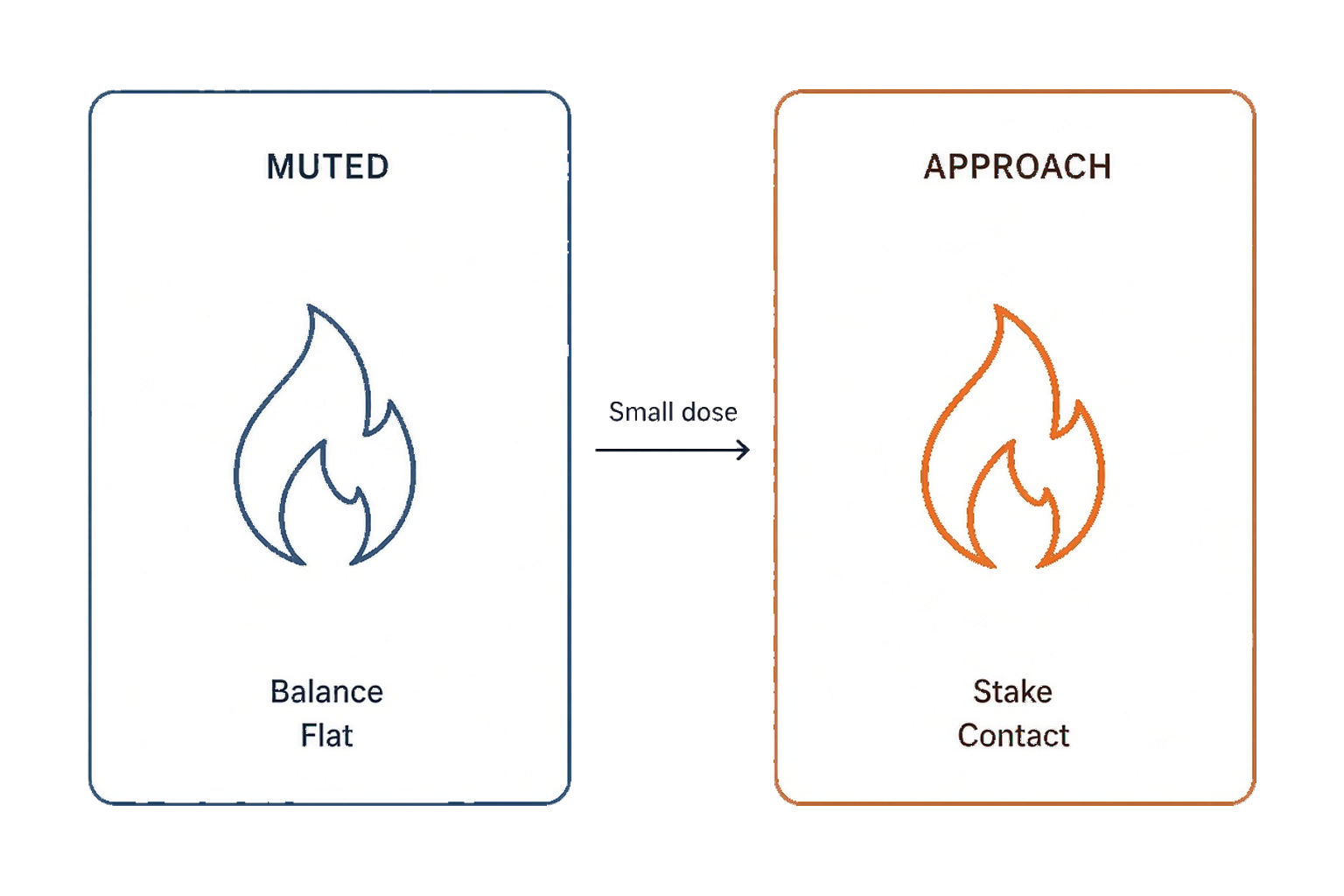
Balance can mute the approach. A small dose is contact, not a bonfire.
Applications
- When balance work has made you easier to live with and harder to recognize, ask which approach you stopped allowing.
- Separate the destructive face (harm, contempt, scorched relationships) from the motor (movement toward a stake). Keep the refusal of the first. Test a dose of the second.
- Pair with an equilibrium model when a long exhale is being treated as a finished personality.
Failure modes
- Collector trap: another theory of why the fire died, and no dose this week.
- Overclaim trap: lighting every muted state and calling the damage authenticity.
- Test today: name one muted approach. Give it a bounded act that cannot harm anyone. Write what moved.
Sources
Cite
- Carver, C. S., & Harmon-Jones, E. (2009). Anger is an approach-related affect: Evidence and implications. Psychological Bulletin, 135(2), 183–204.
- Elliot, A. J., & Thrash, T. M. (2002). Approach-avoidance motivation in personality: Approach and avoidance temperaments and goals. Journal of Personality and Social Psychology, 82(5), 804–818.