Definition
The burnout pattern is the neurochemical trap of running on dopamine alone — chasing the next achievement without restoring the here-and-now chemistry of enjoyment — so effort compounds while fulfilment never arrives.
Origin
A named pattern from The Molecule of More (Lieberman & Long), sitting at the junction of the wanting-versus-liking split and the chronic-stress account of burnout (Maslach; Sapolsky). Where the general construct of Burnout describes the exhaustion syndrome, this note isolates its dopaminergic engine.
Mechanism
Dopamine rewards pursuit, not arrival.
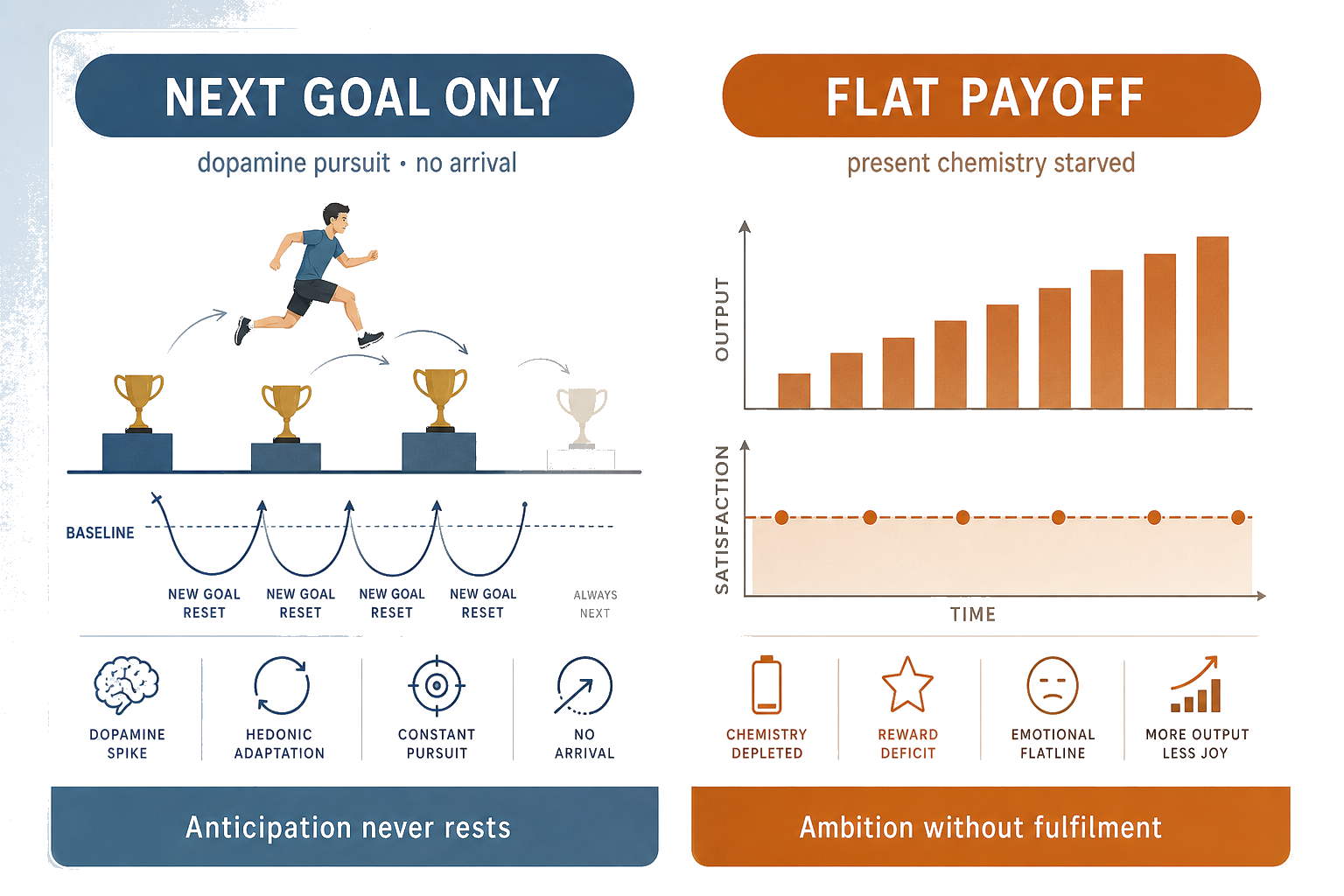
Next-goal pursuit with flat payoff — the dopaminergic engine. Pair Wanting versus liking · Burnout.
A person organised entirely around the next goal keeps the anticipation system firing and starves the present-moment systems that deliver satisfaction and recovery. Each achievement is immediately discounted as the baseline resets and attention jumps to the next target. Over time this produces relentless ambition with no felt payoff, and — because recovery is never scheduled, only deferred — the chronic-stress wear that defines burnout. The signature is telling: more output, less meaning; constant pursuit, vanishing enjoyment.
Applications
- Spotting “I’ll feel it after the next one” as the engine, not a phase that will end on its own.
- Deliberately building here-and-now reward and recovery into the pursuit, not as a prize for finishing.
- Reading falling satisfaction amid rising achievement as an early burnout signal.
Sources
Cite
- Lieberman, D. Z., & Long, M. E. (2018). The molecule of more. BenBella Books.
- Maslach, C., Schaufeli, W. B., & Leiter, M. P. (2001). Job burnout. Annual Review of Psychology, 52, 397–422.