Definition
Burnout is a psychological syndrome arising from prolonged, unrelieved stress, characterised by emotional exhaustion, cynical detachment, and a diminished sense of personal accomplishment.
Origin
The construct was defined and measured by Christina Maslach and colleagues, whose Maslach Burnout Inventory established its three dimensions. Its physiological substrate is described in the chronic-stress literature (notably Robert Sapolsky): the same stress response that is adaptive in short bursts becomes corrosive when it never switches off.
Mechanism
Burnout is a pattern of sustained effort without recovery.
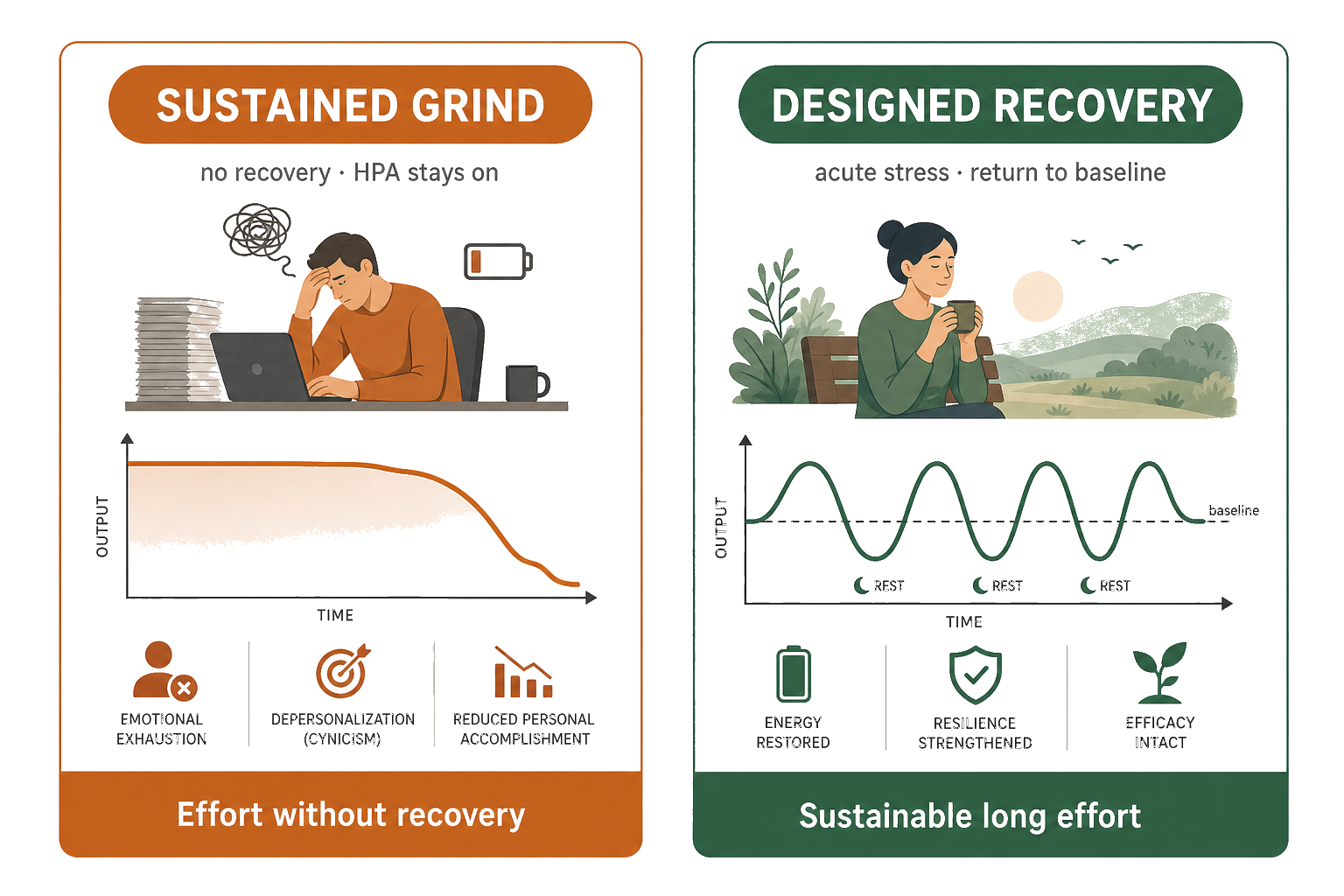
Grind without recovery versus designed rest valleys — effectivity at the cost of efficiency. Pair Efficiency vs Effectivity · Stress infrastructure design.
The stress response (the HPA axis and sympathetic arousal) is built for acute threats followed by return to baseline; when demand is continuous and control or recovery is low, the system stays activated and the cumulative wear — allostatic load — degrades mood, motivation, and cognition. The recognisable pattern: high output maintained by force, rising exhaustion and cynicism, then collapse of efficacy — the costly route to a result, where effectivity is reached but efficiency is destroyed.
Applications
- Reading the early signature (exhaustion + cynicism + dropping efficacy) before collapse.
- Designing recovery into effort rather than treating rest as a reward earned only after the result.
- Distinguishing a sustainable long effort from a self-sabotaging grind.
Sources
Cite
- Maslach, C., Schaufeli, W. B., & Leiter, M. P. (2001). Job burnout. Annual Review of Psychology, 52, 397–422.
- Sapolsky, R. M. (2004). Why zebras don’t get ulcers (3rd ed.). Henry Holt.