Definition
Stress infrastructure design is the practice of shaping your environment and systems in advance so that chronic, predictable stressors are reduced structurally — rather than relying on in-the-moment willpower to absorb them.
Origin
The principle applies the findings of stress physiology to design. Robert Sapolsky and the allostatic-load model (Bruce McEwen) show that the damage of stress comes less from acute spikes than from the cumulative cost of chronic activation, and that three factors strongly modulate that cost: predictability, controllability, and the availability of outlets. The design move is to engineer those factors into the system instead of leaving them to chance.
Mechanism
Because chronic stress is cumulative (allostatic load), the highest-leverage intervention is upstream: remove or buffer recurring stressors so the stress response is triggered less often.
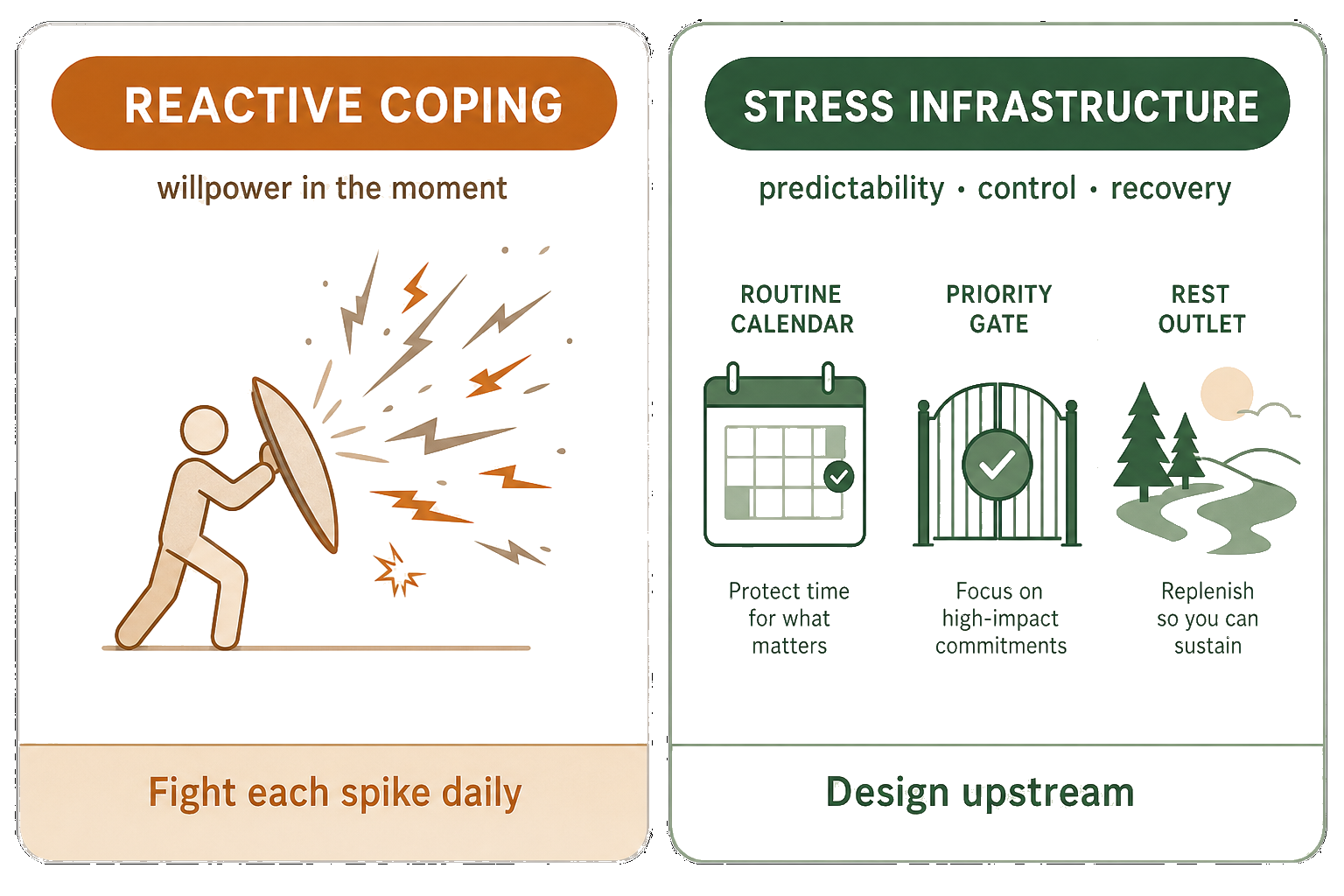
Reactive coping versus upstream design — predictability, control, recovery outlets. Pair Life Is the System · Burnout.
This means building in predictability (routines, defaults, advance preparation), control (clear priorities, the ability to say no), and recovery outlets (scheduled rest, movement). A well-designed infrastructure means fewer decisions made under load, less friction between intention and action, and a baseline that does not have to be defended by force — the structural counterpart to flow.
Applications
- Reducing decision load by pre-deciding routines and defaults.
- Building buffers and recovery into a schedule before a demanding push, not after.
- Treating recurring friction as a design problem to solve once, not a willpower problem to re-fight daily.
Sources
Cite
- McEwen, B. S., & Stellar, E. (1993). Stress and the individual: Mechanisms leading to disease. Archives of Internal Medicine, 153(18), 2093–2101.
- Sapolsky, R. M. (2004). Why zebras don’t get ulcers (3rd ed.). Henry Holt.
Related doctrine
Life Is the System
Personal Alignment System