Definition
An information gap is a specific hole between what you know and a piece you can name. Curiosity is the discomfort of that hole. An unbounded pile does not open a hole. It closes the want to look.
Origin
George Loewenstein (1994) reframed curiosity as a form of cognitively induced deprivation. You feel a gap in knowledge the way you feel a gap in a drive: the gap has an object. Insight, in this account, is rewarding because it closes a deprivation, not because novelty is pleasant in the abstract. The paper is a review and a reinterpretation of earlier curiosity work, not a single experiment.
The operational neighbor is not “be more curious.” It is the size of the hole. A question you can point at — what I said I would do, and what I did — is a gap. A library with no named missing piece is an ocean. Oceans do not pull. They overwhelm.
Intention–execution gap is one species of hole: intention on one side, the behaviour you can count on the other. This note is the curiosity mechanism that makes you want to look at that species, or at any other specific hole. Signal vs Noise is how you refuse the ocean so a hole can form.
Mechanism
- Name the missing piece in one line. If you cannot name it, you do not have a gap. You have a mood.
- Keep the reference point close. Loewenstein’s account is sharper when you almost know. A total beginner facing an entire field often does not feel curiosity. They feel avoidance.
- Close or abandon. Insight closes the deprivation. An insight you immediately bury under ten new topics reopens an ocean and the want drops.
- Unpleasant gaps still pull when they are specific. A flattering summary of what you already believe does not. The want to look is not the want to be praised.
Epistemic boundary. Loewenstein (1994) integrates prior studies; it does not prove that every personal dashboard increases curiosity. Golman and Loewenstein (2018) formalise a preference to open a named gap or to leave it closed. That paper is a theory of those preferences. It does not test archives or observers. A record that only repeats what you already said is not an information gap. It is a mirror with no hole.
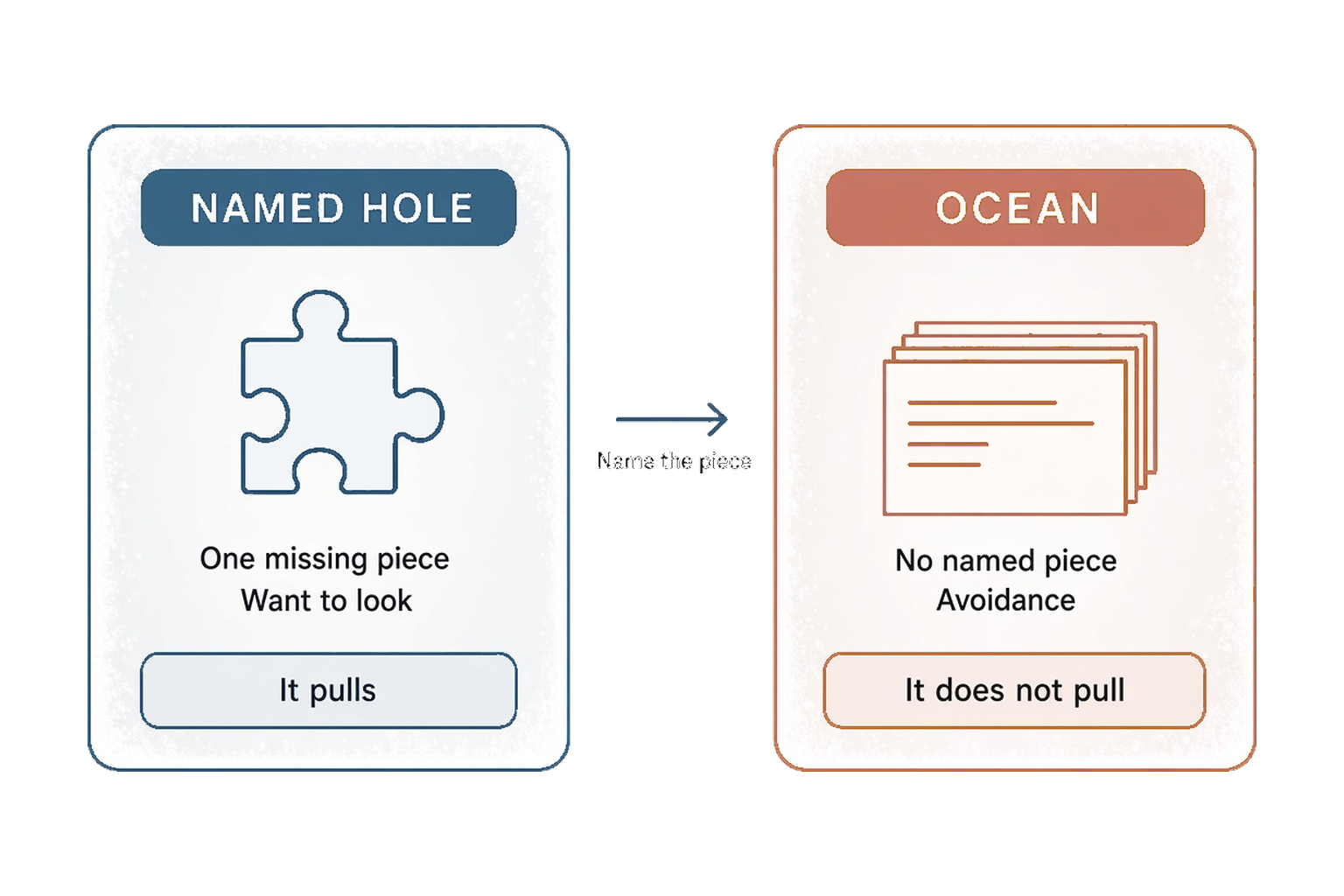
A named hole pulls. An ocean of unnamed topics does not.
Applications
- When you avoid a body of notes, ask whether a single missing piece is named. If not, name one before you add anything.
- When you want someone to return to a record, show one discrepancy they did not already have in mind. Repetition of their own speech will not create the want.
- Pair a gap with a filter. Ten thousand unfiltered lines are an ocean even if one line inside them would have been a hole.
Failure modes
- Collector trap: adding material until no specific hole remains.
- Overclaim trap: treating a curious mood as an information gap, or treating any software summary as a deprivation the theory predicted.
- Test today: write one missing piece in a single sentence. If the sentence is a topic, it is not yet a gap.
Sources
Cite
- Loewenstein, G. (1994). The psychology of curiosity: A review and reinterpretation. Psychological Bulletin, 116(1), 75–98.
- Golman, R., & Loewenstein, G. (2018). Information gaps: A theory of preferences regarding the presence and absence of information. Decision, 5(3), 143–164.