Definition
Social comparison is the evaluation of your opinions and abilities against other people when an objective standard is not at hand. Upward comparison against a figure who shows no gap tends to lower self-evaluation.
Origin
Leon Festinger (1954) proposed that people need to evaluate their opinions and abilities, and that when physical reality does not supply a test they use other people. The drive is toward uniformity with similar others, and the choice of whom to compare with is not random: similarity makes the comparison informative. The paper is a theory, with hypotheses, not a modern randomised trial.
Later experiments showed the hedonic cost is uneven. Lyubomirsky and Ross (1997) found that people lower in happiness reacted more strongly to upward comparison — a peer who had done better — while happier participants were less thrown by the same contrast. Downward comparison was a weaker comfort than upward comparison was a sting.
Esteem Matrix is the self-evaluation that moves. Social performance vs self-authored score is the alternative standard: a score you author, instead of a gapless public figure.
Mechanism
- No objective meter, so a person becomes the meter. A feed of ideal postures, or a page of completed victories with no misses, functions as that person.
- Upward and similar bites. Festinger’s similarity hypothesis says a comparison informs you when the other is close enough to be a real alternative. A distant superhuman can still be used as a meter. The information is worse. The esteem hit can still land.
- A visible gap in the model changes the meter. A figure who shows a miss, a delay, or a weakness is a different comparison target than a figure who only shows the finished rep. The theory does not say that disclosure always raises the observer’s esteem. It says the target of comparison is the input. Change the target and the evaluation changes.
- Chronic style matters. Lyubomirsky and Ross treat comparison as a habit, not a single scroll. One honest example does not rewire a style. It gives the style a different input once.
Epistemic boundary. Festinger (1954) is theoretical. Lyubomirsky and Ross (1997) measured mood in laboratory and survey paradigms, not coaching retention. Do not claim that showing weakness is a proven growth intervention. Claim only that a gapless ideal is a comparison target, and that upward comparison has a hedonic cost that is larger for some people.
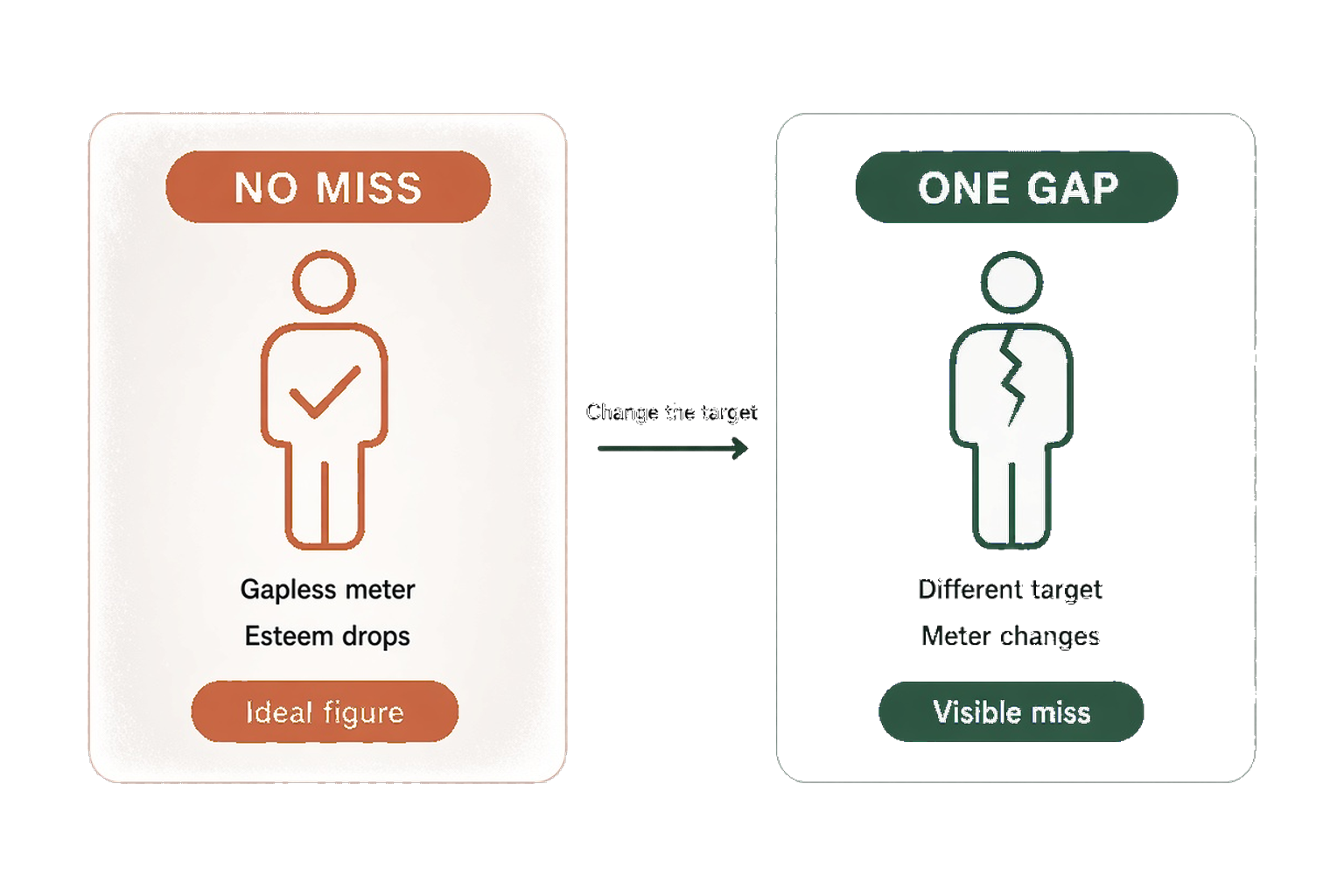
A figure with no miss becomes the meter. A visible gap is a different target.
Applications
- When a standard is only “someone who does it all correctly,” name the missing gap in that picture before you use it as a meter.
- When you publish a finished result, add one visible miss if the reader will otherwise compare against an impossible figure.
- If comparison is chronic, one honest example is an input, not a cure. The style is the loop.
Failure modes
- Collector trap: collecting ideal examples until no ordinary meter remains.
- Overclaim trap: treating self-disclosure as a guaranteed esteem intervention, or treating Festinger as an experiment.
- Test today: one comparison you are running, and whether the other figure has a visible gap.
Sources
Cite
- Festinger, L. (1954). A theory of social comparison processes. Human Relations, 7(2), 117–140.
- Lyubomirsky, S., & Ross, L. (1997). Hedonic consequences of social comparison. Journal of Personality and Social Psychology, 73(6), 1141–1157.