Definition
Serendipity is an unplanned finding that matters because you were already prepared to notice it. The accident is real. The preparation is what makes the accident strategic.
Origin
Horace Walpole coined the word in a 1754 letter, from the Persian tale of the Three Princes of Serendip, who “were always making discoveries, by accidents and sagacity, of things which they were not in quest of.” Robert K. Merton later named a serendipity pattern in empirical research: an unexpected observation that presses theory because the observer can see that it is strategic (Merton, 1948). Information-science work treats serendipity as a real mode of finding, not a romantic leftover — unexpected and yet intelligible after the fact (Foster & Ford, 2003).
Two loci, not one. Archival serendipity is the connection that appears while you move through a prepared body of notes. Interpersonal serendipity is the connection that appears in a live exchange because neither person could have pre-written the turn. Collapsing the second into the first lets an archive pretend it replaces a meeting. Collapsing the first into the second lets a meeting pretend that nothing can be found again tomorrow.
Mechanism
Merton’s pattern needs three conditions. You were looking, or at least oriented. Something arrived that you did not schedule. You were prepared enough to recognise it as more than noise. Without preparation, the accident is trivia. Without the accident, preparation is only a plan.
The dual face is structural. A rich, linked shelf increases the chance of an unplanned connection and, past a point, removes the chance of recognising one. Complexity Trap is the second face: the pleasure of more links becomes the reason nobody enters. simplification is sophistication is not the deletion of the stumble. It is a path on which a prepared person can still be surprised. Personal Growth Engineering is the use: the finding has to become a fitted practice, or it stays a tourist emotion.
Epistemic boundary. Merton (1948) is a theoretical essay on how research feeds theory, not a controlled study of browsing. Foster and Ford (2003) interview information seekers; they do not measure life-design outcomes. Do not treat a pleasant wander as evidence that unstructured time outperforms a prepared question.
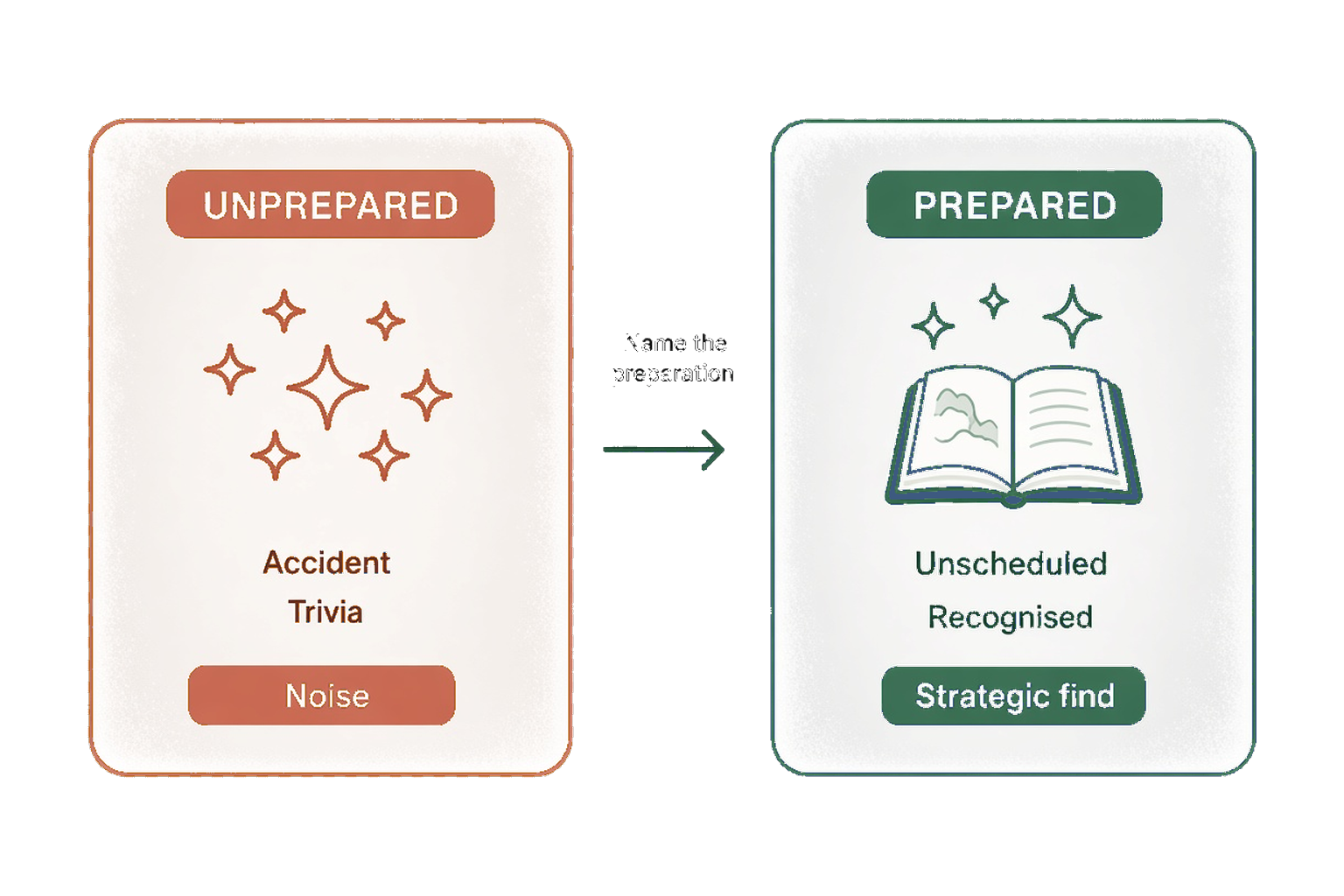
Without preparation the accident is trivia. Preparation makes it strategic.
Applications
- When a connection surprises you, write the preparation that made it visible. The accident without that line will not repeat.
- When you design a shelf for discovery, keep one obvious path. Serendipity that requires heroism to enter does not occur for most readers.
- When a live conversation produces a line the notes did not contain, file it as interpersonal serendipity. Do not pretend the archive already had it.
Failure modes
- Collector trap: adding links until the stumble is guaranteed and recognition is impossible.
- Overclaim trap: calling every coincidence serendipity, or calling a meeting unnecessary because the notes exist.
- Test today: one unplanned connection, plus the one-line preparation that let you see it.
Sources
Cite
- Merton, R. K. (1948). The bearing of empirical research upon the development of social theory. American Sociological Review, 13(5), 505.
- Foster, A., & Ford, N. (2003). Serendipity and information seeking: An empirical study. Journal of Documentation, 59(3), 321–340.