Definition
Excellence hides in the system is the claim that ordinary machinery votes before you do. A day of thought and a sliver of act is not a personality. It is the system you are already inside.
Origin
Bargh and Chartrand (1999) argued that much of daily action starts without a fresh intention you could narrate. The environment cues a response that has run in that place before, and the person meets the result as if it had been chosen. Wood and Neal (2007) set the same fact at the habit–goal line. Habits form as associations between a response and the contexts that have covaried with it. Once learned, the context can fire the response even when the goal you would endorse today would vote otherwise.
This note is the operational reading of that pair. The inverse of excellence hides in the machinery you do not inspect: the open subjects, the desk, the sequence that always continues. Excellence hides in the nuance is a different claim. Nuance is where you keep the reins with a tool, and where you deliberately release them. The system is colder. It decides, and you call the decision a thought.
Mechanism
Evidence level: theoretical — a review of automaticity and a model of habit, not a diary of anyone’s hours.
- A cue fires a response that has lived in that context. The chair, the open list, the tool that is still on. You do not hold a vote at each step. The chain holds it for you.
- The experience of the chain is a thought. Planning that never spends, polishing that spends an hour already won, a block you re-decide every morning after it has already proved itself: each can feel like judgment. The feeling is not evidence that a fresh decision occurred.
- The proportion is the system. A day that is almost all thought and almost no act is a ratio you can count. Changing the slogan without changing the cue leaves the ratio in place. the deterministic day is the opposite arrangement: the path is known, so the result is not still a mystery at dusk. Complexity Trap is what the head does instead — every subject stays open, so none of them becomes the path.
- Excellence and waste use the same hiding place. A validated block that no longer returns to a vote is a system. A loop that spends the effective hour on detail is a system. Efficiency vs Effectivity separates a result you can repeat from a win that costs a life. The system decides which one you get.
Rumination costs is the neighbour, and the boundary matters. That shelf is the price of replaying distress without movement. This one includes planning that never spends. Both can starve the act. Only the second is machinery you can redesign without first calling it a mood.
Epistemic boundary. Bargh and Chartrand wrote a review of automaticity in ordinary life. They did not clock a ratio of thought to act, and they did not show that noticing the cue dissolves it. Wood and Neal offer a model of how habits interface with goals. The model is not a measurement of polishing, of an unmade block, or of a moral failure. Automaticity can carry a block you have already validated as easily as it can carry waste. Do not treat the phrase as a verdict on character. Scite was not in this session; both lines are Crossref-confirmed shelf anchors.
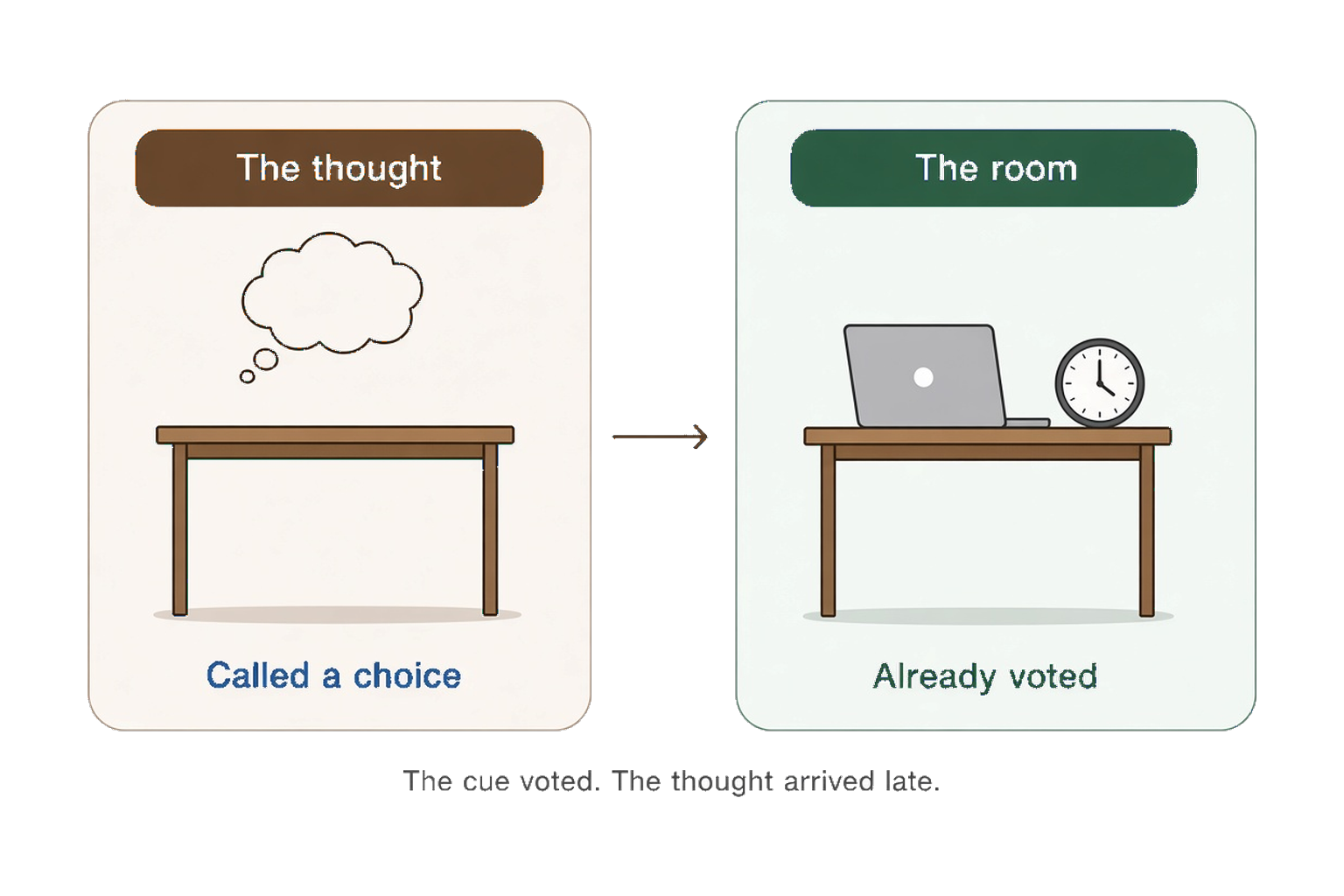
The empty desk still calls itself a choice. The laptop and the clock already voted.
Applications
- Count one day as thought versus act. If the act is a sliver, change the cue that keeps the thought in charge. Do not add a longer list.
- When a block has already proved itself, stop returning it to a vote. The re-decision is the system pretending to be care.
- When the extra minute only polishes, the system is continuation. Remove the means to continue. A decision to be done is what that system renegotiates.
Failure modes
- Collector trap: a new inventory of the machinery, with the same cue still firing tomorrow.
- Overclaim trap: reading a 1999 review, or a 2007 habit model, as proof that your hours were measured.
- Test today: one cue you call a choice. Move it, or turn it off, for one block. Note whether the act appeared without a fresh debate.
Sources
Cite
- Bargh, J. A., & Chartrand, T. L. (1999). The unbearable automaticity of being. American Psychologist, 54(7), 462–479.
- Wood, W., & Neal, D. T. (2007). A new look at habits and the habit-goal interface. Psychological Review, 114(4), 843–863.