Definition
Character armor is a chronic pattern of posture, muscle tension, and attitude that functions as a defense. It binds anxiety and impulse so the person is less available to a feeling they learned not to live.
Origin
Wilhelm Reich, in the character-analytic work first published in 1933 and revised through the 1940s, treated a person’s typical manner — how they resist, hold, and present — as a compact defense, not as a list of isolated symptoms. He argued that this “armor” protects against stimuli from outside and against inner striving, and that anxiety is continually bound in the maintenance of the pattern. A later note in his own revision states the holding as muscular and vegetative, not only as a story the patient tells. Alexander Lowen, developing bioenergetic analysis from that lineage, treated character structure as an organized survival system: tensions coordinate so the person gets the maximum safety they feel they need, rather than a scattered set of tight muscles.
Epistemic boundary. This is a clinical lineage, not a controlled trial and not a imaging result. Reich’s stronger claims — that dissolving armor reliably recovers a specific childhood scene, or that a disease is explained by a holding — are not the claim to teach. The transferable claim is functional. A protection can become chronic enough that the person no longer has to choose it each time. Contact with feeling drops. Risk and sensitivity rise when a layer comes off.
Mechanism
- A feeling is too costly to live. Fear, anger, grief, or excitation meets a prohibition, a danger, or a relationship that cannot hold it.
- The body and the attitude take the same job. A jaw, a breath, a stance, and a social manner bind the feeling so it does not have to be renegotiated.
- The binding lowers the alarm. With the armor in play, anxiety can sit lower because the defense is already on. The person feels less, and calls the numbness “just how I am.”
- The layer is not the same as a decision. A coat you button for one conversation is a choice. Armor is the pattern that stays when you are no longer choosing.
- Removal raises contact and risk. One layer off returns sensation. Many layers off at once can flood. The clinical caution in this lineage is dose.
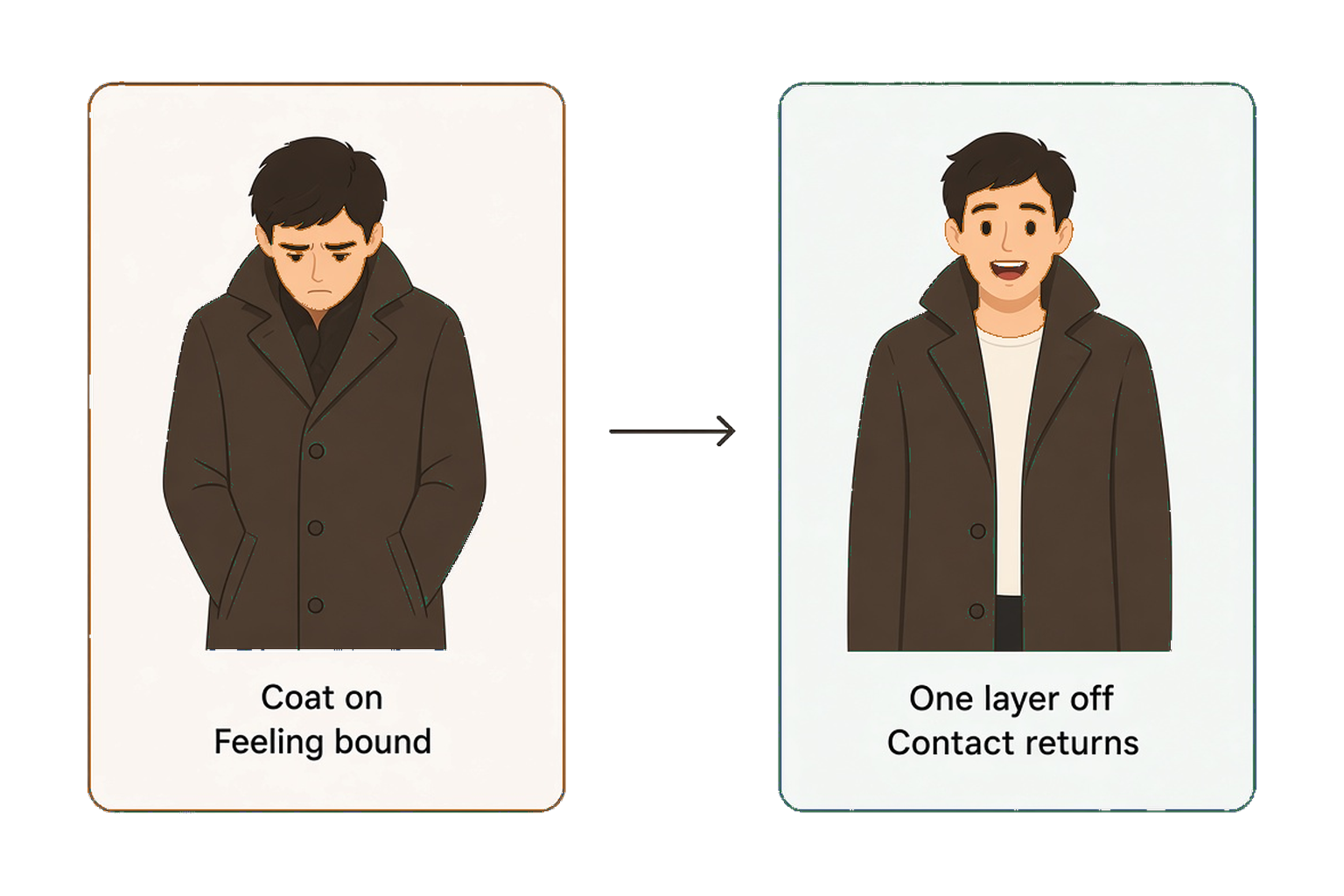
The coat binds the feeling. One layer off returns contact.
Applications
- When a hard sentence is easy to say and impossible to feel, look for the holding that made the sentence cheap.
- Separate a tension you trained on purpose (a lift, a brace, a rest) from a tension that is always on and dulls contact.
- Remove one layer in one conversation. Do not schedule the removal of the whole pattern for a single afternoon.
Failure modes
- Collector trap: reading the lineage instead of staying with one sensation for one breath.
- Overclaim trap: every tight muscle is repressed trauma. Training, injury, illness, and cold are other causes.
- Test today: name one coat that goes on before a difficult sentence, and one sensation you will not explain away.
Sources
Cite
- Reich, W. (1933). Character analysis. Simon & Schuster.
- Lowen, A. (1958). The language of the body. Collier Books.