Definition
Wabi-sabi values imperfection, incompleteness, and change. Kintsugi makes the repair visible — gold in the fracture — instead of pretending the break never happened.
Origin
Japanese tea ceremony and craft traditions treated asymmetry and wear as beauty, not defects. Kintsugi (golden joinery) repairs pottery with lacquer and powdered gold so the break line becomes part of the object’s story.
Mechanism
Hiding a flaw often costs more energy than integrating it: shame drives cover-up; integrated fracture can become honest signal (reliability named in one domain, limits named in another). Pairs with polarity thinking — holding opposites without collapsing to one mask.
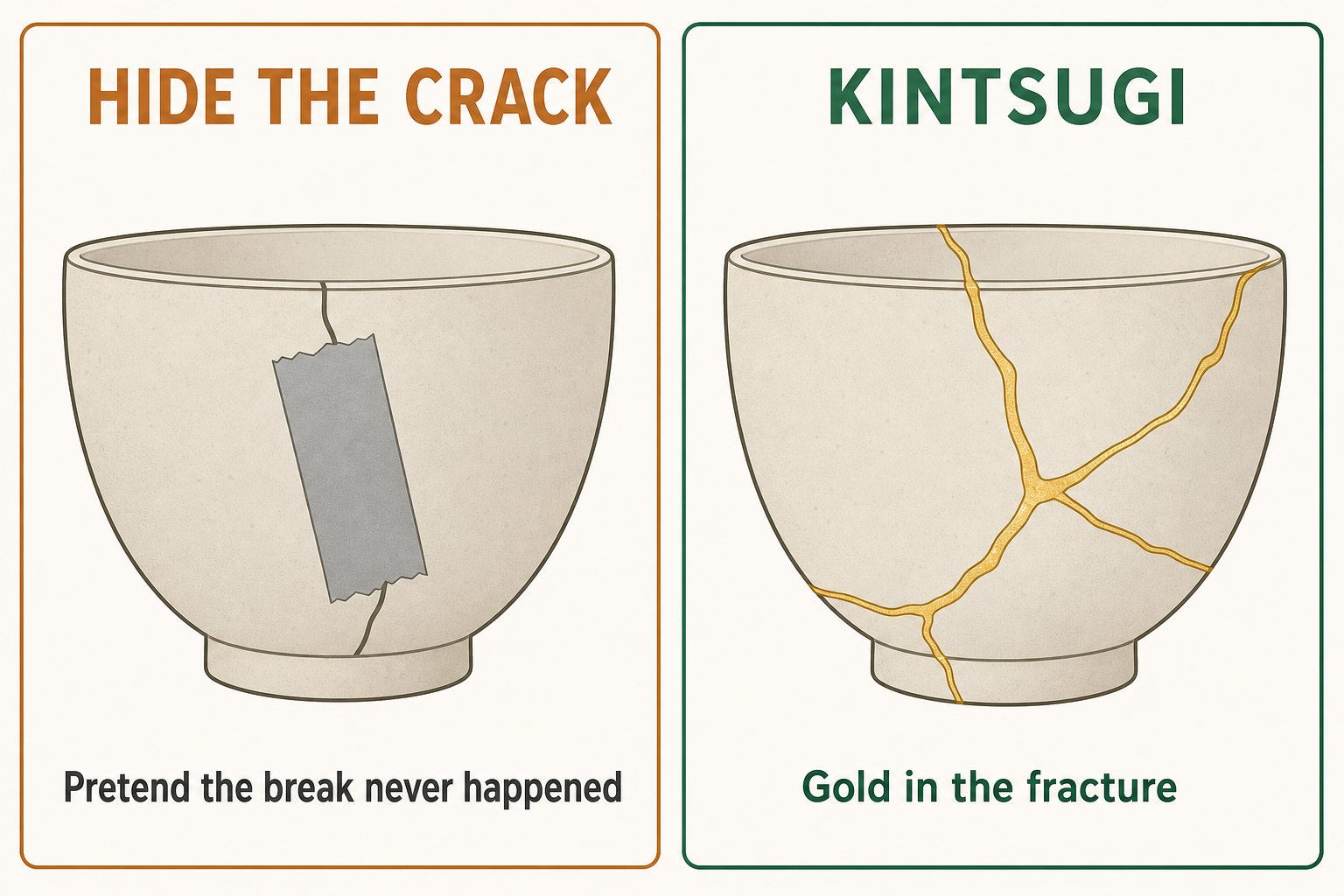
Mechanism diagram — hide the crack (cover-up) versus kintsugi (gold-visible repair). Related doctrine: Master of Opposites.
Applications
Applications
Useful after setbacks, identity gaps, and reliability theatre — turning a judged weakness into a legible commitment rather than performance of perfection.
Sources
Cite
- Koren, L. (1994). Wabi-sabi for artists, designers, poets & philosophers. Stone Bridge Press
- Suzuki, D. T. (1959). Zen and Japanese culture. Princeton University Press