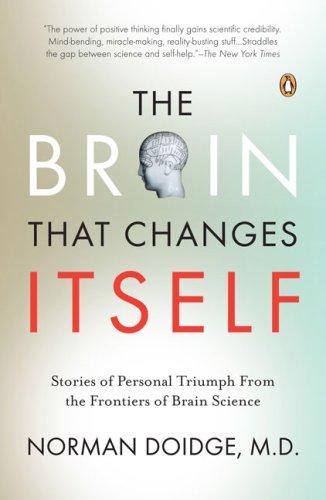
 | Doidge’s thesis: the adult brain remains structurally editable — sustained experience rewires maps and circuits, not only childhood development. Norman Doidge First published 2007 - Reprint (2007) · Penguin Books · ISBN 9780143113102 |
|---|
Key principles
- Neuroplasticity — The brain’s maps, pathways, and even local anatomy can change across the lifespan when experience is repeated and salient enough — the “hardwired adult brain” model is obsolete.
- Use it or lose it — Circuits you exercise grow stronger; idle networks get pruned or repurposed — neglect is a form of rewiring, not neutral maintenance.
- Competitive plasticity — Neighbouring brain real estate is contested; when one function drops (vision, movement, an old habit), another can colonise that territory unless you actively train the target skill.
- Experience drives structure — Intensive practice — physical or mental — can enlarge cortical representation of a skill; repetition is biological infrastructure, not motivational wallpaper.
- Remapping after injury — Constraint, sensory substitution, and graded challenge can reroute function around damage — recovery is often retraining maps, not waiting for tissue to regenerate.
- Plasticity has limits — Change is real but not magical: age, injury, sleep, stress, and dose of practice set the ceiling — structured reps within biology, not wishful thinking.
Core science
Doidge synthesises clinical and research cases for experience-dependent plasticity: sensory loss and gain, motor rehabilitation after stroke, learning disorders, and psychotherapy outcomes framed as physical changes in neural circuitry. The through-line is Hebbian learning — correlated activity strengthens synaptic links — scaled to months of directed intervention rather than single insights. The cases above instantiate the principles of use/lose, competitive remapping, and experience-driven structure.
Application
Reach for this volume when you doubt that logged repetition can change capacity — after stroke or injury, when an old habit feels “fixed,” or when you are debating identity before counting reps. It supports environment design and daily dose, not one-off insight or affirmation alone. Open Behavioral change canon on the Atlas shelf for the mechanism map. Curated domain trail: Deliberate Practice.