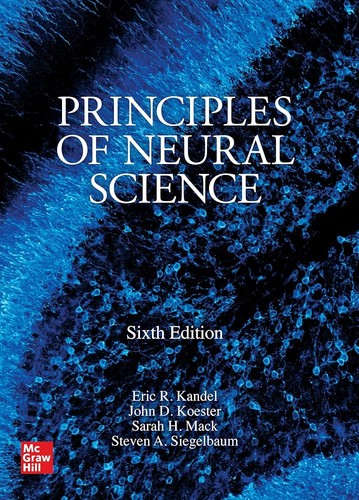
 | The reference spine for how sensation, integration, and motor output share one anatomical stack — synaptic transmission, autonomic divisions, and plasticity at textbook depth. Kandel, Schwartz, Jessell, Siegelbaum, Hudspeth, & Mack (Eds.) First published 1981 - Updated (2021) · McGraw Hill · ISBN 9781259642234 |
|---|
Key principles
- One integrated stack — Central and peripheral nervous systems, somatic and autonomic branches, and endocrine interfaces are coupled layers on shared hardware — not separate “mind” and “body” realms.
- Synapse as unit of change — Ion channels, neurotransmitters, and plasticity at junctions underpin every Atlas note on body chemistry and learning.
- Autonomic modules — Brainstem and hypothalamic circuits explain mobilization, recovery, and visceral readout — the anatomy behind Polyvagal Tone without pop labels.
- Indexed reference — Reach for chapter-level anatomy when Atlas notes need precision — narrative coaching reads stay on lighter shelf volumes.
Core science
Sixth-edition integrative neuroscience text: cellular biophysics through systems anatomy, sensory transduction, motor control, and cognitive neuroscience. Used here as bibliographic anchor for nervous-system mechanism — not a front-to-back member assignment.
Application
Operator and advanced readers reach for indexed chapters (autonomic nervous system, chemical synapses, sensory systems) when an Atlas note needs anatomical precision. For narrative coaching reads, prefer Behave, The Polyvagal Theory, and Autonomous Intelligence of the Body. Open Nervous system on the Atlas shelf for the mechanism map.