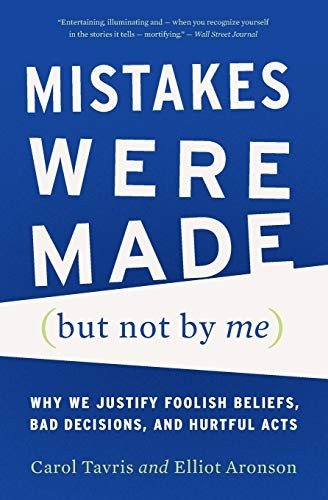
 | Tavris and Aronson map self-justification — the mind’s repair shop after a choice collides with self-image. Memory rewrites, blame shifts, and pyramid commitments follow — not because people are stupid, but because coherence feels like survival. Tavris, C., & Aronson, E. First published 2007 - Updated (2015) · Mariner Books · ISBN 9780544574786 |
|---|
Key principles
- Self-justification drive — The goal is not truth first — it is a bearable self-story after the act — rationalization is emotional repair, not logic sport.
- Dissonance reduction — Behaviour and belief in tension — the mind changes memory, blame, or values to close the gap.
- Blind spot versus lie — Most self-deception is unconscious coherence work — not a deliberate con — which is why argument alone rarely lands.
- Memory revision — Recollection shifts to make the narrator less responsible — the past edits to match the present story.
- Pyramid of commitment — Small early yeses escalate — each step makes reversal more costly than the next justification.
- Passive-voice responsibility — Mistakes were made — agency dissolves in grammar before it dissolves in character — name who chose.
Core science
Tavris and Aronson popularize cognitive-dissonance and self-justification research (Festinger onward) for couples, politics, therapy, and everyday regret — clinical and social psychology, not sales craft. It pairs with identity coherence when the bruise is which self was allowed in the room and with the Festinger volume when you need the original dissonance architecture — not a second moral lecture.
Application
Reach for this volume after a regretted yes — yours or a partner’s — when the story hardens instead of updating: blame spray, rewritten memory, or new evidence that magically supports the old choice. Open Self-lying on the Atlas shelf when the repair story protects engagement identity more than declared priority.