Definition
A blind spot is structure you cannot see from inside the frame; a lie is a story you could correct if willing.
People reliably spot bias in others while underestimating the same patterns in themselves — visibility limits and willful deception require different coaching moves.
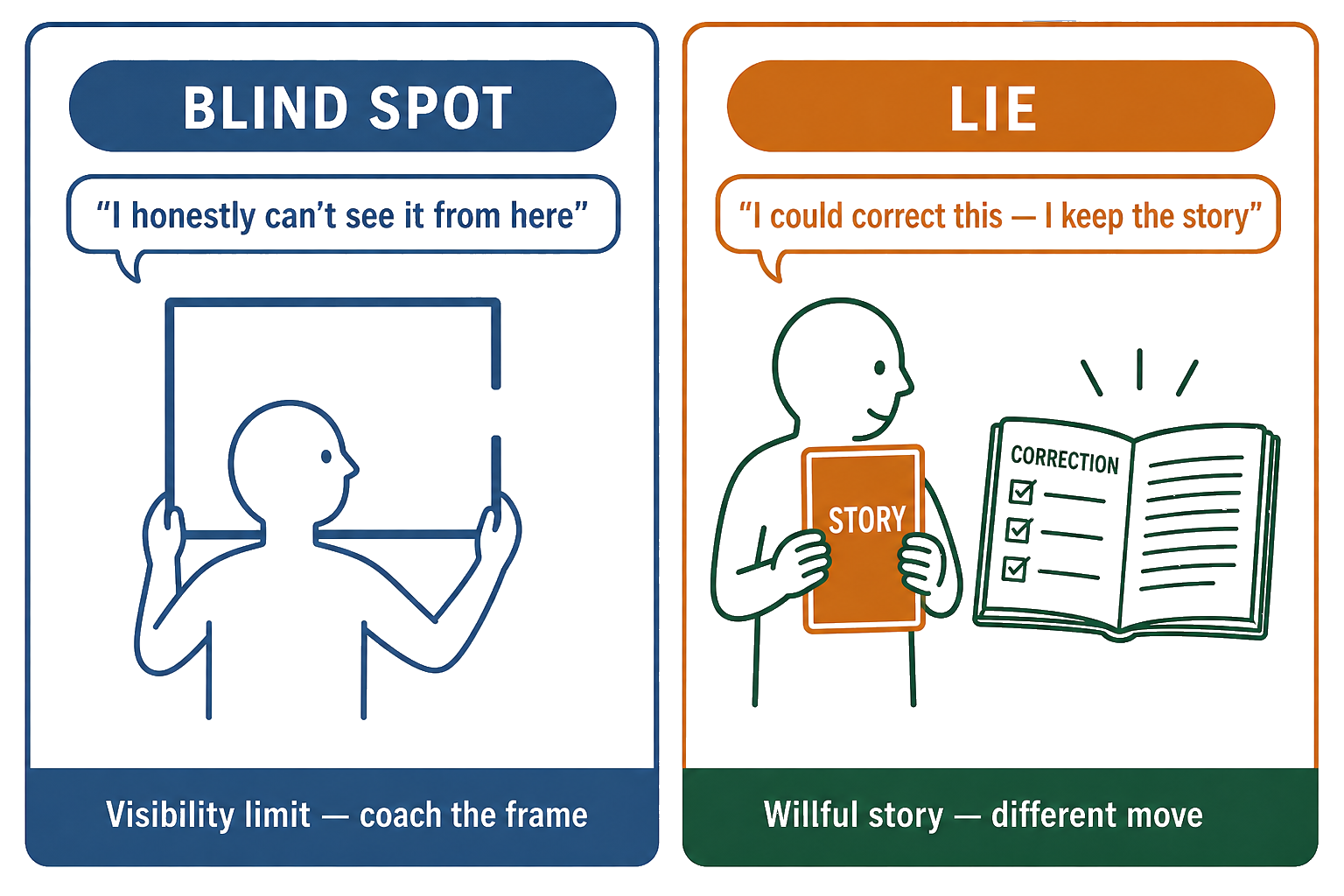
Blind spot versus lie — coach the frame or name the willful story. Pair Self-justification drive.
Mechanism
| Pattern | Coaching read |
|---|---|
| Blind spot | Structure you cannot see from inside the frame — train visibility, not accusation |
| Lie | Story the person could correct if willing — name payoff and cost of the story |
The bias blind spot literature shows asymmetric insight: others’ errors look obvious; your own look like realism until the frame shifts.
Applications
In coaching, accuse neither too fast — ask whether the gap is visibility (skill, script, affect) or will (payoff to keep the story).
Sources
Cite
- Pronin, E., & Kugler, M. B. (2007). Valuing thoughts, ignoring behavior: The…. Journal of Experimental Social Psychology, 43(4), 565–578
- Tavris, C., & Aronson, E. (2007). Mistakes were made (but not by me). Harcourt