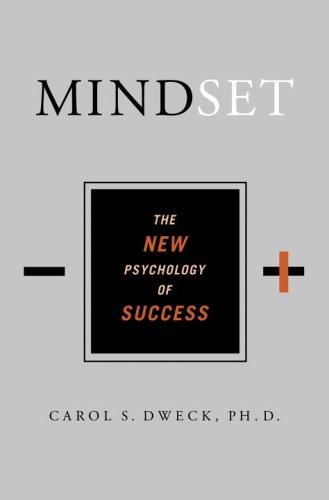
 | Dweck names the belief layer under performance: fixed mindset treats ability as a verdict — growth mindset treats ability as trainable. The lever is not positive thinking; it is whether difficulty exposes a ceiling or invites a rep. Dweck First published 2006 - Reprint (2007) · Ballantine Books · ISBN 9780345472328 |
|---|
Key principles
- Fixed-versus-growth frame — Beliefs about whether traits can change predict how people interpret setback — same event, different story about self.
- Learning-versus-performance goals — Growth aims at mastery; fixed aims at looking smart — challenge becomes threat when the scoreboard is identity.
- Effort paradox — In a fixed frame, effort signals inadequacy; in a growth frame, effort is the path — rep quality starts with which frame is running.
- Process-not-trait praise — Praising ability reinforces brittle entity theory; praising strategy, focus, and persistence reinforces incremental theory — feedback is intervention.
- Challenge uptake — Growth beliefs increase willingness to attempt hard tasks — difficulty reads as training data, not exposure of permanent limits.
- Mindset as lens — Mindset is not a mood hack; it is the implicit theory that filters every Battle rep — swap the lens before swapping the tactic.
Core science
Dweck’s 2006 volume popularizes implicit theories of intelligence — entity (fixed) versus incremental (growth) — for parents, educators, leaders, and athletes. It is accessible synthesis built on decades of lab and field work (the empirical spine lives in Self-Theories). Pair with the Player stance on the Atlas shelf when coaching needs bounded reps, fast feedback, and seasons — not homework energy under failure.
Application
Reach for this volume when someone quits, hides, or performs small after one bruising round — when failure reads as verdict instead of data. Open Player when the next move is bounded reps and scorekeeping, not another identity debate.