Working definition
An impulsivity matrix is your personal grid — trigger, urge, action, cost — filled often enough that your reticular filter starts showing the gorilla you missed.
How it works
Impulsivity derails frame when the block was set but the next shiny object wins. The matrix is not diagnosis — it is lead data. Pair with hourly pings so observation density rises before you rewrite the Battle. One week of rows beats a perfect plan with zero logs.
Signature
Gorilla-video principle: you cannot steer what you never counted.
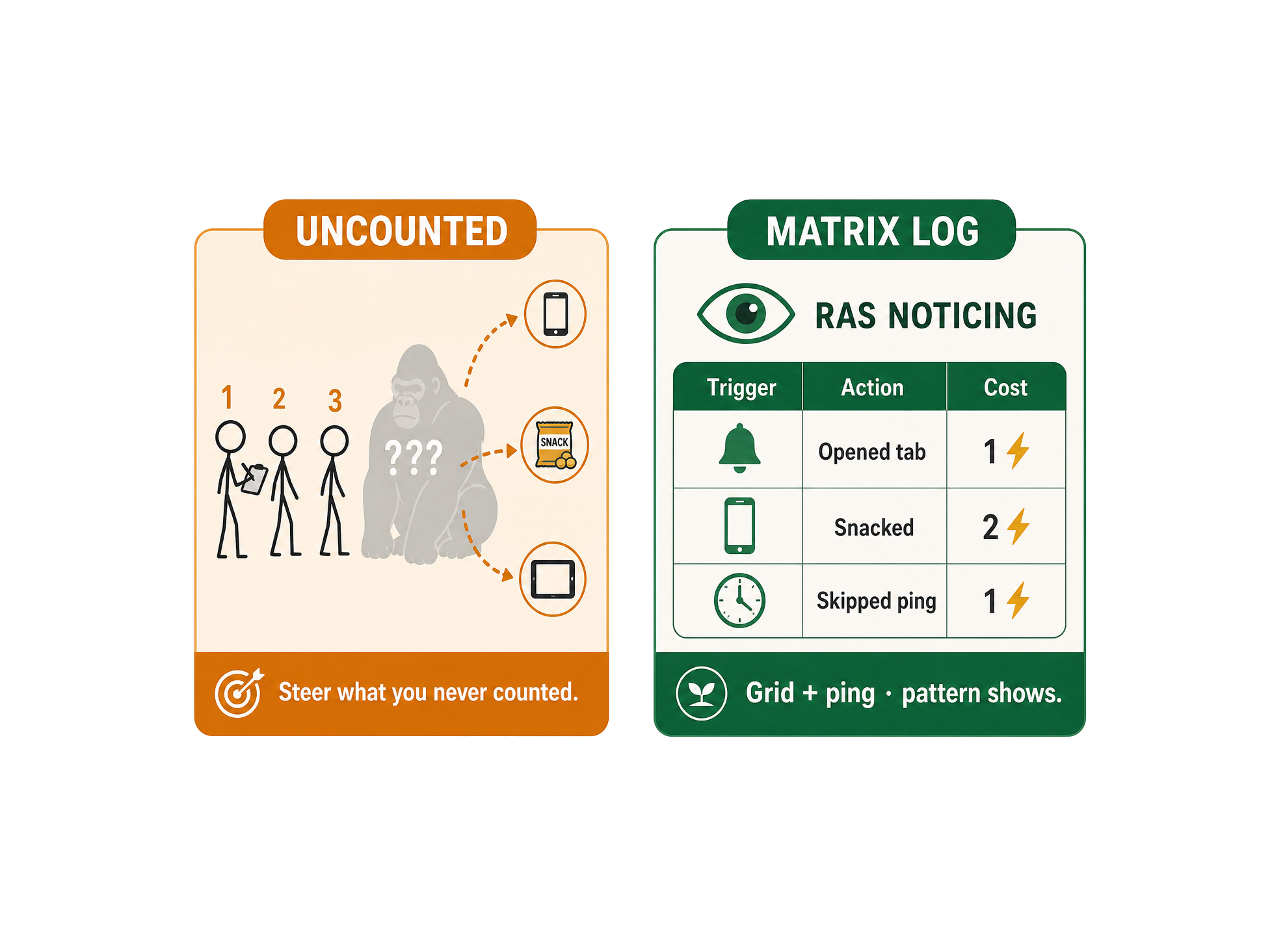
Uncounted derail versus matrix log — the gorilla stays invisible until trigger · action · cost rows repeat. Your move: Your move this week.
Your move this week
Draft a 3-column grid (trigger · what you did · cost/next time) and fill it once per day for seven days before changing the Battle wording.
Scientific grounding
Cite
- Tomko, R. L., Solhan, M. B., Carpenter, R. W., & Brown, W. C. (2014). Measuring impulsivity in daily life: The Momentary Impulsivity Scale. Psychological Assessment, 26(2), 339–349.
- Clift, J. B., & Veilleux, J. C. (2024). The dynamics of emotion-related impulsivity via ecological momentary assessment. Journal of Psychopathology and Clinical Science, 133(7), 541–553.
Ecological momentary assessment captures within-person impulsivity swings that retrospective questionnaires miss — repeated logs are the method, not the metaphor.
Adjacent
Feedback density · Reticular Activating System · Battle Of the Week