Definition
The whirlwind is the constant churn of urgent day-to-day work required just to keep things running; whirlwind recognition is the act of seeing it clearly so it does not silently consume the energy reserved for what matters most.
Origin
A core image from Discipline 1 of The 4 Disciplines of Execution — “focus on the wildly important.” The authors observe that the enemy of execution is rarely a bad plan; it is the whirlwind — the urgent operational demands that always feel more pressing than the important goal.
Mechanism
The whirlwind always wins by default because it is loud, immediate, and necessary. The first discipline of execution is therefore perceptual: to recognise the whirlwind as distinct from progress.
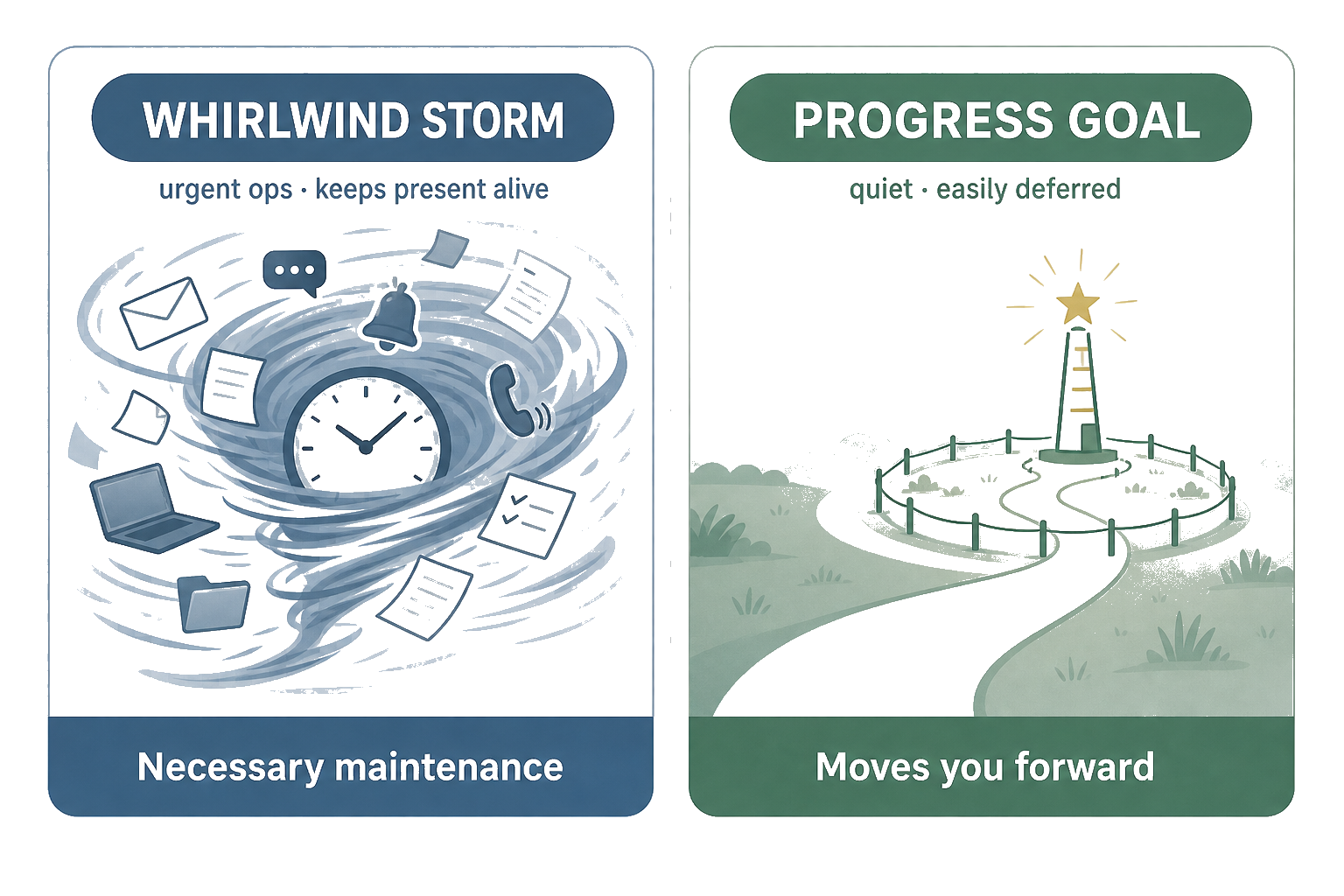
Name the storm — urgent ops keep the present alive; progress stays quiet. Pair Wildly important goal · Signal vs Noise. Urgent maintenance keeps the present alive but does not move you forward; the wildly important goal moves you forward but is quiet and easily deferred. Naming the two separately is what lets you ring-fence a protected slice of attention and energy for the goal instead of letting it be absorbed, day after day, into the storm.
Applications
- Labelling routine urgent work as “whirlwind” so it stops masquerading as achievement.
- Protecting a fixed block of time and energy for the important goal before the whirlwind claims the day.
- Diagnosing why a goal never advances despite constant busyness.
Sources
Cite
- McChesney, C., Covey, S., & Huling, J. (2012). The 4 disciplines of execution. Free Press.