Definition
The spotlight effect is the tendency to believe others are watching and evaluating us more than they actually are.
Origin
The term was formalized in social-psychology experiments by Thomas Gilovich and collaborators, showing that participants consistently overestimate how visible their behavior and discomfort are to others.
Mechanism
Attention is anchored to one’s own internal state (embarrassment, effort, anxiety), then projected outward as if it were equally salient to everyone else. Because personal salience is high, perceived social salience is inflated.
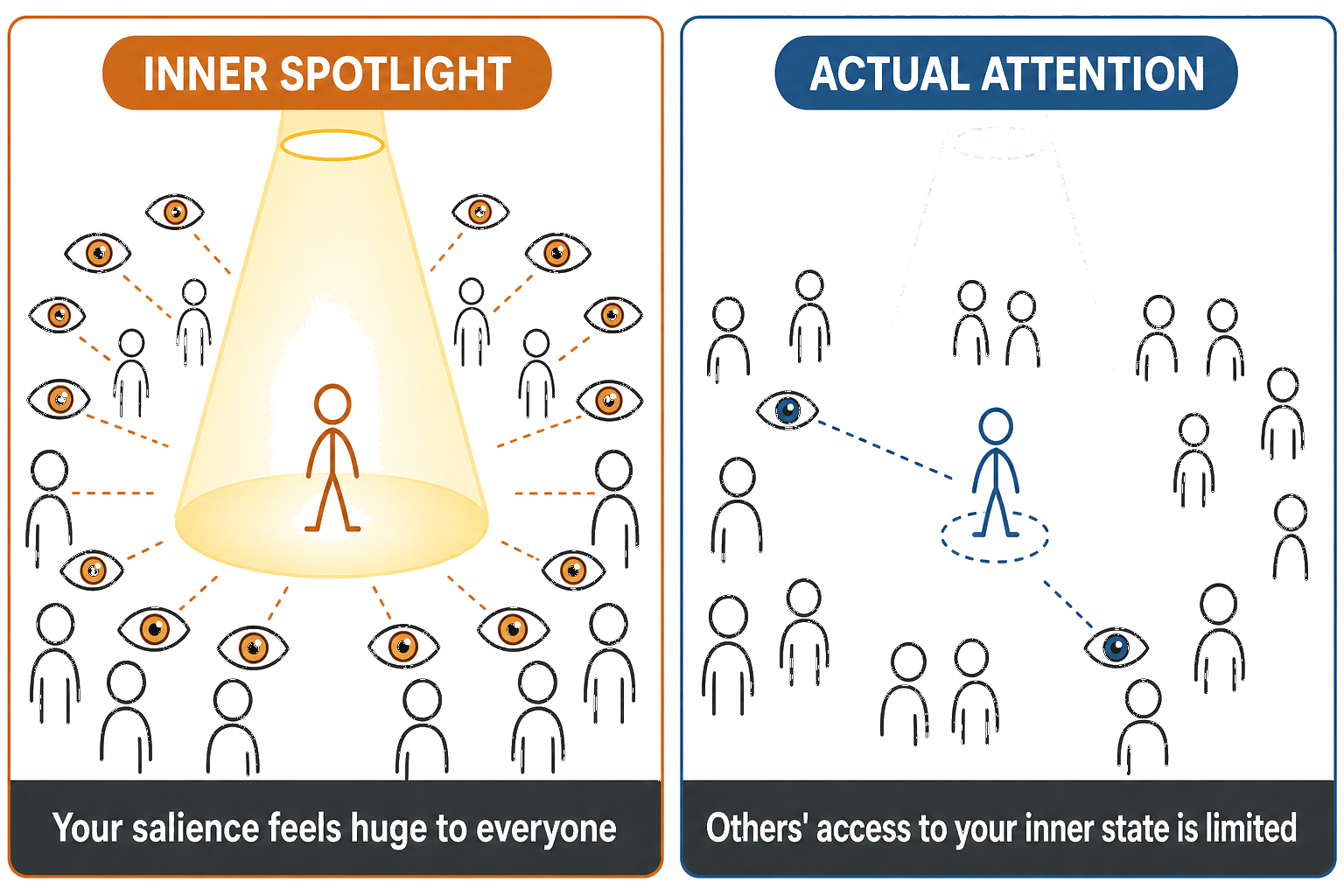
Inner spotlight inflates salience — actual attention from others is far smaller. Test behaviour under scrutiny rather than assume extreme audience focus.
Gilovich et al. documented the bias in controlled social-judgment paradigms (memorable T-shirts, group discussions) with an anchoring-and-adjustment account — people anchor on vivid self-consciousness and under-adjust for others’ limited access to that inner state. The sibling illusion of transparency (Savitsky & Gilovich, 2003) shows the same egocentric gap for nervous internal cues. Magnitude and generalization vary by context; the operational move is still to test behaviour under perceived scrutiny rather than assume extreme audience attention.
Applications
Useful for exposure training, public speaking, language practice, and assertiveness work: acting under “everyone is watching” pressure often reveals that real external attention is much lower than predicted.
Sources
Cite
- Gilovich, T., Medvec, V. H., & Savitsky, K. (2000). The spotlight effect in social judgment: An…. Journal of Personality and Social Psychology, 78(2), 211–222
- Gilovich, T., & Savitsky, K. (2003). The illusion of transparency and the alleviation of…. Journal of Experimental Social Psychology, 39(6), 618–625