Definition
Self-responsibility is the practice of taking ownership of one’s choices, actions, and well-being — accepting authorship of one’s life rather than assigning the cause to others or to circumstance.
Origin
The third of Branden’s six pillars of self-esteem. It maps onto decades of research on locus of control (Julian Rotter): people with an internal locus — who attribute outcomes to their own actions — show greater initiative, persistence, and well-being than those who attribute outcomes mainly to luck or external forces.
Mechanism
Responsibility is literally response-ability — the capacity to choose a response.
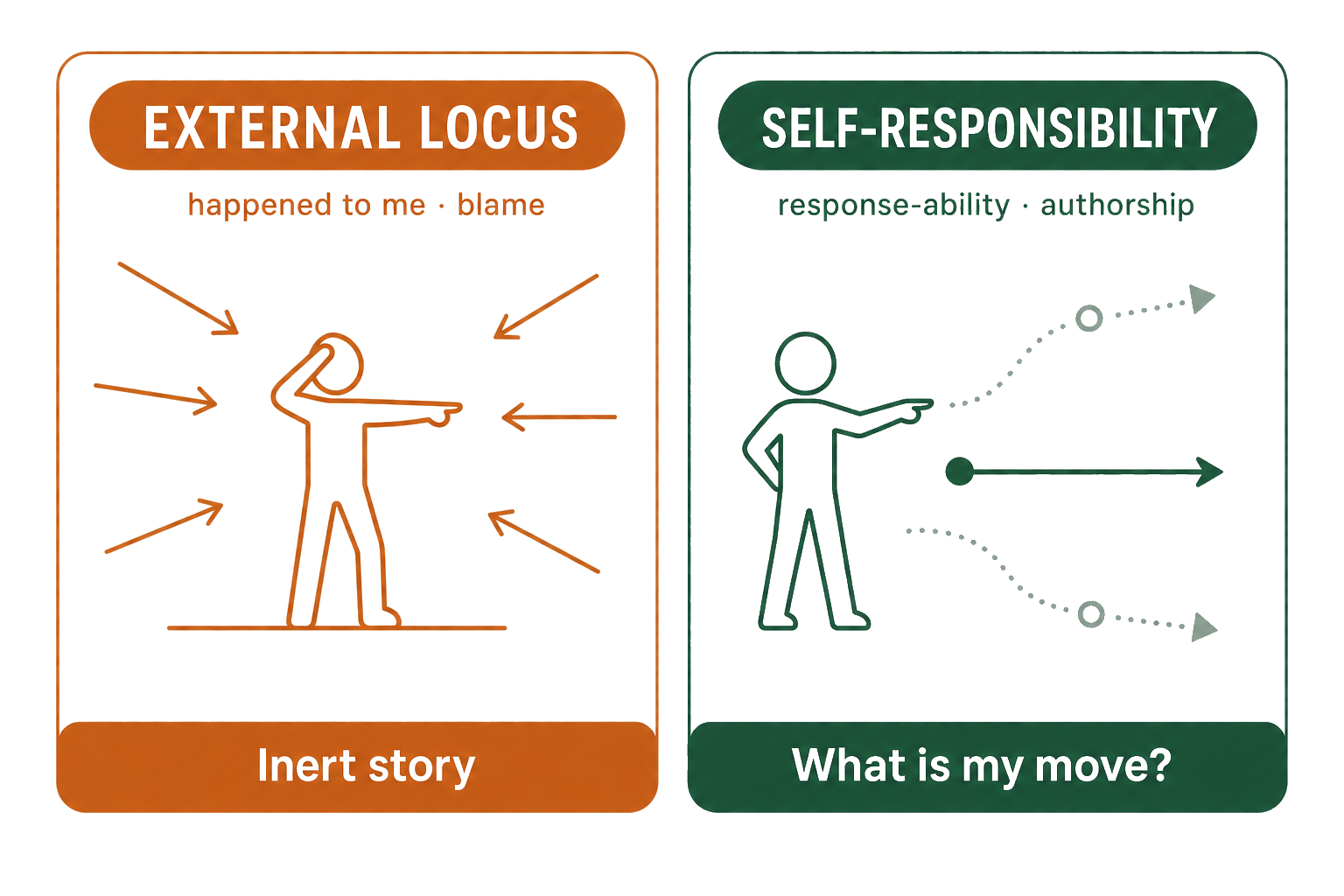
External blame versus authorship — leverage lives in your next move. Pair Life Is the System · Self-esteem.
Owning authorship does not deny that external events happen; it relocates the leverage to the one variable you control: your reaction and your next action. The shift from “this happened to me” to “what will I do about it” converts blame (which is inert) into agency (which moves). Branden ties this directly to self-esteem: you cannot respect a self you experience as helpless.
Applications
- Replacing blame narratives with “what is my move here?”
- Owning the parts of a problem you can act on instead of waiting for conditions to change.
- The stance underneath any system you build for your own life.
Sources
Cite
- Branden, N. (1994). The six pillars of self-esteem. Bantam.
- Rotter, J. B. (1966). Generalized expectancies for internal versus external control of reinforcement. Psychological Monographs, 80(1), 1–28.