Definition
The love-and-addiction split is the observation that early romantic passion and substance addiction run on the same dopamine-driven pursuit system, while lasting bonds and real enjoyment depend on a different, present-moment chemistry.
Origin
Drawn from The Molecule of More (Lieberman & Long), built on the wanting-versus-liking distinction (Berridge). It names a specific application of that split: the chemistry of seeking versus the chemistry of having, applied to relationships and compulsion.
Mechanism
Early infatuation is dopaminergic — future-oriented, novelty-seeking, craving the not-yet-possessed; it feels overwhelming precisely because it is the anticipation system at full power.
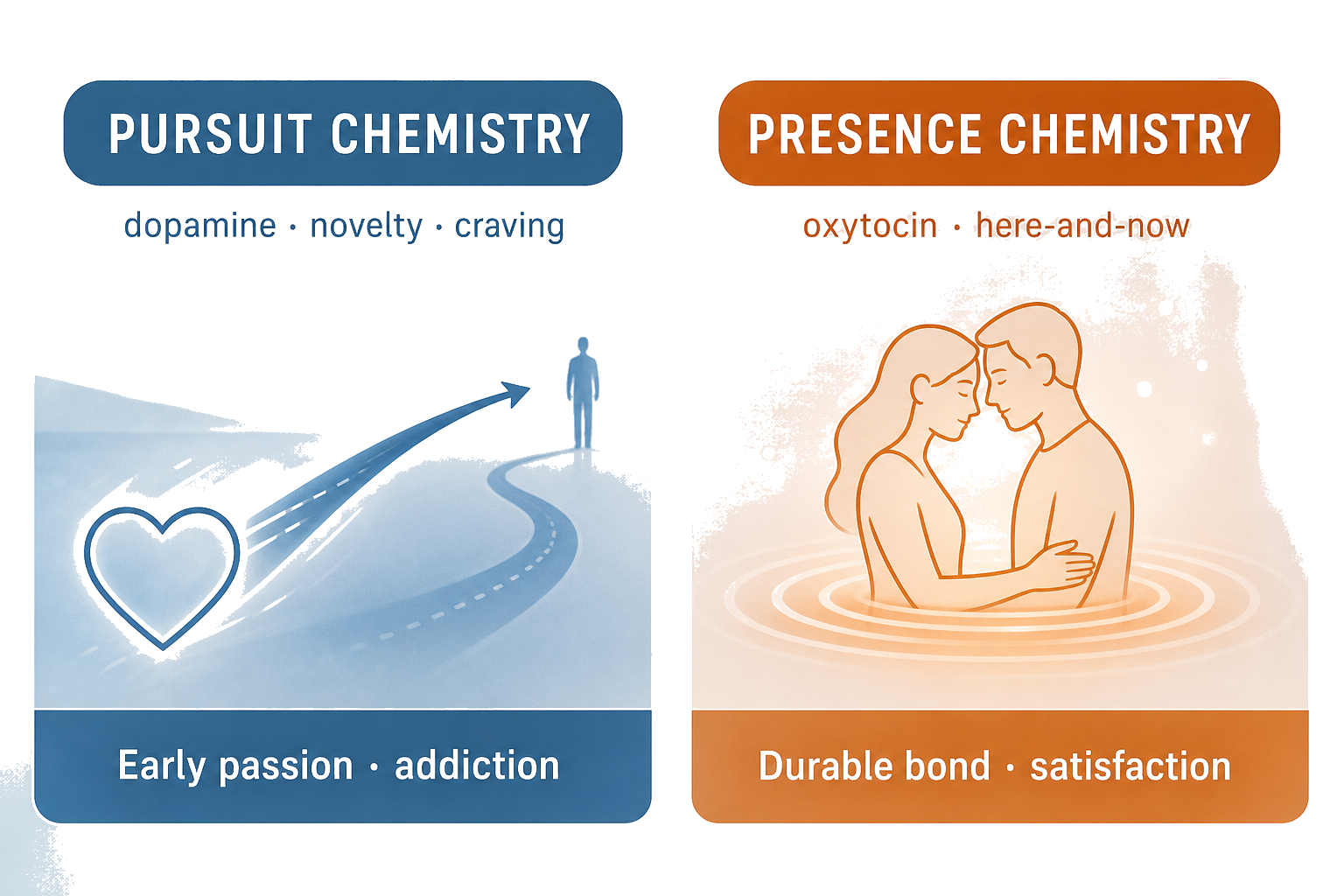
Pursuit chemistry versus presence chemistry — passion, addiction, durable bond. Pair Wanting versus liking · Desire ≠ enjoyment.
As a bond matures, the relationship must transition to here-and-now chemistry (oxytocin, endorphins) to endure, or it fades when the novelty does. Addiction is the same dopaminergic wanting amplified and decoupled from liking: the pursuit continues, and even intensifies, while the pleasure flattens. Reading which system is running tells you whether you are in pursuit or in presence — and whether what feels like love or need is actually craving.
Applications
- Not mistaking the dopaminergic rush of early attraction for the substance of a durable bond.
- Recognising the addiction signature: escalating pursuit alongside falling enjoyment.
- Deliberately building present-moment chemistry into long relationships rather than chasing novelty.
Sources
Cite
- Lieberman, D. Z., & Long, M. E. (2018). The molecule of more. BenBella Books.
- Berridge, K. C., Robinson, T. E., & Aldridge, J. W. (2009). Dissecting components of reward: ‘Liking’, ‘wanting’, and learning. Current Opinion in Pharmacology, 9(1), 65–73.