Definition
Desire and enjoyment are produced by separate systems: the dopaminergic drive that makes you want something is not the chemistry that lets you enjoy it — so intensity of craving predicts pursuit, not satisfaction.
Origin
A direct corollary of the wanting-versus-liking research (Kent Berridge) popularised in The Molecule of More (Lieberman & Long): dopamine is the molecule of anticipation and pursuit, not of present pleasure. This note isolates the single practical takeaway — how much you want a thing tells you little about how much you will enjoy it.
Mechanism
Dopamine fires for the prediction of reward, peaking before you obtain it; the pleasure of consumption is carried by here-and-now chemistry (opioids, endorphins, oxytocin).
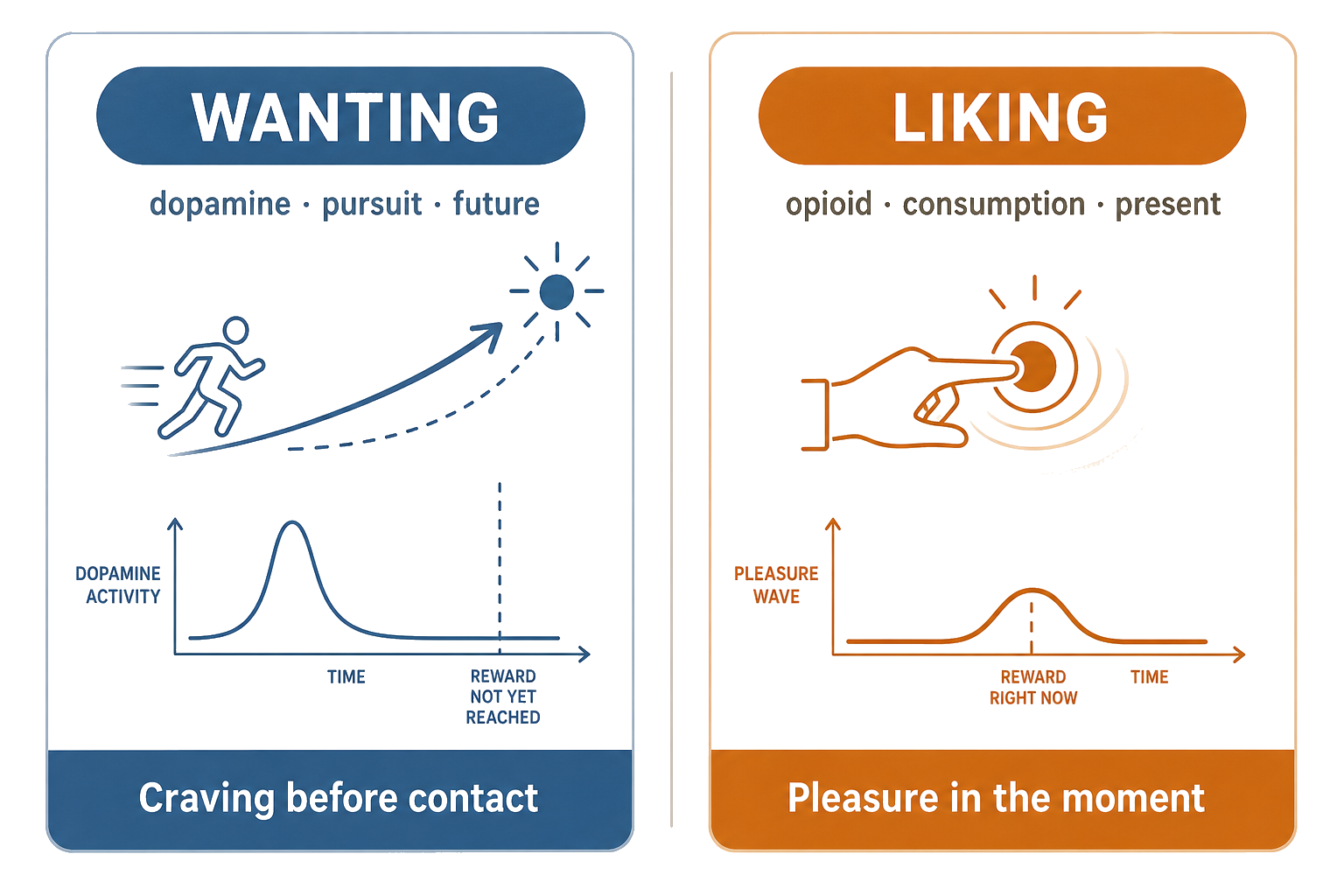
Same split as Wanting versus liking — craving intensity does not predict enjoyment. Pair The Molecule of More.
Because the two are decoupled, a strong desire can be followed by a flat experience — the well-known anticlimax of finally getting the thing. Calibrating to desire alone therefore systematically overshoots: you chase what the pursuit-system inflates, then meet a quieter reality.
Applications
- Pausing on a craving to ask will I actually enjoy this, or do I just want it? before acting.
- Explaining post-purchase, post-achievement, and post-acquisition flatness without treating it as failure.
- Designing for present-moment reward instead of chasing the next anticipation spike.
Sources
Cite
- Berridge, K. C., & Robinson, T. E. (1998). What is the role of dopamine in reward: Hedonic impact, reward learning, or incentive salience?. Brain Research Reviews, 28(3), 309–369.
- Lieberman, D. Z., & Long, M. E. (2018). The molecule of more. BenBella Books.