Definition
Relational presence is the depth of attunement to another person in a live exchange. It is gradable: from a surface transaction that registers only words, to a full presence that senses what the other emits beneath them.
Origin
The idea sits at the meeting point of several traditions. Martin Buber distinguished the I–It of using from the I–Thou of meeting. Carl Rogers placed presence and accurate empathic attunement at the centre of helping relationships. Otto Scharmer’s Theory U formalises levels of listening — downloading, factual, empathic, and generative — each reaching deeper than the last.
Mechanism
Presence has gradations, and depth changes what information is available.
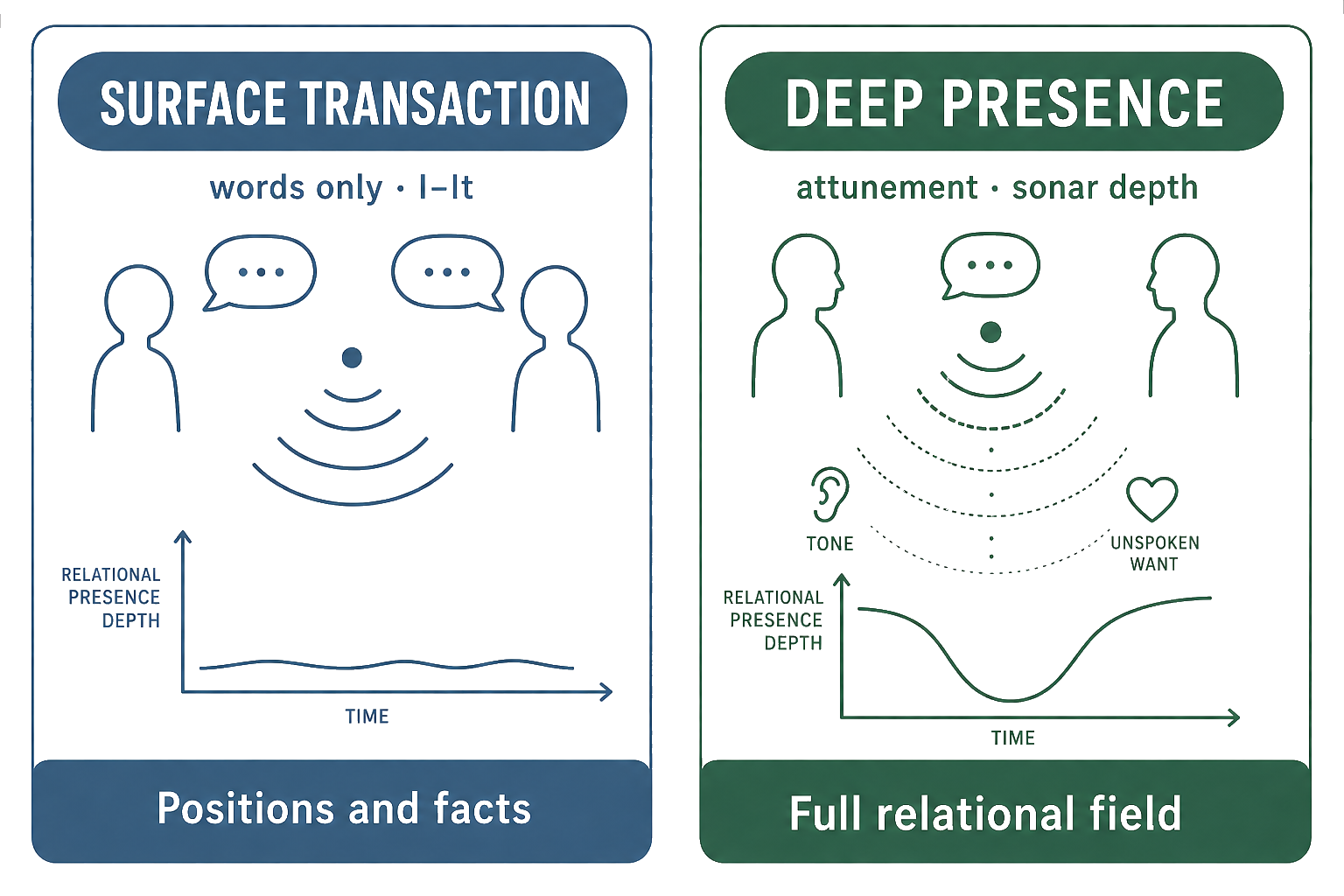
Surface transaction versus deep attunement — sonar depth returns more of the field. Pair Intention Behind the Move · Being vs doing.
At shallow levels you hear positions and facts; at deeper levels you register tone, body, the unspoken want — the “sonar” image: the deeper the ping, the more of the other’s field returns to you. Depth is partly a choice and partly a trained capacity; reactivity, self-defence, and the urge to be right all pull presence back toward the surface.
Applications
Coaching and listening practice; reading a room before acting; noticing when a defence reflex has collapsed your presence to transaction; deliberately deepening one level in a hard conversation before responding.
Sources
Cite
- Buber, M. (1970). I and thou (W. Kaufmann, Trans.). Scribner. (Original work published 1923)
- Rogers, C. R. (1957). The necessary and sufficient conditions of…. Journal of Consulting Psychology, 21(2), 95–103
- Scharmer, C. O. (2009). Theory U: Leading from the future as it emerges. Berrett-Koehler.