Definition
Hedonic adaptation is the process by which the emotional impact of a repeated or ongoing condition fades. The peak becomes ordinary. A stronger or newer input is then required to recapture attention.
Origin
Brickman and Campbell (1971) named the hedonic treadmill: after good or bad events, people tend to drift back toward a prior level of happiness, so gains stop feeling like gains. The 1978 lottery-and-accident study is the empirical contrast: a peak can leave ordinary pleasures flatter, which is a different claim from the 1971 name. Frederick and Loewenstein (1999) reviewed adaptation as a general feature of well-being, faster for some conditions than for others. Diener, Lucas, and Scollon (2006) revise the strong form. Set points are not a neutral zero, they differ by temperament, pleasant affect and life satisfaction can move separately, some set points can change, and people adapt at different speeds.
Dopamine baseline is the line of stimulation a nervous system treats as normal. Hedonic adaptation is the fading of one repeated good against that line. They travel together. They are not the same object. A raised baseline says how large a hit must be. Adaptation says why yesterday’s hit, repeated, stops recruiting you.
Mechanism
- Novelty pays. A new place, practice, or recognition answers a need for variety and captures attention.
- Repetition fades the pay. The same input, once predicted, moves well-being less. Boredom is the subjective face of that fade.
- The ordinary resets. What used to be a peak becomes the background. Attention asks for more, or for a different cue.
- The fade is protective and costly. It stops one peak from owning you forever. It also empties the return to a practice you meant to keep.
- People and domains differ. Adaptation is not a single clock. A condition can fade in one domain of well-being and hold in another.
Epistemic boundary. The literature is about well-being after life events and repeated conditions, not a prescription for which rooms you should keep attending. The transferable claim is the fade: repetition changes the impact. Whether you design a new use, or simply chase a larger hit, is a separate decision.
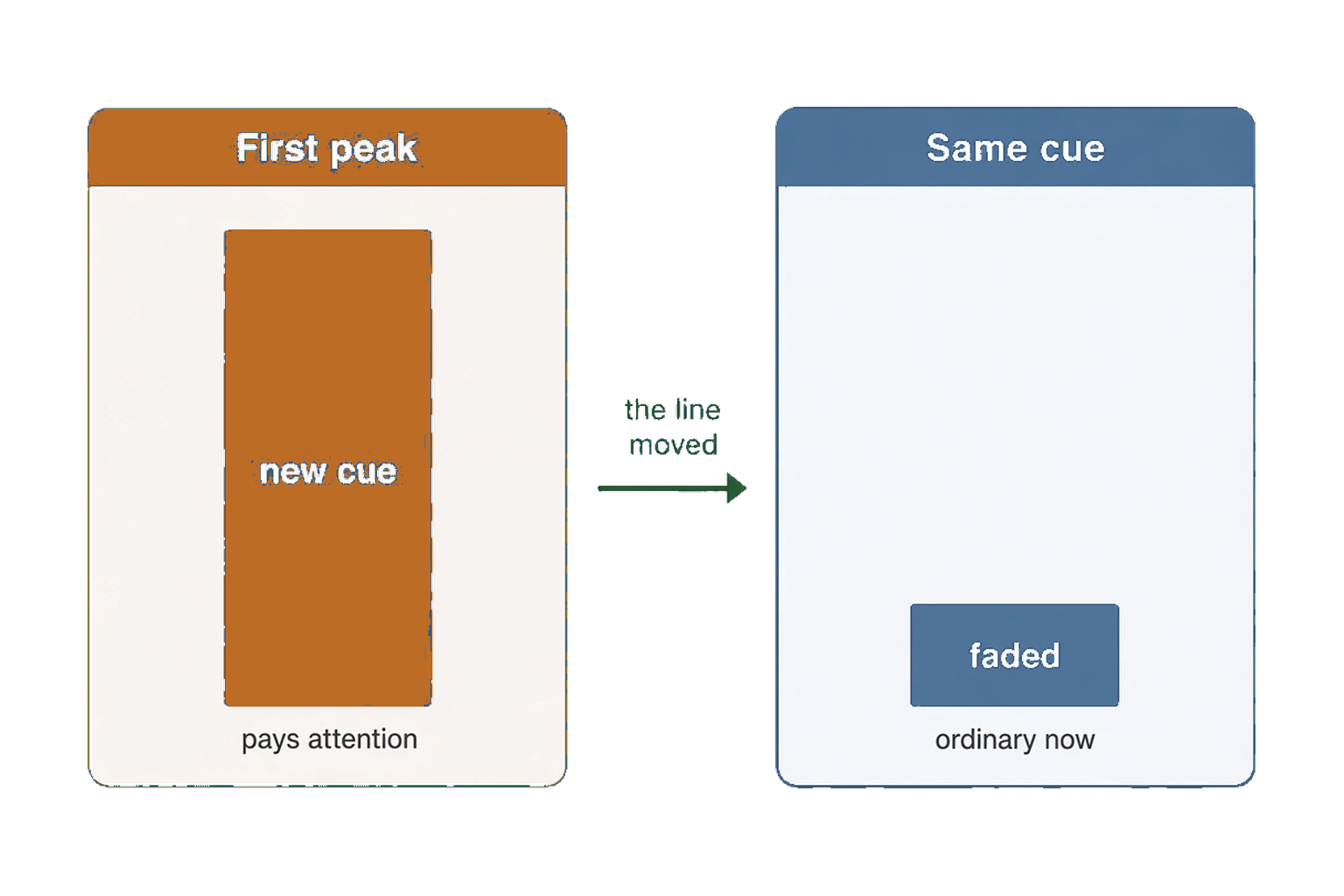
The first peak pays. The same cue, repeated, fades.
Applications
- When a practice you chose has gone flat, name the fade before you treat leaving as wisdom.
- Separate a larger dose of the same cue from a new use of the same practice.
- Expect variety-need and adaptation to argue. One asks for the new. The other makes the new ordinary.
Failure modes
- Collector trap: calling every loss of spark “adaptation” so you never ask whether the practice itself is finished.
- Overclaim trap: reading Diener’s revisions as “nobody adapts” or the treadmill as “nobody can change a set point.”
- Test today: one repeated cue that has gone flat, and one change that is a new use rather than a bigger hit.
Sources
Cite
- Brickman, P., Coates, D., & Janoff-Bulman, R. (1978). Lottery winners and accident victims: Is happiness relative?. Journal of Personality and Social Psychology, 36(8), 917–927.
- Diener, E., Lucas, R. E., & Scollon, C. N. (2006). Beyond the hedonic treadmill: Revising the adaptation theory of well-being. American Psychologist, 61(4), 305–314.
Related doctrine
Certainty vs uncertainty needs