Definition
An ego-syntonic failure is a miss that fits the self-image. The person can call it failure and still experience it, inside, as a success at being who they are.
Origin
Clinical language distinguishes an ego-dystonic experience — alien, unwanted, at odds with the self — from an ego-syntonic one — congruent with the self-image, and therefore not felt as an intruder. Belloch, Roncero, and Perpiñá (2012) showed the split on upsetting intrusive thoughts: eating-related intrusions were more congruent with the self, obsessive intrusions more alien. Gregertsen, Mandy, and Serpell (2017) review the same congruence in anorexia nervosa, where the illness can be valued and treatment engagement drops. Secondary gain, the advantage a symptom confers, is a neighbour: it names the payoff. Ego-syntonic failure names the congruence. The miss feels like home.
Failure Strategy maps the sequence that delivers the familiar miss. Saboteur mechanics names the script that makes a restart expensive. This note is the inner score on that sequence: the pattern worked for the identity, so a demand to “become someone else” misses the mechanism.
Mechanism
- A result falls short of the stated goal. The adult word is failure.
- The same result matches a protected self-image. Illegitimacy, invisibility, loyalty to an old rule: the miss proves the image.
- The score splits. One part wants to counter-attack and become a new character. Another part has already been fed.
- A pause can move the sentence. “I succeed … at not succeeding” lands in a different place from “I am failing,” because the first clause honours the inner success before the miss is named.
- Seeing the feed comes before replacing the person. A new character, adopted in a hurry, leaves the congruence untouched and adds a wheel.
Epistemic boundary. Ego-syntonic is a clinical descriptor, not a lab measure of identity, and it is not a verdict that every miss is secretly wanted. The transferable claim is the split score. Whether this particular miss is congruent has to be checked in the person’s own language.
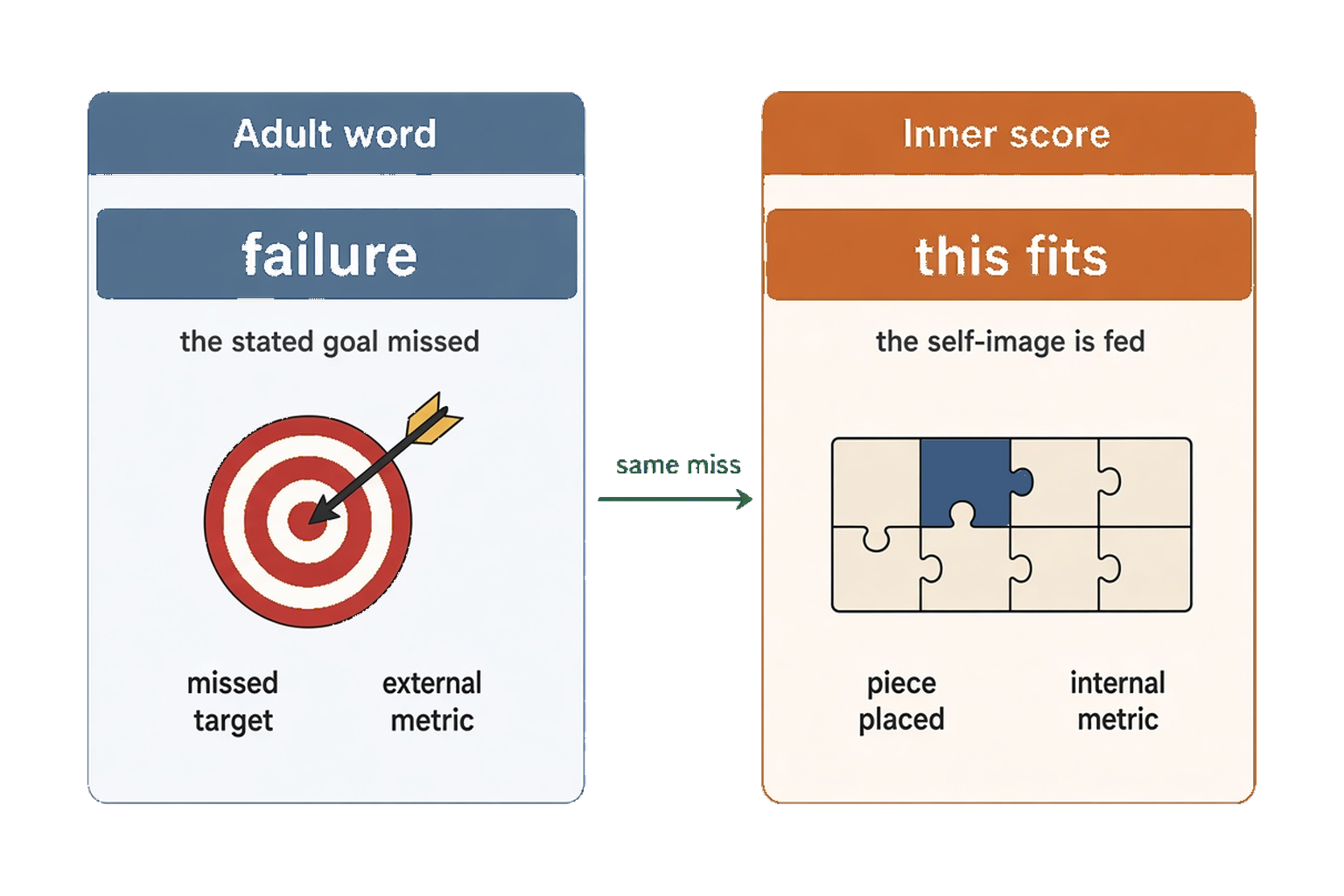
The adult word is failure. The inner score can still say this fits.
Applications
- Write the sentence with a pause, and notice which clause the body recognises.
- Name the identity the miss feeds before you design a replacement self.
- Use a miss you chose — a trial, a rep — as feedback. Keep it separate from a miss that has been feeding you without being chosen.
Failure modes
- Collector trap: calling every setback ego-syntonic so responsibility dissolves into “it serves me.”
- Overclaim trap: treating the construct as a diagnosis. It is a lens for a split score.
- Test today: one paused sentence, and one line on the identity the miss feeds.
Sources
Cite
- Belloch, A., Roncero, M., & Perpiñá, C. (2012). Ego-syntonicity and ego-dystonicity associated with upsetting intrusive cognitions. Journal of Psychopathology and Behavioral Assessment, 34(1), 94–106.
- Gregertsen, E. C., Mandy, W., & Serpell, L. (2017). The egosyntonic nature of anorexia: An impediment to recovery in anorexia nervosa treatment. Frontiers in Psychology, 8, Article 2273.
Related doctrine
Failure Strategy · Saboteur mechanics · Quality of Questions