Definition
The arrival fallacy is the expectation that reaching a destination will deliver the feeling you have attached to it. Drop someone on the summit without the route and the summit does not pay, because the pay was in the chapters.
Origin
The phrase is a teaching name in positive-psychology writing, not a diagnostic category. The nearest laboratory neighbor is affective forecasting: people mis-predict how intense and how long a future feeling will be, and they overweight the focal event while ignoring the rest of the day that will still be there. Affective forecasting is that review. This note is the special case where the forecast puts the entire feeling at the arrival, and deletes the path that would have made arrival legible.
A ticket to the top of a mountain is the image. The person is there. The gladness is not, because gladness was going to be produced by the camps, the weather, and the effort, not by the coordinate.
Mechanism
- The forecast binds feeling to a coordinate — the seat filled, the title, the formula shipped.
- Attention narrows on that coordinate and treats the route as delay, not as the material of the feeling.
- Arrival without the route under-delivers, which the person then reads as “the goal was wrong” rather than “the feeling was mis-located.”
- A designed route puts pay in the camps. Each camp is a real stop with its own effort, not a waiting room for the summit.
- Wanting the summit and releasing the result can sit together. Held apart, a strong want makes every missed camp a collapse. The path is what keeps the want from being only the scoreboard.
Epistemic boundary. Impact bias is well documented in short-horizon forecasts. It does not measure mountaineering, and it does not prove that destinations never feel good. The claim is narrower: if you strip the path, do not expect the destination to contain the path’s feeling.
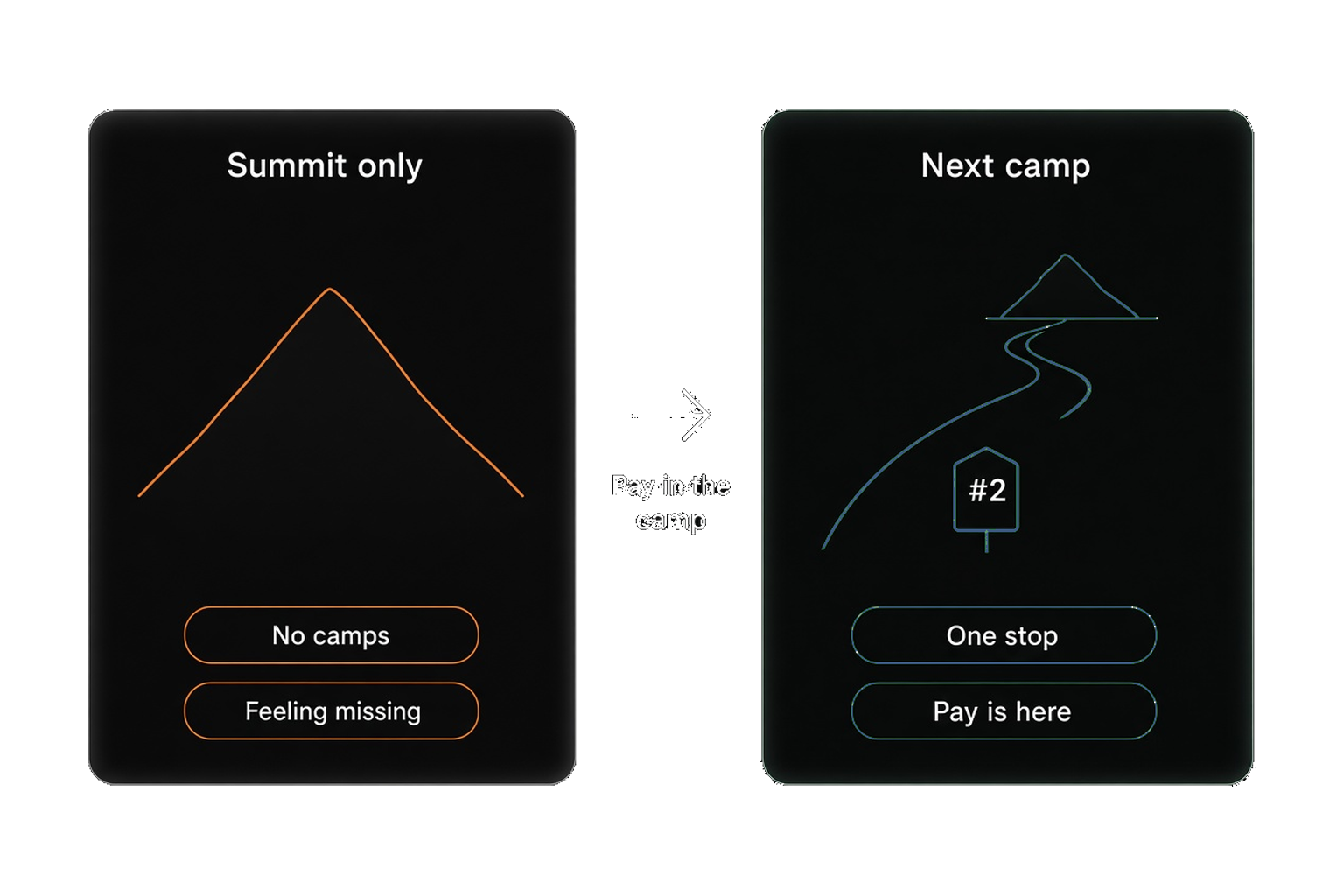
A summit with no camps does not hold the feeling. The next camp does.
Applications
- When a goal feels flat on arrival, ask whether the route was deleted, not only whether the goal was false.
- Name the next camp. A camp has a height, a stop, and a pleasure you can actually have this week.
- Do not buy a feeling that only exists at the end and then punish yourself for not feeling it in the middle.
Failure modes
- Collector trap: an itinerary of camps with no summit you still want.
- Overclaim trap: treating every post-goal flatness as this fallacy, including grief, illness, or a goal that was never yours.
- Test today: write the next camp and one pleasure that belongs to the camp, not to the summit.
Sources
Cite
- Wilson, T. D., & Gilbert, D. T. (2003). Affective forecasting. Advances in Experimental Social Psychology, 35, 345–411.
- Gilbert, D. T., & Wilson, T. D. (2007). Prospection: Experiencing the future. Science, 317(5843), 1351–1354.