Definition
Affect labeling is putting an affective state into words. In the laboratory, assigning a name to the feeling in a picture disrupted amygdala response. In ordinary life the cousin is narrower and more useful: say the whole chain — state, part, story, act — before the act runs you.
Origin
James J. Gross and others had already separated reappraisal (changing the meaning) from suppression (pushing the expression down). Lieberman and colleagues (2007) tested a third, quieter move. People lay in a scanner and saw faces and scenes that carried affect. On some trials they chose a word that named the emotion. On others they chose a name, or matched the face to another face. Labeling the affect, not merely looking and not merely naming a person, was associated with less amygdala activity and with more activity in right ventrolateral prefrontal cortex. The paper’s claim is about that disruption. It is not a claim about willpower speeches.
Mechanism
Four steps, easy to collapse into “I should be more mindful.”
- The state is already in the body. A drop, a comparison, a need for comfort. The act that usually follows (the reach, the scroll, the postponement) is faster than a debate.
- A label is not a lecture. The scanner task was a choice of a word, not an essay. The operational extension is still linguistic: words, including the intonation you can hear in your own head.
- The chain is longer than the label. Naming “sad” is the laboratory form. The self-regulation form that matches the finding’s spirit is to walk the sequence out loud: what the body is doing, which part wants relief, what story says the act will fix it, and what the act actually is. Stopping at the first adjective leaves the story in charge.
- Language here is exposure, not suppression. The point of saying the chain is that the act can lose its obviousness. Suppression would be refusing to feel it and reaching anyway. Reappraisal would be inventing a brighter meaning. Labeling leaves the state in view and takes the automatic conclusion off its rails.
Epistemic boundary. Lieberman and colleagues measured blood-oxygen response while people labeled emotional pictures. They did not time a reach for food, a phone, or a postponed file. They did not show that every sentence spoken alone works, or that a person who explains the urge will always decline it. Gross and John (2003) had already separated habitual reappraisal from suppression. That split is the neighbour, not a second proof of labeling, and it does not time a reach either. A label can also become a story you use to permit the act (“I have named it, so I may have it”). The finding supports a disruption of the reactive path under specific instructions. It does not rank your evening.
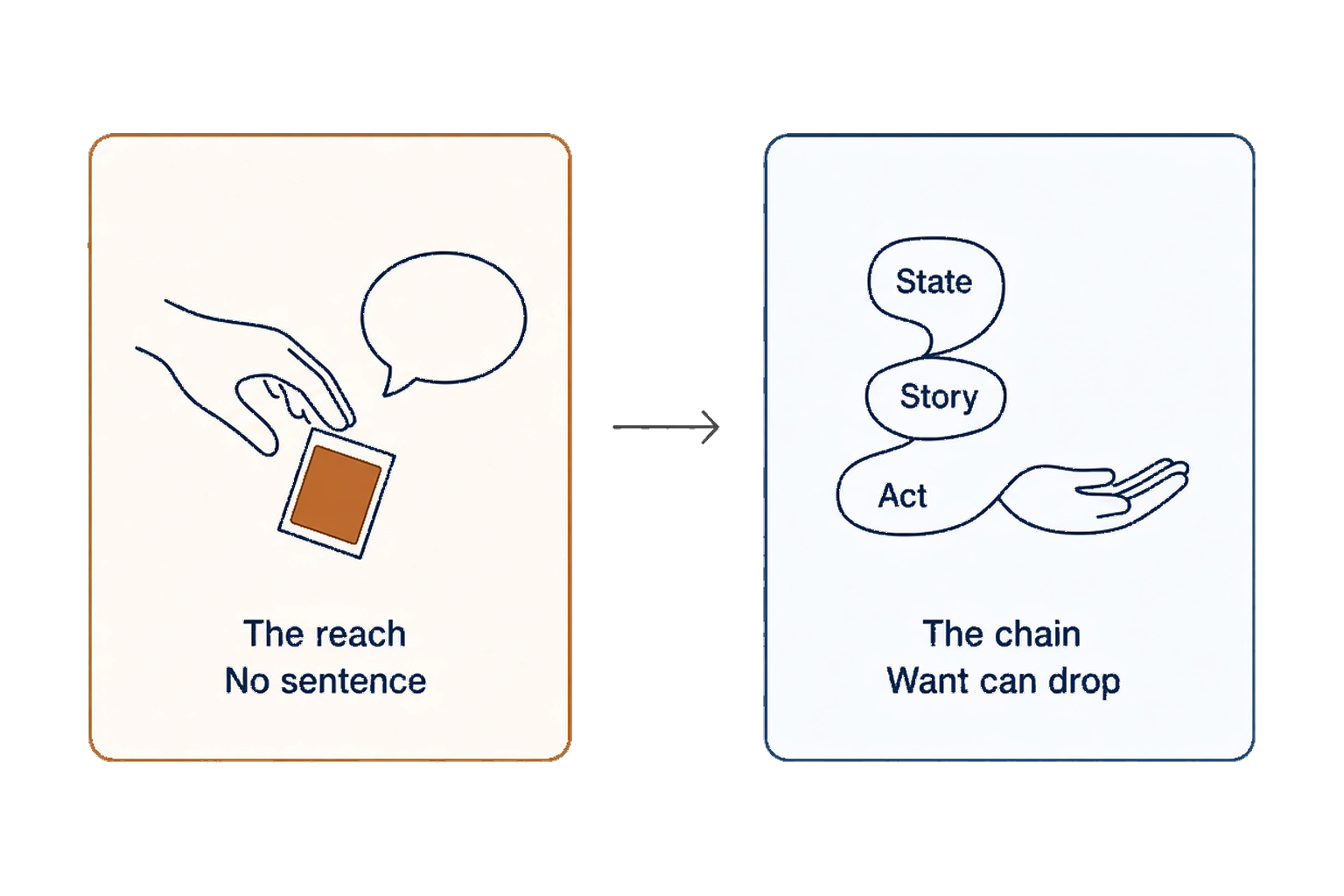
The reach has no sentence. The chain can drop the want before the hand moves.
Applications
- Before an automatic reach, say the chain once, aloud, through to the false promise. Stop if the want drops. If it does not, you still have a cleaner vote.
- A single mood word is the laboratory minimum. If the act still feels inevitable, you have not finished the chain.
- Do not treat a voiced excuse as labeling. “I deserve this” is a permit. The chain includes the part that wants comfort and the story that the act will repair the state.
Failure modes
- Collector trap: a log of every urge, with the reach still automatic.
- Overclaim trap: treating a 2007 scanner result as proof that speaking about snacks, inboxes, or fear rewires the amygdala tonight.
- Test today: one reach you usually do not narrate. Say the chain aloud before you act. Note whether the want dropped, or only whether you noticed it.
Sources
Cite
- Lieberman, M. D., Eisenberger, N. I., Crockett, M. J., Tom, S. M., Pfeifer, J. H., & Way, B. M. (2007). Putting feelings into words. Psychological Science, 18(5), 421–428.
- Gross, J. J., & John, O. P. (2003). Individual differences in two emotion regulation processes. Journal of Personality and Social Psychology, 85(2), 348–362.