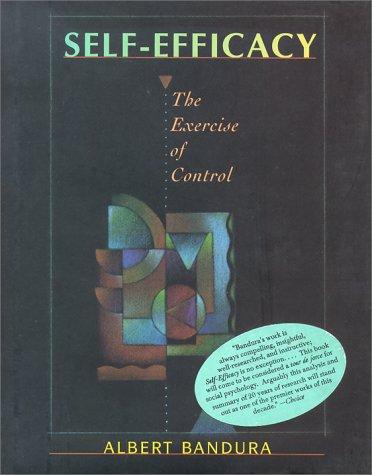
 | Bandura’s magnum opus treats perceived self-efficacy — belief in your capability to organise and execute a course of action — as the central lever on human agency. Outcome expectations matter; efficacy belief determines whether you start, how hard you try after setback, and which strategies you even consider. Bandura First published 1997 - Reprint (2000) · W. H. Freeman · ISBN 9780716728504 |
|---|
Key principles
- Perceived self-efficacy — Confidence in your ability to produce given attainments — not global self-esteem, not outcome guarantee.
- Four sources — Mastery experiences (strongest), vicarious models, verbal persuasion, and physiological/affective states interpreted as capability signals.
- Efficacy vs outcome expectancy — Can I do it? differs from Will it work if I do? — both gate action; conflating them breeds quit or magical thinking.
- Reciprocal determinism — Person, behaviour, and environment co-influence in ongoing loops — change one vector with engineered reps, not willpower sermons alone.
- Self-regulatory function — Efficacy shapes goal choice, effort allocation, resilience after failure, and vulnerability to stress — low efficacy narrows the menu before facts do.
- Collective efficacy — Shared belief in group capability — teams stall on the same mechanism at scale.
Core science
Bandura synthesises decades of experimental and field work into a unifying social-cognitive theory of human motivation and change — self-efficacy predicts performance over and above prior attainment when tasks are novel or demanding. Mastery experiences dominate because they supply authentic enactive evidence; cheap praise without reps often backfires. The volume anchors Emancipation and Self-engineering on the Atlas shelf — pair with Carver and Scheier on feedback loops when the failure is discrepancy monitoring, not belief in capability.
Application
Reach when a member has the blueprint but will not run the rep — when I can’t is really I don’t believe I can yet. Open Self-engineering on the Atlas shelf for the loop design map; use mastery-sized wins before outcome arguments.