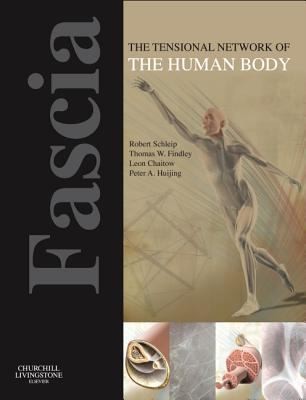
 | Connective tissue is not packaging around muscles — it is a continuous tensional network that distributes load, senses stretch, and shapes how force travels through the body. This edited volume maps the science behind manual and movement work on myofascial continuity. Schleip, Findley, Chaitow, & Huijing (Eds.) (2012) · Churchill Livingstone · ISBN 9780702034251 |
|---|
Key principles
- Tensional network — Fascia forms one interconnected web — not isolated sheets — so local tension can propagate system-wide.
- Force transmission — Mechanical load travels along myofascial chains beyond the muscle that visibly contracts — integration, not isolation.
- Biotensegrity — Body architecture balances tension and compression through fascial integrity — stability without rigid stacking.
- Mechanoreceptor density — Fascia is richly innervated — proprioceptive and interoceptive signal arrives from connective tissue, not only from joints or skin.
- Viscoelastic response — Tissue shows creep, hysteresis, and thixotropy — brief load and movement change stiffness on a timeline cognition ignores.
- Myofascial continuity — Muscle and fascia act as one functional unit in manual therapy and movement re-education — treat the line, not the lump.
Core science
The 2012 Fascia Research Congress synthesis brought anatomy, biomechanics, and clinical practice onto one shelf: connective tissue as load-bearing and sensory infrastructure. Chapters span histology, imaging, force chains, and intervention models for manual and movement therapists — the reference spine behind claims that the body stores patterned tension and that graded movement can remodel fascial behaviour without reducing the person to metaphor alone.
Application
Reach for this volume when coaching body-first signal — belly contraction before the story finishes, bracing that outlasts insight, or interoceptive work that needs anatomical grounding. Pair with operational doctrine on interoception and adversity design; use Atlas notes for member-facing vocabulary without assigning the full textbook. Open Fascia memory on the Atlas shelf for the mechanism map.