Definition
In this layer, storytelling means structuring personal evidence into a coherent narrative frame so the self can process progress as if hearing testimony — not crafting fiction for others.
Origin
McAdams’s narrative identity research treats life as an internalised story integrating past episodes and imagined futures. Autobiographical-memory work shows retrieval format (timeline, coach frame, child-simple explanation) changes what is believed about one’s trajectory. Pennebaker’s expressive-writing tradition adds that re-authoring stored facts shifts affect and self-evaluation.
Mechanism
Capture (journals, logs) stores discrete events. Re-presentation (timeline, ranked wins, third-person or coach voice) completes the loop: the brain updates self-model when evidence is heard back in a new frame. Contrast events (peer comparison) can still wipe the stack — which is why harvest must be repeatable, not one-off.
Distinct from logging alone: logging is storage; narrative re-presentation is belief integration.
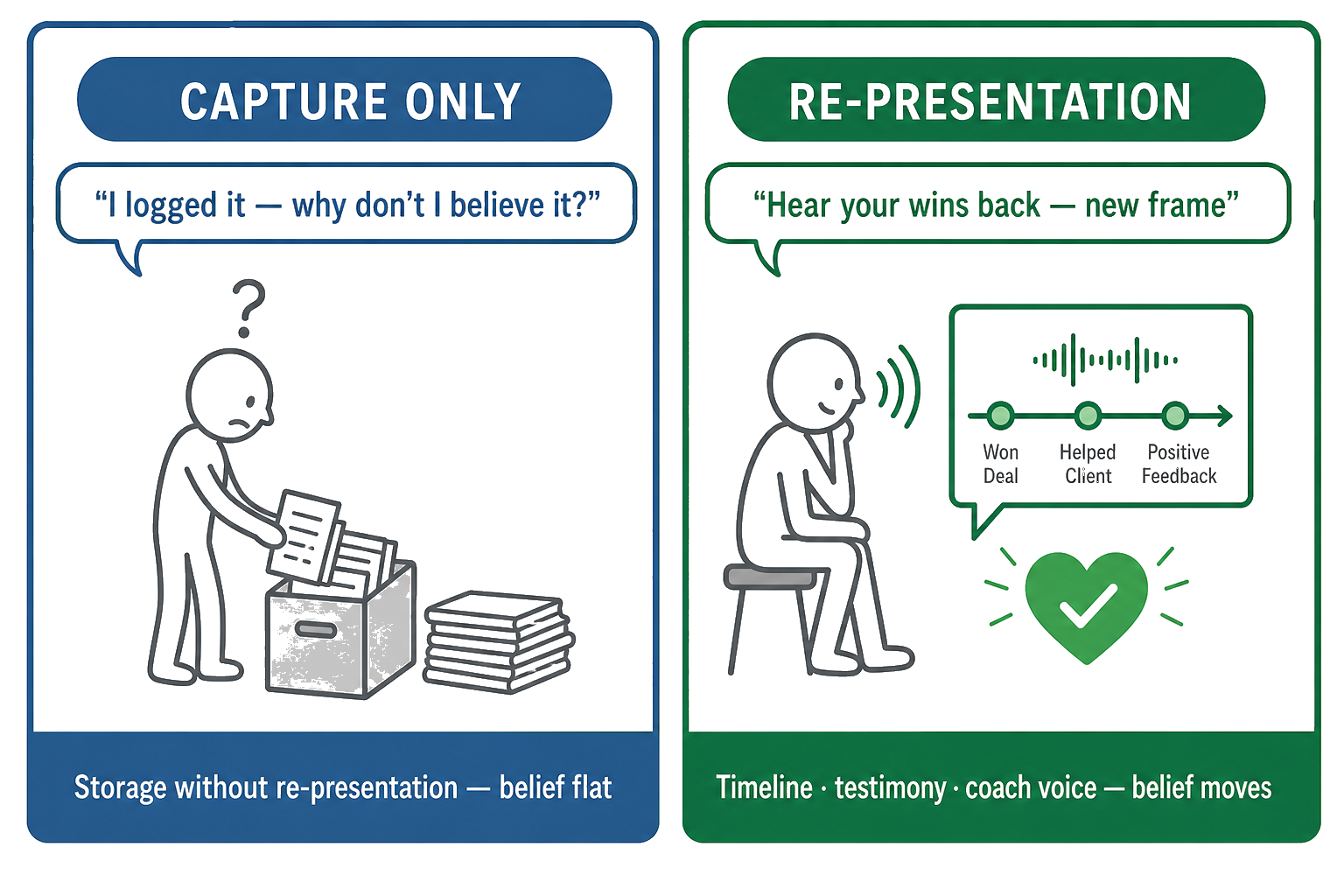
Capture only versus re-presentation — hear wins back in a new frame so belief moves. Pair Sales training · Victory Journal.
Correlational evidence links redemptive and agentic life stories to well-being markers; McAdams and McLean (2013) explicitly call for work that disentangles causal direction between narrative features and adaptation — re-framing logged wins may shift felt confidence without proving that story content alone drives long-term change.
Applications
After structured win capture, re-run the same data through alternate narrative frames (chronology, top-three highlight, simplified explanation). Notice which frame shifts confidence. Useful when progress feels invisible despite logged facts.
Sources
Cite
- McAdams, D. P., & McLean, K. C. (2013). Narrative identity. Current Directions in Psychological Science, 22(3), 233–238.
- Pennebaker, J. W. (1997). Writing about emotional experiences as a…. Psychological Science, 8(3), 162–166
- Conway, M. A., & Pleydell-Pearce, C. W. (2000). The construction of autobiographical memories in…. Psychological Review, 107(2), 261–288