Definition
Reverse-engineering is the practice of starting from a finished result and working backward to recover the mechanism that produced it.
Origin
The term comes from engineering, where a product is disassembled to understand how it was built. The same logic was carried into skill acquisition: expertise research (Anders Ericsson) treats elite performance as a set of trainable components to be isolated and rehearsed, and popular deconstruction frameworks (for example Tim Ferriss’s DiSSS) apply the move to any skill — break a result into its parts, find the few that carry most of the outcome, and rebuild deliberately.
Mechanism
Most competence is tacit: a person produces a good outcome without being able to state how.
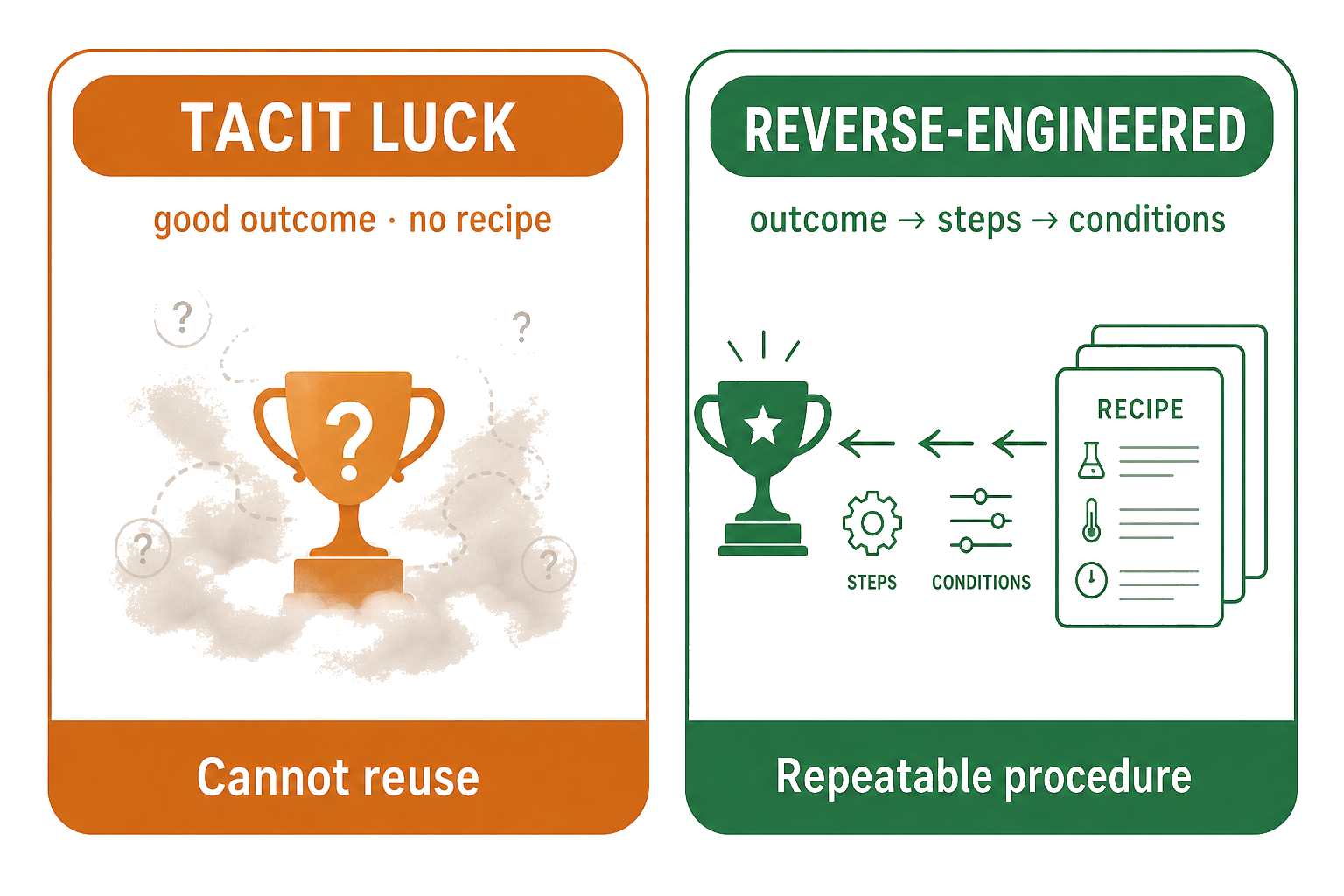
Tacit luck versus traced recipe — outcome, steps, conditions. Pair Life Is the System · Manual Of Me.
Reverse-engineering makes the tacit explicit by tracing outcome → steps → conditions. Once the process is named, it stops being luck and becomes a repeatable procedure that can be transferred to new contexts and refined one variable at a time.
Applications
- Turning an intuitive success into a written, reusable recipe.
- Isolating the high-leverage components of a skill for focused practice.
- Diagnosing a failure by reconstructing the process that led to it.
Sources
Cite
- Ericsson, K. A., Krampe, R. T., & Tesch-Römer, C. (1993). Deliberate practice in expert performance. Psychological Review, 100(3), 363–406.
- Ericsson, K. A. (2008). Deliberate practice overview. Academic Emergency Medicine, 15(11), 988–994.
- Ferriss, T. (2012). The 4-Hour Chef. New Harvest.
Related doctrine
Life Is the System
Manual Of Me