Definition
Computer-closed autonomy is the test that a loop still completes when the computer that usually runs it is off, stolen, or broken. A loop you can only inspect while you sit at that machine is not yet autonomous.
Origin
Reliability work treats a process that exists only on one operator’s machine as a single point of failure. Glass-box testing, in software, asks whether you can see internal state. That question is necessary and it is not this one. You can draw every step and still lose the loop when the laptop lid closes. Site Reliability Engineering frames the neighbor as toil: manual repetition that stays on the human because it was never moved to a host that does not need you at the desk. Thinking in Systems frames the other neighbor: a stock you cannot see keeps flowing after you believe you have stopped it.
This note is the host test. The Glassbox Mindset is whether you can see and steer the engine. Do not collapse the two. A visible engine on one desk fails the closed-computer test.
Mechanism
- Draw the loop. Capture, process, decision, and the last human check. If you cannot draw it, you are not yet at this test.
- Mark the steps that require the open machine. Scripts, local files, a session that dies when the lid shuts.
- Move one of those steps to a host you can reach when that machine is gone. One step, not a migration programme.
- Prove it with the machine closed. Then prove it again. A single recovery shows that restart is possible. It does not show a rate.
Epistemic boundary. Site reliability literature studies production services, not private habits. The transferable claim is the test — does the loop run without the operator at that keyboard — not a claim that every personal practice should be hosted remotely. Meadows’s leverage points are a primer, not an experiment on laptops. No journal DOI carries this host test; the two volume spines below are the shelf record, and neither is retracted literature.
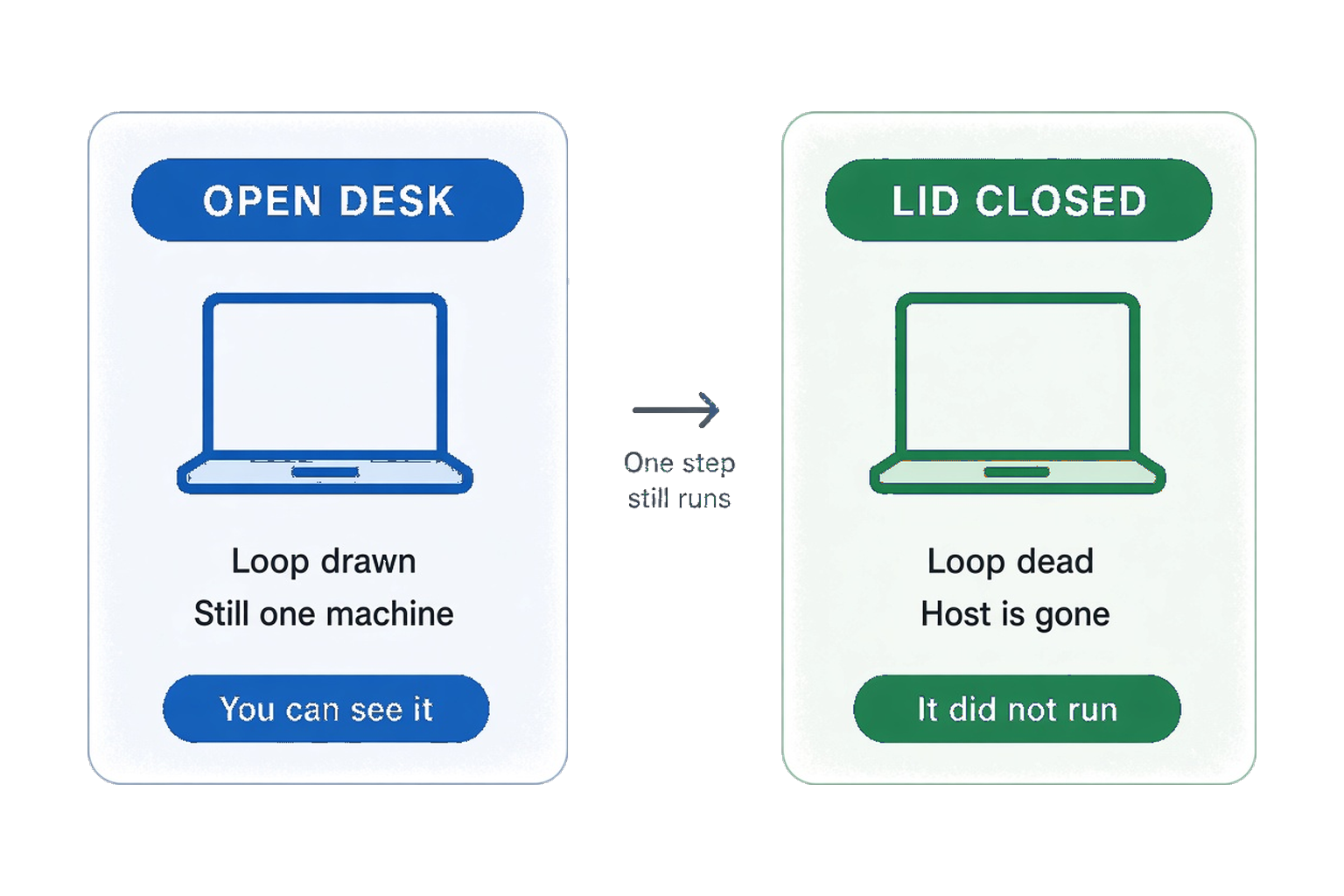
A loop you can draw on one desk still dies when that machine is closed.
Applications
- Before you call a stack autonomous, name the step that dies when the usual computer is off.
- When a fee-free tool charges you maintenance you will not pay, that is a degree of autonomy you refused, not a moral failure.
- One successful restart after a hard stop is a data point. Schedule the second proof before you trust the rate.
Failure modes
- Collector trap: adding another visible dashboard while the engine still lives on one desk.
- Overclaim trap: treating one recovery as proof the loop always recovers, or treating cloud hosting as autonomy when the scripts are still local.
- Test today: with the usual machine closed, name the one step that still runs.
Sources
Cite
- Beyer, B., Jones, C., Petoff, J., & Murphy, N. R. (2016). Site reliability engineering: How Google runs production systems. O’Reilly.
- Meadows, D. H. (2008). Thinking in systems: A primer. Chelsea Green.