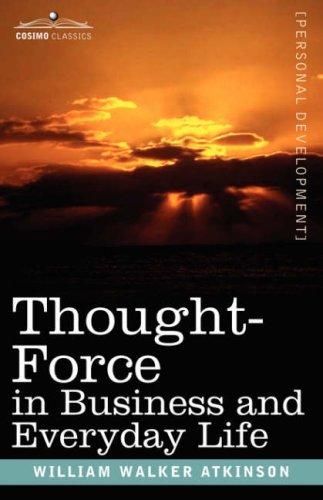
 | Atkinson treats thought as a force — not metaphor only — that shapes attention, interpersonal atmosphere, and habitual response in business and daily life. Early New Thought spine before modern cognitive rehearsal vocabulary; read for historical mechanism language, not as a substitute for controlled trials. Atkinson First published 1900 - Reprint (2010) · Watchmaker Publishing · ISBN 9781602063672 |
|---|
Key principles
- Directed thought — Attention aimed on purpose changes conduct and presence — drifted attention trains drifted outcomes.
- Mental atmosphere — Inner stance radiates in commerce and conversation — thought-force as interpersonal signal, not occult claim.
- Autosuggestion — Repeated inner phrases install default responses — rehearsal precedes automaticity.
- Will and attention — Voluntary focus is trainable — scatter is a habit, not a identity sentence.
- Practical mental science — Business and daily life are laboratories for thought-discipline — not separate from character work.
- Folk epistemic boundary — Pre-1900 mental science — primary essay, not neuroscience — bridge to imagery and regulation, do not cite as lab proof.
Core science
Atkinson’s volume sits at the start of the New Thought thread on New Thought lineage — moral and practical mental science before experimental psychology had the vocabulary. Modern bridges: Jeannerod’s motor-imagery line (imagined action recruits motor systems) and affective neuroscience of imagined scenes (Body chemistry) explain why rehearsal moves the body without endorsing every prosperity inference in the folk prose.
Application
Reach when mental imagery, autosuggestion, or rehearsal needs historical placement before modern doctrine. Open Body chemistry on the Atlas shelf for neutral physiology of imagined scenes — after the lineage table, not instead of it.