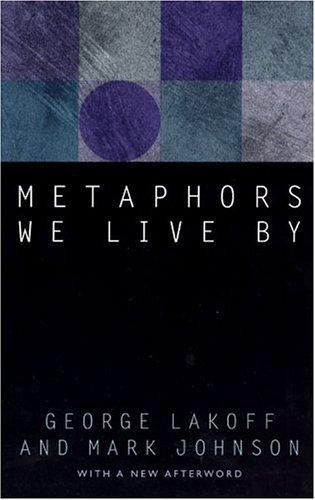
 | Lakoff and Johnson argue conceptual metaphor structures everyday thought — argument is war, time is money, life is a journey — not literary decoration but the cognitive architecture beneath language. Lakoff & Johnson First published 1980 - Updated (2003) · University of Chicago Press · ISBN 9780226468013 |
|---|
Key principles
- Conceptual metaphor — We understand abstract domains by mapping them onto concrete experience — metaphor is thought, not garnish on top of literal truth.
- Embodied grounding — Spatial, force, and container schemas from bodily experience scaffold reasoning about emotion, argument, and self.
- Argument is war — Attack positions, defend claims, win points — the metaphor hides collaborative truth-seeking as optional.
- Highlighting and hiding — Every metaphor foregrounds some relations and backgrounds others — framing is never neutral.
- New metaphors can restructure — Deliberate reframes can shift what feels thinkable — semantic LIDAR work starts here.
Core science
Lakoff and Johnson launched cognitive linguistics’ conceptual-metaphor program — empirical work on how metaphorical language reflects systematic cross-domain mappings. Later neuroscience and grounded-cognition work (Barsalou) partially converges; some claims about universal embodied bases remain debated. Use as framing literacy for coaching language audits — not as proof that one metaphor determines behaviour.
Application
Reach when language, framing, or Semantic LIDAR work needs a spine — scan which metaphor carries the Battle before relabelling friction as fixed personality.